In an opinion piece in The Toronto Star about the moral panic over sex work, Shree Paradkar shared this account of former sex worker Jane Li, back in October 2022:
Numerous police ripped out the door to [Li’s] place and piled in. Was she a sex worker, they asked. She used to be one, but not any more due to health issues. Instead, she used her meagre English skills to take phone calls for other workers who spoke no English at all, and describe the services they offered and the rates they charged. Say $50 or $60. She takes a cut—20 to 30 per cent. Is that exploitation or mutual co-operation? Li can’t work. Her co-workers asked her to help. She has enough experience to suss out the untrustworthy and she needs sustenance… Li was arrested, led out in handcuffs and eventually convicted, leading to time in prison.
Li was arrested under the provisions of the Protection of Communities and Exploited Persons Act (PCEPA), a law that the Canadian government claimed would remove legal penalties for “exploited persons” in the sex industry.
But Li—who is in her sixties—is still criminalized as an “exploiter” through the PCEPA.
Because the public has been fed so many stories and images that romanticize the role of police and government as migrant women’s “rescuers” or hide the real story, there’s little awareness of just how violent anti-trafficking investigations are.
The police and immigration control have the authority—or the legal cover—to smash down the doors of migrant sex work businesses with guns drawn, line women up against the wall, terrorize them, sexually harass and assault them, force them to strip, rob them of all their money, cut them off from contact with their family and friends, and strip them of their jobs, their homes, and their freedom by caging and deporting them.
And they can do all of this to migrant sex workers’ friends and family, too.
We should think of an anti-trafficking raid as a state-authorized armed robbery. Massage business raids can be an incredibly lucrative way for the police to make money off migrant workers through asset forfeiture laws or through theft.
This illustrates some of the reasons why the most dangerous gang in the sex industry is law enforcement.
The police are not just the wrong solution to the problems facing migrant sex workers—they are the most urgent problem facing migrant sex workers.
This is why migrant sex workers reject the argument that increasing policing would make them safer, even in cases where they have been targeted for violence.
When ‘protection’ turns into terror
The late 1990s saw the first wave of police raids on migrant sex-work businesses in the U.S. and Canada, which were characterized by journalists and the police as rescue operations of Asian “sex slaves” or human trafficking victims.
In prior decades, police had regularly framed migrant sex workers as criminals (“illegal” immigrants and sexual deviants), not as helpless human trafficking victims. The key change was that now state violence was increasingly framed as offering care and protection.
In 1998, a group of law enforcement agencies in Toronto and the surrounding areas raided several Asian migrant massage businesses in what they claimed was a human trafficking investigation.
The result? Police laid 750 charges of prostitution and immigration offenses against 68 Asian migrants—mostly Thai and Malaysian women—whom they described as “poor (and) uneducated.”
Media coverage of the raid declared that police had “uncovered a sex slave ring.”
One of the police investigators was quoted as saying, “White slavery is something that’s traditionally [associated with] Third World countries. Suddenly it’s here, in our backyards,” and claimed that similar operations exist “anywhere there’s a significant Asian community.”
When reporters asked the police about their decision to arrest women they’d described as “slaves,” the investigator deflected the question, responding that the prosecutor could decide whether to prosecute the arrested women.
Researchers from community-based organizations were able to speak with more than 25 of the women involved and found that none of them had been forced into Canada or into sex work. None identified as trafficking victims.
But as undocumented migrants in a criminalized sector, they were facing serious problems, including exploitative and poor working conditions, including debt bondage.
They needed support and access to labour protections but instead were the target of police terror.
Here is how one of the women described the ordeal in a report prepared by the community-based organizations:
When I realized that they were the police, I was trembling and frozen with fear. I was so frightened that I could not think clearly. I could not focus on the questions I was asked … I could not even remember my name. As I have never been arrested before, I was overwhelmed.
The police asked how I had come to be here; I could not speak because my mind had gone blank. They asked me about my passport, but I could not answer because I did not speak English.
It was almost impossible for me to even understand them. I could not even go to the washroom. After a while, they called us inside the massage room for a strip search. They told us to take off our clothes.
They used a baton during the search. We were not allowed to talk to one another. I was very scared because I could not speak the language. I was scolded many times because I did not understand the questions they asked.
They did not let me ask a friend next to me or allow me to sit close [to her]. I was so scared that I was about to cry but had to hold back the tears. After the questions, we were handcuffed. I felt nothing except fear. They videotaped everything that happened.
Then we were transported by police cars to an unknown destination. I focused on my parents in order to calm myself. We were all brought to a police station, but I did not know where. There were a number of reporters and journalists waiting for us and they gathered around the car as soon as we arrived. We had to cover ourselves while entering the station.
Police seized the women’s money, passports, wallets, photos, letters, and address books. Their conduct mirrored the behavior that human traffickers are believed to engage in—using terror and violence to force women into captivity, stealing all their wages, and withholding their passports. Later, the women were able to get some of their belongings back—but not their money.
The courts imposed bail conditions on them that prohibited them from associating with each other, returning to their workplaces, or working in any kind of massage business.
The women lived at work, so the bail conditions ended their livelihood, rendered them homeless, and made it illegal for them to seek support from each other.
The courts also deported many of them.
The women went from a situation where they were experiencing harmful labour exploitation to one where the state seized all their wages, their possessions, their jobs, and their homes.
Asian and migrant sex workers today continue to be terrorized, arrested, robbed, and reported to immigration control under the auspices of protection against human traffickers in raids.
Licensing rules that make workers less safe
The danger that police pose to racialized migrant sex workers is well known, but there is less awareness about just how discriminatory and dangerous city-level licensing regulations, and their enforcement, are to racialized migrant sex workers.
In 2013, the City of Toronto’s Municipal Licensing and Standards Office issued a report with a plan for “strengthening the protection of vulnerable women, children and all persons from human traffickers.”
The singling out of women and children communicated that the policy would focus not on labour exploitation and abuse, which occurs in a range of unprotected labour sectors, but instead on surveilling the industry that has been repeatedly associated with “violence against women and children”—the sex industry.
And not just any part of the sex industry. The sex industry is vast and diverse, but Toronto’s city council passed a motion calling specifically for increased human trafficking investigations into the city’s massage businesses, which were staffed largely by Asian migrant women.
One of us (Chanelle) was part of a sex work organization that objected to the new plan, on the basis that it was founded on misinformation and would lead to increased law enforcement abuse, especially of those most strongly linked to sex trafficking in the public imagination.
Multiple sex work advocates and organizations submitted recommendations that the city not adopt the proposal and instead use evidence-based approaches to combating exploitation, coercion, and abuse in a range of labour sectors, including the sex industry.
But the recommendations went ignored by the city council members, who instead followed the guidance of a number of anti-sex work and anti-trafficking nonprofits.
After the introduction of the city’s anti-trafficking plan, licensing enforcement began to descend on the racialized massage sector, conducting constant and lengthy investigations on massage businesses that resulted in a dramatic spike in fines and prosecutions.
Between 2013 and 2017, law enforcement investigations of 400 massage businesses in Toronto skyrocketed from just over 3,000 per year to more than 20,000 investigations in a single year.
Not only were the police saturating the massage sector with constant investigations, they also seemed intent on making life difficult for the workers.
Workers reported that licensing enforcement officers were spending one to two hours in the spas and seemed determined to find an offense.
They began to issue citations for trivial infractions, such as having a scratch mark on a massage table or not having a city-issued license number on a business card.
Another worker who had put a thimbleful of liquor on a small prayer altar for deities was charged with violating the laws against open liquor.
Other workers reported being investigated over 20 times in a single month and enduring investigations that involved as many as seven officers at a time.
During investigations, police would burst into the workers’ closed treatment rooms, shower areas, and private changing areas where women were changing or undressed. Some workers were terrified, thinking that a robbery was under way.
Some officers forced workers to stand or not to move for the full length of the questioning.
Each officer enforced the regulations differently, and they frequently would not explain the charges and fines they were issuing or would present the information in English only. Consequently, some workers could not understand what they were being charged with.
Licensing officers also began to more frequently enforce regulations that put workers in danger.
For instance, workers in Toronto massage businesses are prohibited from locking the doors to their treatment rooms and installing their own closed-circuit cameras, and they must post their license with their full legal name and home address somewhere that is visible to customers.
These discriminatory regulations put workers’ personal safety at risk, especially for women working alone at night in isolated areas.
Some predators know that massage businesses are likely to have cash on hand and are legally forced to keep their doors unlocked, without any cameras in place. Workers are safer if their clients do not have their personal information.
Before 2013, most city-licensing officers did not enforce these rules—something that workers appreciated. This changed, however, after the introduction of the city’s anti-trafficking plan, with licensing officers increasingly motivated to prosecute any infraction they could find, including the rules that endangered workers’ safety.
Massage workers were forced to make a choice—leave their doors open and risk a robbery or a serious assault, or lock the doors and risk getting charges and fines.
A business that racked up a certain number of these charges and fines could lose its license, meaning all the workers in that establishment could lose their jobs. The city’s human trafficking policies and enforcement thus forcibly made racialized migrant sex workers vulnerable to workplace violence.
Police also began to issue fines that were up to five times higher than what other businesses faced for similar infractions.
Some workers tried to fight back against the excessive investigations and false charges by contesting the charges in court. But when they did, the police would retaliate, increasing the number of investigations and the size of the fines.
In one case in which a worker tried to fight her fine, the police punished her by levying seven fines in short succession.
Investigation as a pretext for harassment
After 2013, workers reported that the tone of their interactions with police changed dramatically. Police became suspicious and hostile and began to more frequently harass migrant sex workers and treat them in a degrading manner.
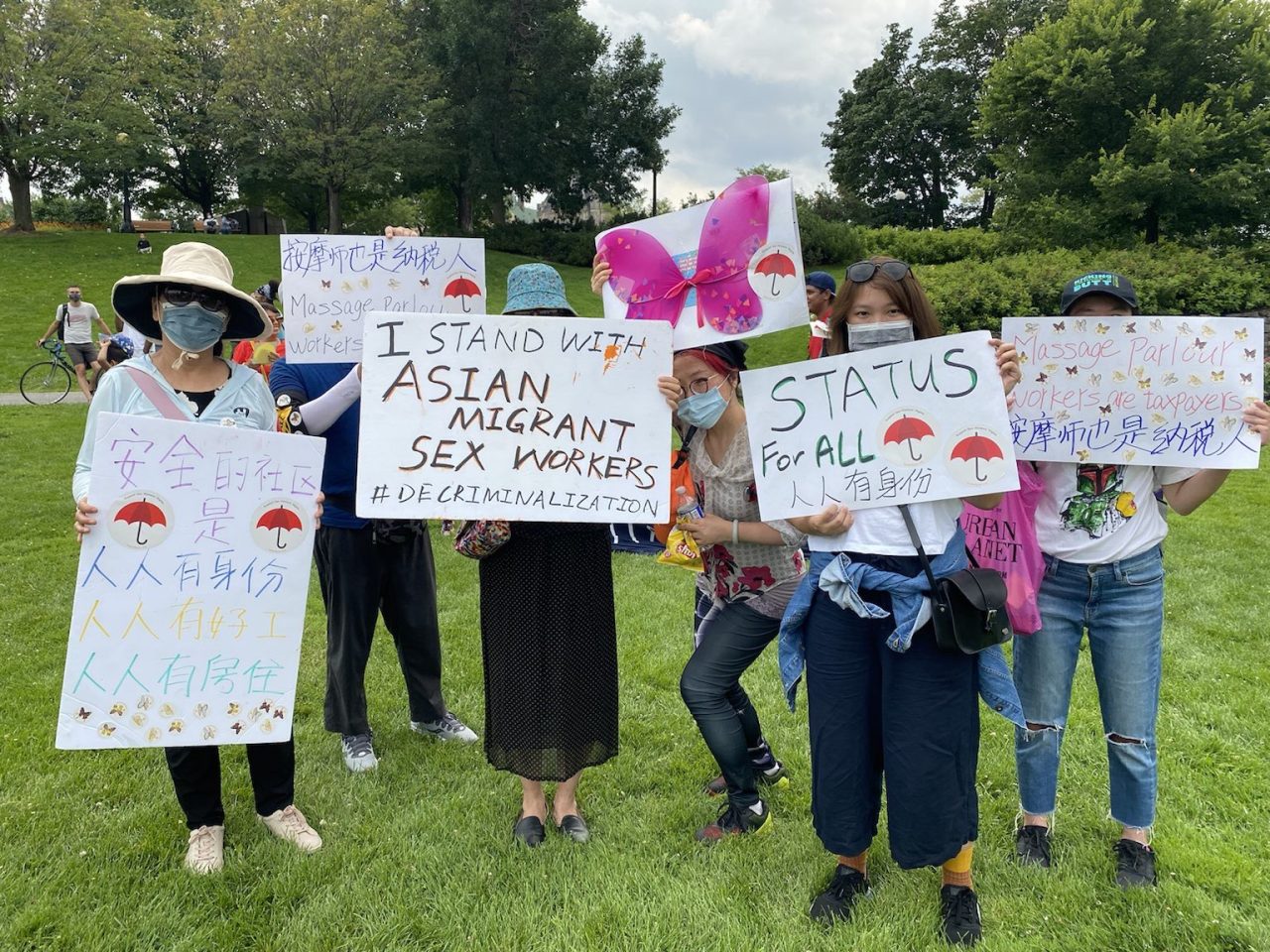
In research conducted by Toronto-based Asian and migrant sex worker support network Butterfly in 2018 on Toronto’s migrant massage sector, 33 per cent of the women working in massage parlors reported discrimination, harassment, or abuse by law enforcement, including different forms of sexual abuse.
More police officers began to demand sex in exchange for reduced charges and fines, and to punish workers who refused those demands.
Officers increasingly demanded that the workers remove their clothing. In addition to forcing them to undress, some officers would order workers to sing, dance, and entertain them.
One worker shared, “Four police officers and bylaw officers came together. They were extremely violent and rude. They ordered us to face the wall, and we were not allowed to talk. They treated me like a criminal as they searched my place, including all the drawers, wallets—even my underwear—without a warrant. They left the room in a mess.”
Workers reported being searched repeatedly by city enforcement officers without a warrant and that the police were more likely to officially seize their money and property or to steal it outright than they had been prior to the implementation of the city’s anti-trafficking plan.
Four women said that police took money from each of them in amounts ranging from $2,000 to $50,000. Police claimed they were seizing money as part of their investigation, but the workers received no record of the seizure and were never able to recover the funds.
Recalling an investigation of the establishment where she worked, Wendy Liu, a Butterfly member, said, “One day, a police officer pretended to be a client and set up a date with me.
“When I opened the door, more police arrived. They asked me if I had a boss or if someone took my money. They asked if I was being trafficked. I said no. After that, they asked me for my passport. They also forced me to unlock my phone and looked through my messages and photos. The police called the Canadian Border Services Agency, and I was arrested and deported after being detained for one month.”
Toronto’s anti-trafficking plan led to expanded collaboration between the city and immigration authorities, even when this violated the city’s own human rights policies.
Workers reported that after 2013, officers became more likely to demand that they show proof of immigration status, or officers would contact the Canadian immigration control agency to check on a worker’s immigration status or turn them over to immigration control.
Some police would say to workers, “If I see you here again, I’ll call CBSA.” Some officers would simply bring immigration control agents into an investigation.
The city’s administrative staff also became increasingly likely to report migrant workers to immigration control. One massage worker related that in the process of renewing her massage business license at the municipal offices, a city staff member that she was dealing with called immigration control to have her investigated.
Marginalization leads to workplace violence
“A white guy came in and started choking me with his hands,” a worker named Nana recounted. “He hit my head against the wall. I was really afraid. I gave him what I had earned on that day.”
After the introduction of the city’s anti-trafficking plan, workers reported an increase in violent attacks like that suffered by Nana, as well as an increase in intimate partner violence.
In a 2016 survey of the migrant sex workers surveyed in Toronto, 60 per cent reported having experienced violence, including robberies, sexual and physical assault, and state violence.
Workers who were interviewed for the report described this as a significant increase from before the introduction of the city’s anti-trafficking plan.
Some workers told Butterfly that after they reported a robbery to the police, the police would keep coming back—not to help them but to conduct investigations on them, using the initial report merely as a pretext to begin the investigation.
As a result, workers became more afraid to report robberies out of fear that the police would call immigration.
In one case, a worker had managed to get a photo of the robber and showed the police the picture when she reported the robbery. But all they did in response was charge her for locking the door of her treatment room.
Another worker reported a brutal sexual assault, but the police only charged her with breaking a city regulation that controls the type of clothing massage workers are permitted to wear at work.
Some aggressors plan to harm workers from the beginning. But in others cases, the conflicts with clients owe to miscommunication. Under criminalization, sex workers cannot easily communicate or negotiate services or boundaries, which means that clients are more likely to become frustrated and feel cheated. This increases conflict.
Criminalization also increases client violence against migrant sex workers because it scares off the good quality clients. Clients who are respectful, considerate, and supportive are usually the kind of people who do not want to risk being arrested during a raid on a massage business. They stop coming to massage businesses.
The clients who continue coming are those who are not scared off by the risk of an arrest, and these tend to be lower-quality clients who are more likely to be difficult, get into conflicts with workers, or be abusive.
‘Child sex trafficking’ is a smokescreen to harm adult workers
The myth that the sex industry is full of drugged and abducted 13-year-olds plays a key part in the moral panic about “modern slavery” because it is used to criminalize adult racialized migrant sex workers.
The anti-trafficking industry constantly promotes misinformation that links adult migrant sex work with child abuse.
Campaigns to shut down migrant sex and massage businesses refer to “women and children” jointly in a way that conflates adult sex work with child sexual abuse: they spread the myth that the average age of entry into prostitution is 13, their public education materials heavily use images of children, and they conduct and disseminate research on “child sex trafficking” with data sets that might include individuals who are in their twenties and even as old as 35.
It’s important to remember that in terms of age range, migrant sex workers tend to be in their thirties, forties, or fifties. They are more likely to be seniors than minors.
In research conducted on Asian migrant sex workers in Toronto, Butterfly identified zero minors under 18, but 15 per cent were over 55 years old.
It is racist and sexist to conflate migrant sex workers with vulnerable children. It stokes fear and disgust in order to crush their campaigns for the legal and workplace rights they need and deserve.
Fear-mongering about “children’s safety” is an empty strategy. It does not protect children—it is used to direct funding into law enforcement and raids on migrant massage businesses, rather than into services that actually address the structural causes of sexual violence against children and young people, inside and outside the sex industry, such as poverty and homelessness.
But what about the young people who are in sex work? What can be done to protect them? The anti-trafficking industry misleads us about young people and the sex industry.
Research shows that young people in the sex industry are typically 16 to 17, and 91 to 96 per cent were not forced or recruited into sex work through violence or coercion.
They are often poor and precariously housed, having run away from unsafe housing—either their own home or some sort of institutional setting, such as foster care or a group home.
A high percentage are LGBTQ+ and dealing with multiple forms of discrimination, including racism. They are discriminated against in other jobs or school, they can’t stay in their unsafe housing, and they sell sex for the same reasons as adults—they need money.
The idea that human trafficking laws and their enforcement will protect young people is based on a deadly misunderstanding about the function of the state. The police can and do use human trafficking laws to criminalize youth, especially poor and racialized youth.
A human trafficking framework provides the police with even more power over the lives of young people than it does over adults.
In 2015 and 2016, a young woman in the Oakland area reported that up to 29 police officers from seven different police departments had had sex with her in exchange for protection, money, drugs, and information about raids and investigations, many of them while she was still a minor.
This is not a bug in the system—it is by design. We need to listen to young people in the sex trade who tell us what they need.
But this, too, has been criminalized under human trafficking legislation. In 2013, the only U.S. group led by and for young people of colour in the sex trade—Young Women’s Empowerment Project—was forced to close because anti-trafficking legislation had criminalized some of the harm reduction services it provided.
The anti-trafficking industry has led to state violence against racialized workers, the passage of hundreds of new laws, expanded police powers, hardened borders, millions in public funds diverted into policing and border security, opposition to nearly every social and economic justice movement, and the criminalization of young people.
Given how harmful carceral approaches are, why do so many people support them when they should be supporting migrant sex workers and advocating to end the harms of policing and immigration control in their lives?
This is an adapted excerpt from Not Your Rescue Project: Migrant Sex Workers Fighting for Justice by Chanelle Gallant and Elene Lam, published in November 2024 by Haymarket Books.

The Breach’s investigations don’t just inform our readers—they force the powerful to react.
An exposé on blood plasma privatization led to national headlines. Our revelations about the government’s cozy connections to Big Pharma sparked a parliamentary probe. A report on high-tech price-fixing by mega landlords resulted in a criminal investigation.
From activists to elected officials, people are using The Breach’s journalism to push for transformative change.
– Dru Oja Jay, Board President, The Breach