
As the postal workers’ strike stretched to four weeks, one argument against them has resounded loudly: that the post office is a quaint relic of a bygone era. Past its due due, no longer worth defending, it would be better supplanted by the digital giants or privatized entirely.
At least this is what the corporate class, right wing politicians, and the establishment media want you to think.
While the postal service is indeed threatened by a digital crisis, its purpose has in fact barely been realized.
Few people stop to think that there are actually twice as many post offices as Tim Hortons, making it a retail network unlike any other in the country. Working with this understanding, eight years ago the postal workers put forward Delivering Community Power, a comprehensive plan to transform Canada Post into a vibrant 21st century public service.
Though this plan has recently barely gotten any media coverage, it had enormous appeal: they proposed converting their fleet of cars to electric vehicles and setting up electric charging stations at post offices, introducing check-ins for seniors living at home and farm-to-table food delivery, and offering public banking services that could help low-income communities and bankroll renewable energy projects. (By way of disclosure, I helped launch this campaign, in my pre-Breach life.)
The plan’s environmental potential freaked out conservative pundits, one of whom was inspired to invoke a notorious anti-government quip. “Ronald Reagan often said the nine most terrifying words in the English language were ‘I’m from the government and I’m here to help.’ Not even Reagan could have imagined,” William Watson wrote in the Financial Post, “that people would one day be saying ‘We’re from the post office and we’re going to save the climate.’”
The plan had columnists spilling ink for a reason: it represented a way for the postal service to add new revenues, deepen posties’ beloved status among the population, and accelerate the creation of a thriving, green economy.
This week the Liberal government began the process of forcing postal workers back to work. The legislation is not just a suppression of labour rights. It’s a missed opportunity to implement the visionary proposals of the postal workers.
Instead of the austerity Canada Post executives and Liberal ministers have in mind, the government could be implementing win-win measures that create secure meaningful jobs as well as address the crises of affordability, isolation, and climate breakdown.
They just have to listen.
Slow moving toward fast chargers
The core of the 2016 Delivering Community Power proposal was to mobilize the vast real estate and logistical operations of Canada Post to fuel a green shift in transportation technology: charging stations in front of post offices to hasten the adoption of electric vehicles, solar power on the rooftops, and electrification of the fleet.
Their rationale was simple: moving toward zero-carbon delivery is good for the air people breathe and the stable climate we all rely on. It’s also crucial to maintaining Canada Post’s leadership and fending off constant attempts to privatize it.
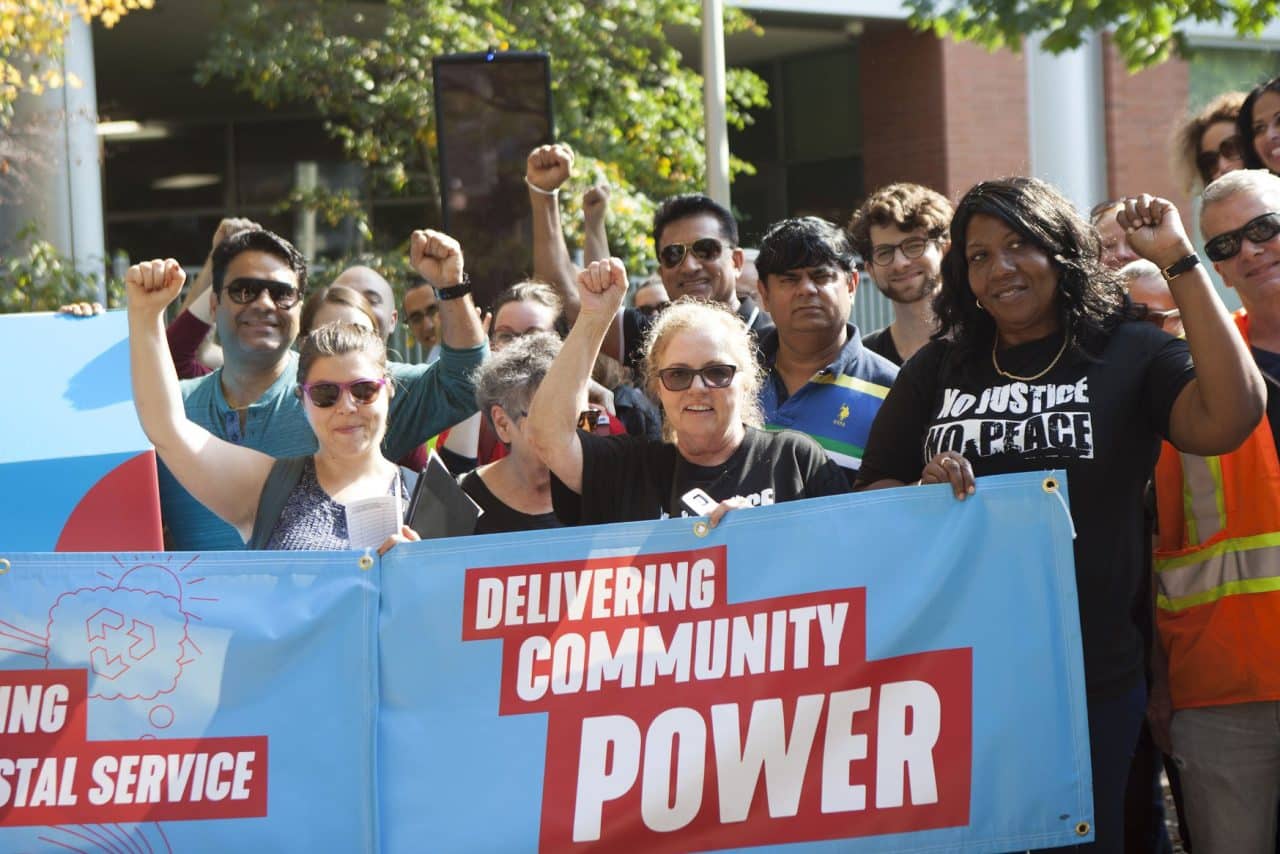
In 2019, postal workers and allies took over post offices in Toronto and Burnaby, redecorating them to show what the post office of the future would look like.
Canada Post would dig in their heels for another three years.
Finally in 2022, they announced that they would electrify the fleet fully…by 2040. For those keeping track at home, that’s the same year France is aiming to eliminate the sale of fossil fuel consumer cars for the entire country.
Meanwhile, charging stations have been built elsewhere by more enterprising operators. Once again, postal workers led, and Canada Post reluctantly followed after years of instransigence.

Getting back to the bank
For years before the launch of the Delivering Community Power campaign, postal workers have been advocating for postal banking, and put together a broad coalition to back it. Banking services were part of Canada Post’s offer until 1968, when commercial banks successfully lobbied the crown corporation to drop it.
Anti-poverty groups like ACORN backed the bank as an alternative to predatory payday lenders, while rural communities saw it as a way to get services to residents where local branches closed decades ago—despite outsized bank profits.
Naturally, the banks saw it as a threat for the exact reason it was a great idea: it would create competition, and it had the potential to serve communities instead of extracting their wealth through absurd fees and high interest rates.
In 2022, after more than a decade of campaigning by two postal workers’ unions—and intransigence from management—Canada Post finally rolled out an underwhelming partnership with TD Bank in 2022. A month after launch, TD pulled the plug.
Just last month, they announced another partnership with a smaller bank.
Needless to say, the underwhelming white-label service has none of the far-reaching potential of the postal workers’ proposal.
The last mile
Canada Post is seeking to make postal work more like gig work—on the model of Amazon or Uber Eats. A “cheaper and more precarious” workforce is the desired outcome, as postal worker Kieran Delamont wrote last week in The Breach.
By creating systems fueled by constant burnout and high turnover, companies like Amazon are constantly lowering the bar for delivery workers.
And Canada Post is looking to lower its own standards to compete. The impasse between Canada Post management and workers is about practices designed to squeeze ever more physical exertion out of Canada Post’s letter carriers—for example, by eliminating light days and specializing sortation duties, leading to longer hours of walking with heavy bags of mail.
Do we simply have to accept a race to the bottom, with hyper-exploited labourers competing against each other in a battle of self-degradation?
Postals workers have proposed a consolidated last mile. The idea is that parcel delivery logistics are a natural monopoly: having a bunch of delivery vans and drivers running overlapping routes actually costs more, and creates extra congestion and pollution. As a public service with reach across the entire country, Canada Post would be the obvious choice.
With a consolidated last mile, companies like Amazon could move their goods to warehouses and neighbourhood depots, but Canada Post would take the packages to the doorstep.
The result would be far more efficient, but not at the expense of workers. Those doing the delivering would have the leverage to reverse the race to the bottom, gain living wages and maintain their physical health.
Postal workers have proposed a consolidated last mile, but admittedly they haven’t been very loud about it. That’s because they’re busy fighting for the basics: fending off the constant erosion of their dignity, pay and working conditions.
It wouldn’t even occur to Canada Post’s corporate leadership. But executives in government and Canada Post alike have lost big by turning away from postal workers’ leadership and bold proposals.
Maybe it’s time to follow their lead.

When I went to journalism school 10 years ago, my parents thought that they would eventually read my articles in The Montreal Gazette. Today, that newspaper is a husk of its former self. But I get to explain that I’m working towards critical, independent, and sustainable journalism.
Want to be a part of the future of journalism? Support our work with a monthly contribution. Sign up here.
– Amanda Siino, Development Director, The Breach
Labour | Postal workers are fighting the gigification of a vital public service

Workers' Rights | As cost of living soars for all, federal workers are fighting back

Labour | After UFCW-Uber revelation, gig workers ramp up fight for decent work

3 comments
Comments are closed.

Why do people fail to realize that the postal service is a SERVICE? And one with a mandate – it must deliver to every address in the country. It cannot be held to the “profitability” standards of private delivery services (assuming these should even exist). The only way to make the postal service financially profitable is to suppress wages, just as it is with all the other public services that have been privatized. Privatization does not work for the people – just for owners.
Yes, the postal service must adapt to the changing nature of society, and that means being innovative, not wage suppression.
Nothing was mentioned about the top executives pay? The ceo makes over half a million a year plus bonuses. More than our prime minister!!! Many other top jobs are in tge millikns. That said is why they are in deficit. This has been going on from the last strike.! Why are the same executives still in their roles????
Nothing was mentioned about the top executives pay? The ceo makes over half a million a year plus bonuses. More than our prime minister!!! Many other top jobs are in tge millikns. That said is why they are in deficit. This has been going on from the last strike.! Why are the same executives still in their roles????