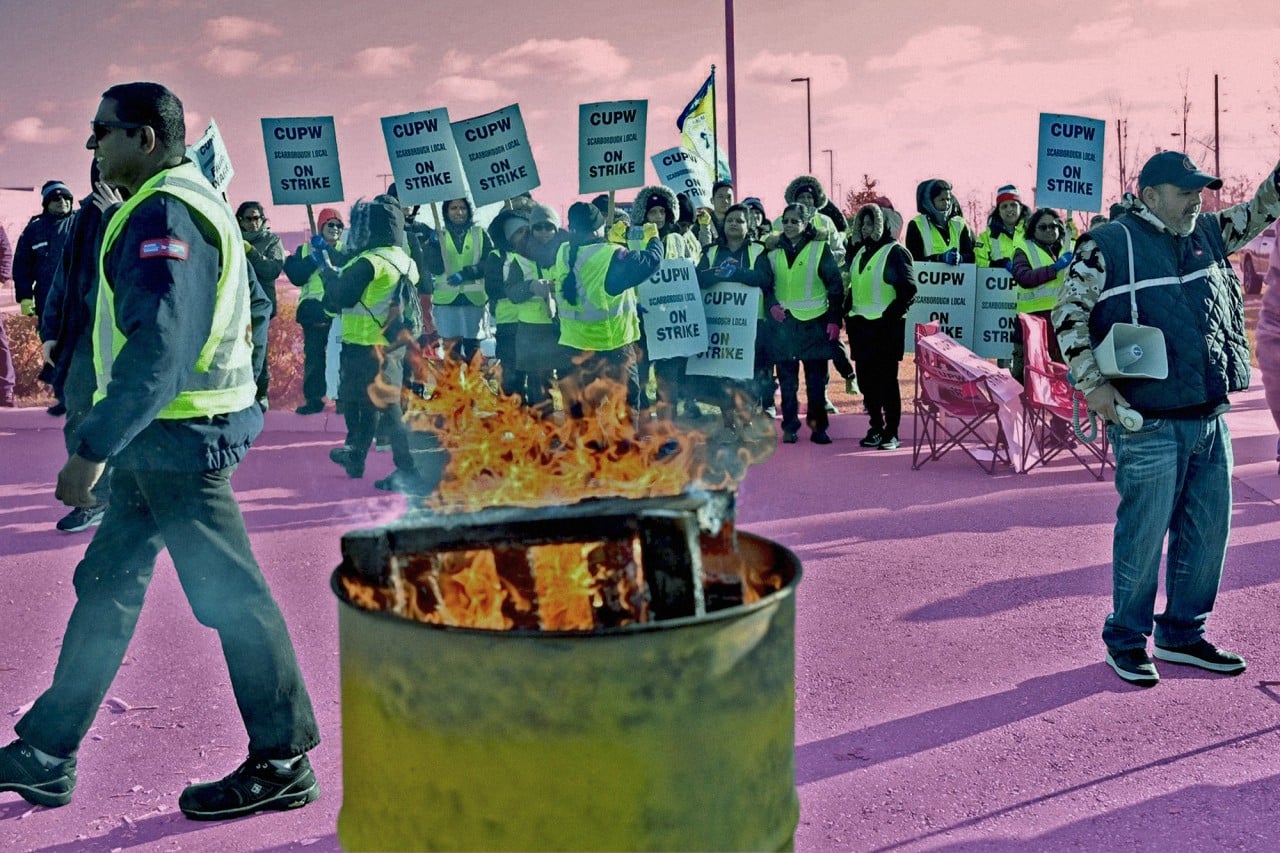
Huddled around fires on picket lines across the country, postal workers like myself are carrying a load that many Canadians aren’t aware of.
My co-workers are famously fit, but even our most in-shape, seasoned letter carriers seem to agree: standing in the cold, bracing yourself against harsh wind, has left us worn down at the end of the day.
We’re mentally exhausted, too, after a year of fractious negotiations that went nowhere, leading to an even more contentious month of rhetoric in the lead-up to our strike, which has now hit its third week.
And then there’s the hue and cry from the corporate sector and the establishment media, who’ve brandished the stories about everyday Canadians waiting on packages.
Though you wouldn’t know it from the media coverage, these stories break our hearts too. The person who can’t get home without a passport, the business sitting on a product that they need to ship with Canada Post, the isolated communities and seniors that are without a vital service—it weighs heavily on a lot of us.
I’ve heard many of my co-workers say, at one point or another, that they’d much rather be out walking our routes right about now—not that 30,000 steps a day ever sounds easy.
But the loud protests of Canada’s elite also show what we’ve been pleading with people to understand: we posties grease the wheels of the Canadian economy; without us, it starts to groan.
The strike by the Canadian Union of Postal Workers (CUPW)—of which I’m a member—is now the third-longest non-rotating strike in the history of the Canadian post office. It’s shorter only than the strike in 1975, which won job security, and the strike in 1981, in which we won a maternity leave policy that later formed the basis of public maternity leave for the entire country.
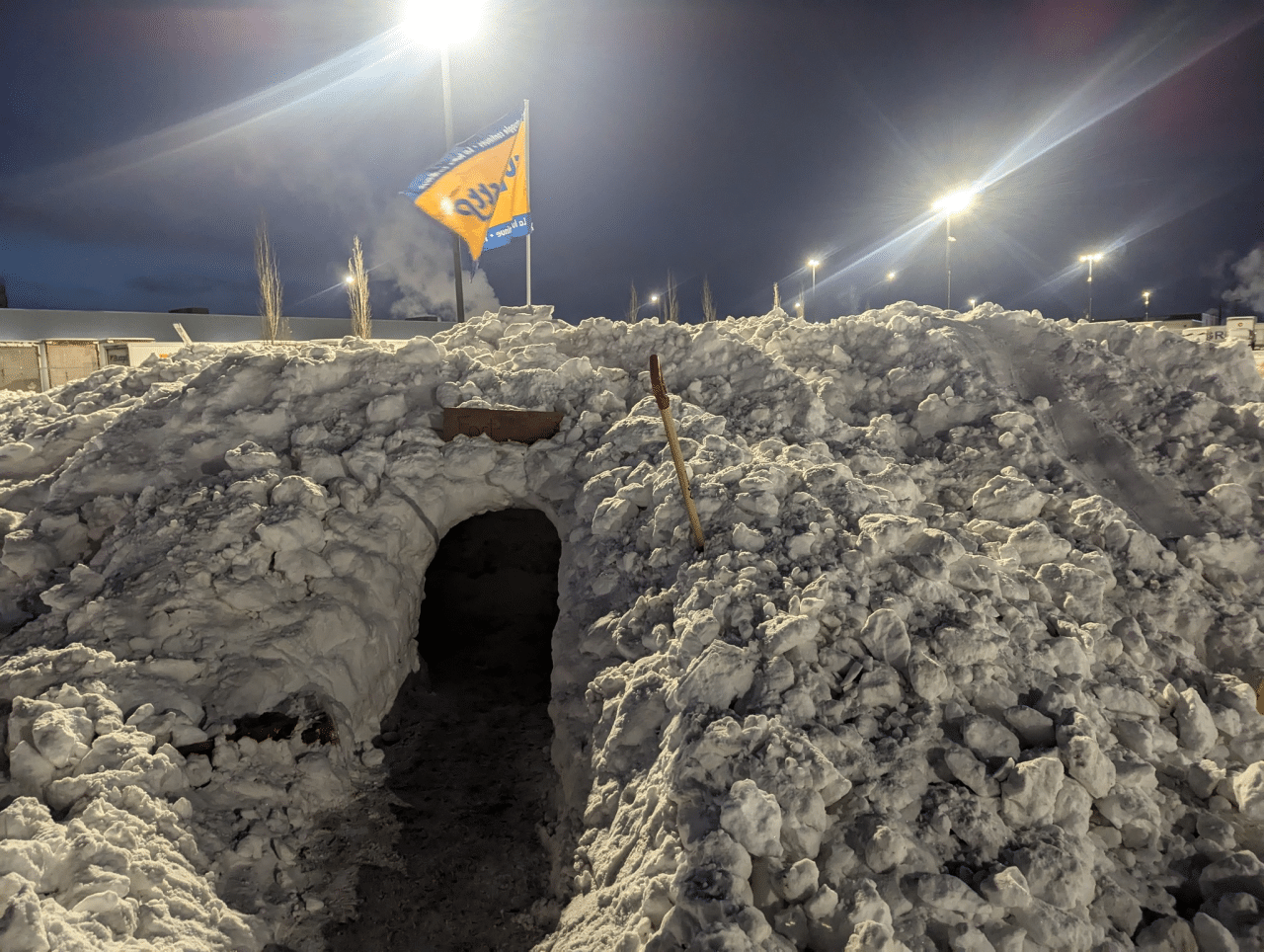
The pickets themselves have matured, with supply tents, barbecues, and even snow forts—and members increasingly willing to enforce hard pickets against management looking to enter buildings.
On the picket lines, the current strike is beginning to invite historical comparison. On the first day, former CUPW president Jean-Claude Parrot stopped by at the age of 87 to lend support. Members who’ve heard the stories of his defiance of back-to-work legislation in 1978, including a three-month stint in jail, lined up to shake his hand.
A lot of the posties out there have never experienced a strike like this before. For many, this has already become the big generational strike, the one through which CUPW’s self-image as one of the toughest, most militant unions in the federal service is renewed for a new cohort of members.
We’re out here to preserve a good job that serves people from coast to coast. We’ve led the way in the past, with our strikes paving the way for Canadians to enjoy maternity leave and job security. Now, we’re fighting to set another precedent—to stop the casualization that threatens so many workers across the country.
Management ‘out of touch’ with workers
Overall, there is a sense that management has grown out of touch with its workforce.
This was clear enough when Canada Post spokesperson John Hamilton told The Globe and Mail that “many young people are not looking for full-time, 9 a.m. to 5 p.m. jobs. They want flexibility. They could work for Canada Post part-time and have other part-time jobs during the week.”
That’s obviously untrue. For one thing, the only reason many CUPW members like myself endure years of temporary/casual status is because of the eventual promise of permanent full-time jobs with job security, pension and benefits. For another, many of Canada Post’s casual workforce are not unencumbered young adults but people in their 40s and 50s, supporting families and beginning to look at their grim retirement prospects.
His line was clearly a justification for the increasing trend of the corporation relying on casual workers, who now constitute around 20 per cent of CUPW’s total membership, myself included. As Jan Simpson, president of CUPW, told The Globe and Mail, “they don’t want to use full-timers. They want to create a part-time work force.”
Many of us love our jobs despite these conditions, but we almost universally believe we deserve at least a little bit more from our employer. To many of us, Hamilton’s quote that we were nothing but flighty young people really tipped the corporation’s hand.
Whatever it said publicly about protecting full-time jobs, the corporation’s only answer to its financial challenges is to lean heavily on part-time and temporary employees. It has done more to imitate the models used by rapid low-cost couriers like Intelcom and UniUni than those used by financially sustainable postal systems around the world, let alone our unionized private-sector parcel business competitors.
Canada Post trying to create “cheaper and more precarious’ workforce
Despite its importance to postal workers and the future of this postal service, the strike is poorly understood from the outside.
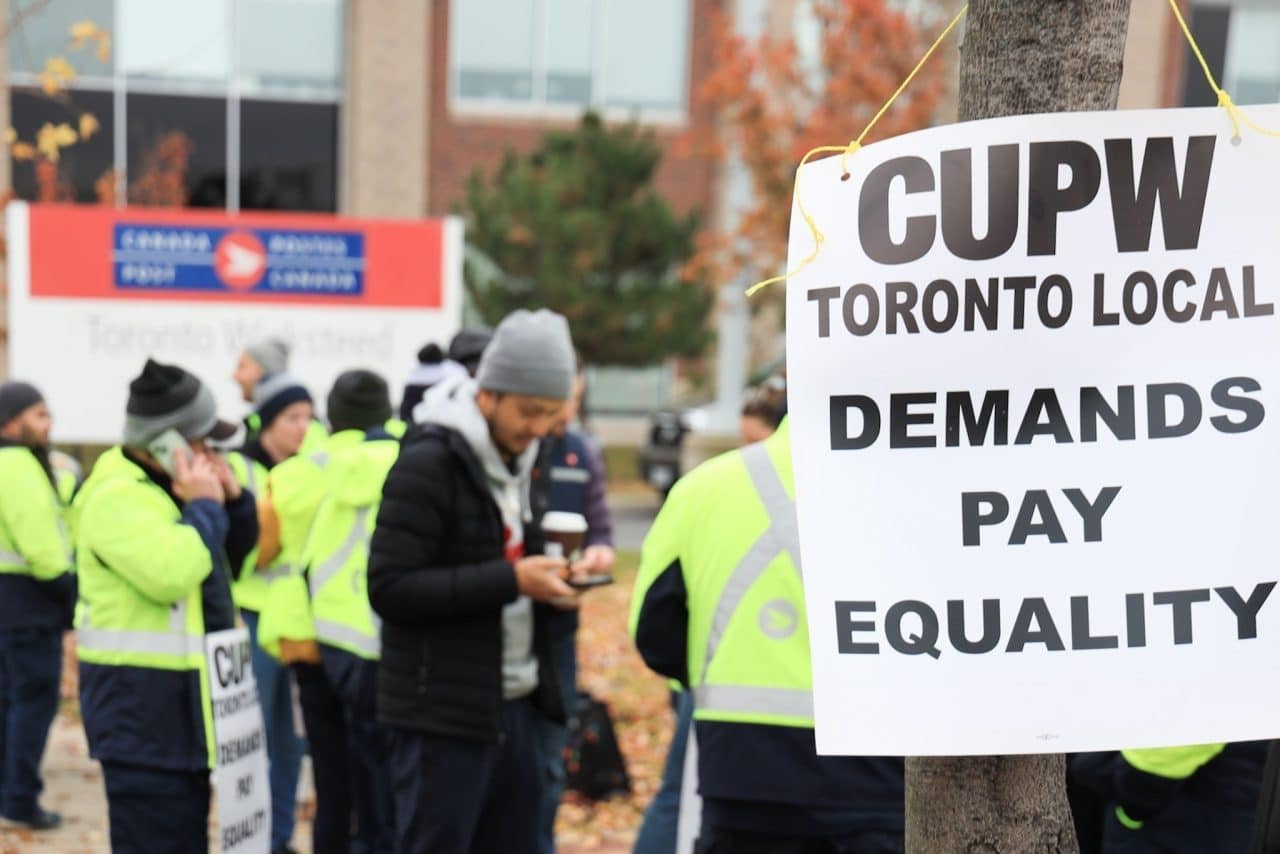
It has mostly been seen as a dispute over wages. And that’s partly true, the wages are part of the disagreement: the union is seeking to keep them in line with inflation, something in the ballpark of 22 to 24 per cent. The corporation has offered just shy of 12 per cent over that same period.
But my sense from the picket line is that while wages are still on the bargaining table, they are far from the defining factor that motivates workers to walk the picket line day after day. Instead, workers are driven by attacks to the pension fund and an even more aggressive push toward casual work.

Management’s proposed pension reforms would shift new hires off the historically popular defined-benefit pension, which pays a predetermined rate to retired members, and onto a defined-contribution pension—in which a member and employer’s contribution is set, but the amount the member will receive is not.
Junior members and casuals waiting for full-time employment see this as a blatant cut to the compensation package. Senior members who would remain on the more popular pension fund see it as move that would starve their pension in the long term. It’s also clearly a ploy by management to divide the two groups of workers—especially when one considers that there are no financial grounds on which to alter the existing benefits.
An even bigger issue for many of us in the union is the increasing part-timing and casualization of the workforce. This has become a key issue at the bargaining table, and appears to be the main reason talks between the two sides have broken down over the past two weeks.
Canada Post is seeking to implement a more flexible model that relies more heavily on part-time and flex-hour workers, a move it sees as necessary to compete in the parcel space with evening and weekend delivery.
Beyond a few details—a guarantee of only eight hours per week, with up to 30 hours of availability expected if the corporation requires it—little is known about the type of positions management wants to create, and employees have not been consulted on potential changes.
Our CUPW leadership appears to view this—correctly, in my opinion—as an attempt to remodel our delivery services at the bargaining table, in part by creating new part-time employee classifications that will over time cannibalize the work currently performed by full-time, permanent staff.
In fact, there are already terms in the collective agreement that would allow Canada Post to pursue evening and weekend delivery using a mix of part-time and temporary employees, but for whatever reason the corporation has refused to implement these models, and is now insisting it needs the power to make further changes instead.
Many of us believe that by getting us to agree to weekend and evening delivery, the corporation’s aim is not to move parcels to your door any faster, but to create a staffing model that is cheaper and more precarious—a benefit only to management, not to anyone served by Canada Post.
Media coverage falls short of what public, postal workers deserve
For the most part, none of this makes the news, and most members have given up on the media. Mainstream outlet reporters have visited our picket line in Ottawa only to chide us that our media department isn’t getting back to them quickly enough, when they could talk to any of the members in front of them.
The media has seemed more interested in the public power struggle between Canada Post and CUPW than any of the actual issues that underlie it. A national union fighting the casualization of labour that has infected the entire Canadian economy ought to be a big story, but the coverage so far has largely focused on existential questions about the post office, set against the all-too-convenient backdrop of the corporation’s latest financial results.
There is no shortage of business interests lining up to help fan these flames. The CBC has, for instance, quoted Carleton professor Ian Lee at least a dozen times, knowing that he’ll paint a reliably dramatic picture of an apocalypse for Canada Post—while rarely disclosing that Lee is a former employee of Canada Post’s corporate department. (That he has unsuccessfully predicted and egged on the demise of the post office for much of the past 15 years seems not to disqualify him either.)
“Even as the media […] has improved their labor coverage when it comes to other public services. It doesn’t seem to be the case when it comes to Canada Post workers,” said labour studies professor Adam D. King, interviewed by Press Progress. “I’m not sure how to explain this, but it is something that I think has been there, not just in this strike, but in previous strikes, there is a tendency to look at the supposed negative impacts.”
On the other hand, few reporters bother to interview the rank-and-file workers, and even fewer take the concerns and questions we have and turn them into hard questions asked of Canada Post’s management. Postal workers have the highest rate of disabling injuries out of all federally regulated sectors—but good luck getting the media to mention that alongside our demands for better working conditions.
Digging in to win
So here we are, into our third week on the picket lines. Members wonder if we’ll be back by Christmas. On our picket line, we’re setting up our annual Christmas food drives, building wind barriers and trying to find ways to keep ourselves busy all day. We’re all sick of Timbits, but we are, for better or worse, dug in.
A strike that was initially about a lot of things, from pay and pension to safety and staffing, has crystallized into something more concise: the fight to protect a good, career job that serves Canadians from coast to coast. We want to work at the post office, because working at the post office means something to us.
None of us are here to get rich, and if we wanted to drive for Amazon, we would all just drive for Amazon. But we won’t embrace the logic of the gig economy, and we definitely won’t allow it to be ushered in through the side door.

‘The first video I ever made with The Breach was on why we need to support the movement for Land Back. Today, it’s being used in educational settings everywhere—in universities and colleges and children’s classrooms too. When I give talks, people will say, ‘I saw your video and it helped me understand the issue.’
That’s what we do at The Breach—reach people where they are at, with bold ideas, principled analysis, and critical investigations.” – Pam Palmater, scholar and author
Become a sustaining member of our work today.
Precarious work took over the economy—but workers are fighting back
How public sector workers redistribute wealth and promote equality

The inside story of how education workers beat back Doug Ford

11 comments
Comments are closed.

Wow Kieran that was the most powerful and truly spoken article I have read since the strike began (and possibly ever). It was absolutely lovely. You speak with your heart and most importantly use factual information and for the last three weeks all I read is the “boring” update by mainstream media. I am also a CP employee as a “on call temporary relief” as you know they don’t hire anyone permanent or full time. It’s sad. Great history, great value to every Canadian and Corporate people are trying to destroy it. Great article thank you. You are going to be fantastic as a journalist if you hang up your boots at CP.
A fan. Thanks again.
Indeed the CBC, it seems the moderators on their forums are there with the intent to run interference on behalf of their masters removing posts and comments that counter the corp. approved slant. Highlights the reason we need independent dissenting voices and publications.
There is always more to the story being told.
A good story but unfortunately a denial of the reality that unless the post office adapts and is able to compete effectively with the private delivery models, it is doomed to fail.
🐌 mail already dying when their employees decide to insert final nail in coffin, same reason Britain hasn’t had domestic automotive industry since last century. I am full-time live-in caregiver to someone mentally & physically disabled, seizing our benefit cheques is no way to engender support, Happy Xmas.
Maybe you should reconsider the 6% every year for 4 years that is a good deal for our times remember JT gave away all our money to other countries
Postal worker strike.
Where is the real information? How much does a postie make after 10 years working? Benefits? Etc
If Canada Post is an essential service, mandate them back to work. No one has a crystal ball to know what the future holds for the postal service, so striking for the sake of a part timers future is futile. Most ridiculous. Your wages are higher than some 2-4 yr techs working in our healthcare system, so boohoo, get back to your jobs before they become extinct
Don’t crabbucket. Across the board there are industries of under compensated labour. Your sense of entitlement because you have a desk job shows that under the right circumstances you. Would behave just like the rest of the 1 percent who dispite knowing the hardships of the masses , will still continue to pursue to take far more then what’s necessary to have a meaningful life. I think that we re around the corner from the point where most people realize that life isn’t manageable and become desperate. When that happens mass Civil unrest will take place and you ll witness a complete breakdown of society. Your gunna seem every billionaire cash their chips in and get out of dodge. These strikes push back against that. You don’t wanna live in a place where law and order break down because your nerd ass isn’t prepared to live in a place like that. Don’t tell your self this can’t happen. It can.
Well written article explaining the Unions position. While I strongly disagree with a 24% wage increase I understand the desire to protect full time jobs. I was a member of the United Steel Workers for 33 years and at my place of employment (I’m now retired) new management also went to a defined contribution plan. Fortunately it didn’t affect our defined benefit pensions.
I don’t have a solution but would prefer to not replace permanent full time positions with temporary or casual positions. Workers need access to benefits & pension.
Strikers must be realistic- the post office needs to be competitive and must not cost the taxpayer $ to keep it afloat.
Ii agree that the current use of part time workers is abusive. Does the union have a business plan that would allow Canada Post to be competitive with couriers in the South of Canada while providing a valuable service to the under populated North?