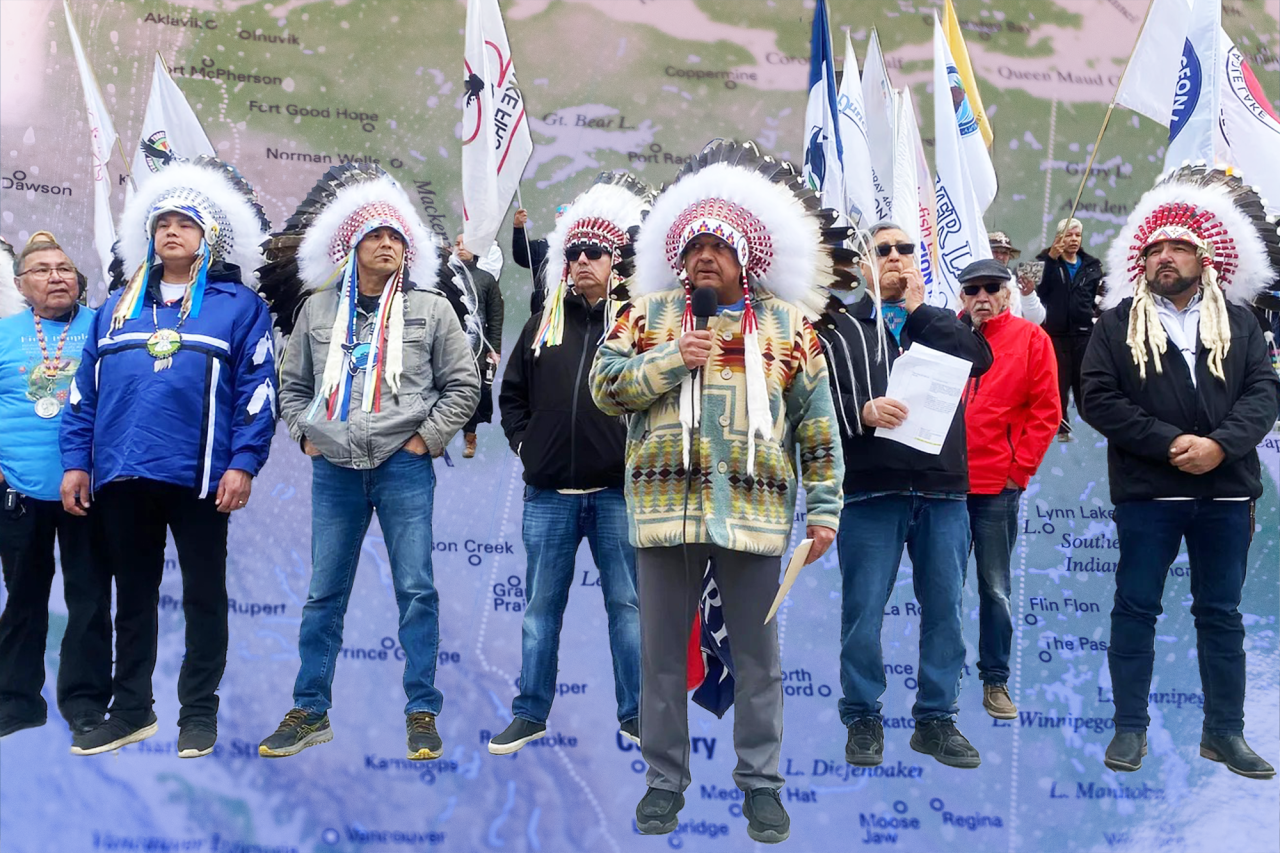
Alberta Premier Danielle Smith’s scheme to hold a referendum on Alberta separatism seemed to be going smoothly—until First Nations sent her a message: we’ll see you in court, Smith.
This fall, the premier has pledged to put to a vote whether Alberta should cleave from Canada, if a petition calling for it gets enough signatures. She’d passed laws to lower the threshold for a referendum and increased the time limit for collecting signatures on a petition.
She’s striding toward a vision for an independent Alberta, backed by the American empire, without any checks on her ability to attack immigrants, trans people, and unions.
But Indigenous peoples, and their rights, appear to be a major obstacle standing in Smith’s way. This week, four Alberta First Nations are in court arguing that the separatism referendum violates their Treaty rights.
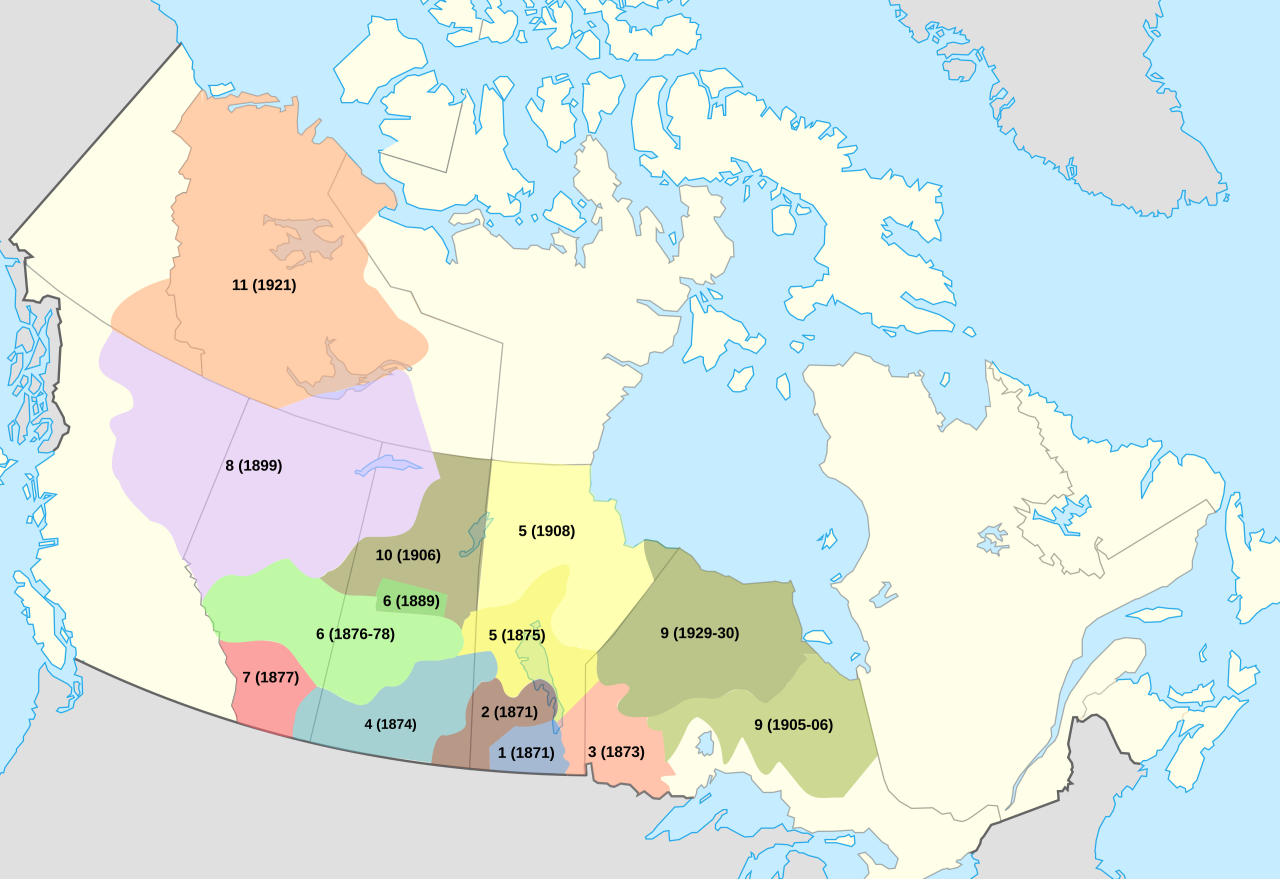
Treaties, signed between First Nations and the Crown years before Alberta even became a province, protect First Nations’ rights to hunt and harvest on their territories, receive payments and services from the Crown, and be consulted about development on their lands.
Canadian provinces are products of the Canadian state, which was itself born from Treaties signed between First Nations and the Crown. It means the province shares the federal government’s obligation to consult with First Nations on policies impacting their traditional lands.
“Our Treaties are not relics. They are not documents to be shelved and forgotten,” said Chief Wilfred Hooka-Nooza of Dene Tha’ First Nation in northern Alberta at a rally against separatism in May 2025. “They are living, breathing commitments.”
At the rally, chiefs were united in their message that Smith has no legal right to sever Alberta from Canada’s Treaty relationships.
These Treaties pose a formidable—possibly insurmountable—challenge to separation. A raft of recent court decisions have affirmed that Treaty rights can act as a check on runaway resource extraction. First Nations hope they could serve as a bulwark against a Danielle Smith government that’s been emboldened by the possibility of a sovereign Alberta to punch down at minorities and unleash fossil fuel expansion.
“Any attempt to undermine or infringe on our Treaty rights will be met with unwavering resistance,” vowed Tsuut’ina Nation Minor Chief Regina Crowchild.
Stoking separatism’s flame
Smith insists she’s no separatist, but she’s piled fuel on the fires of separatism.
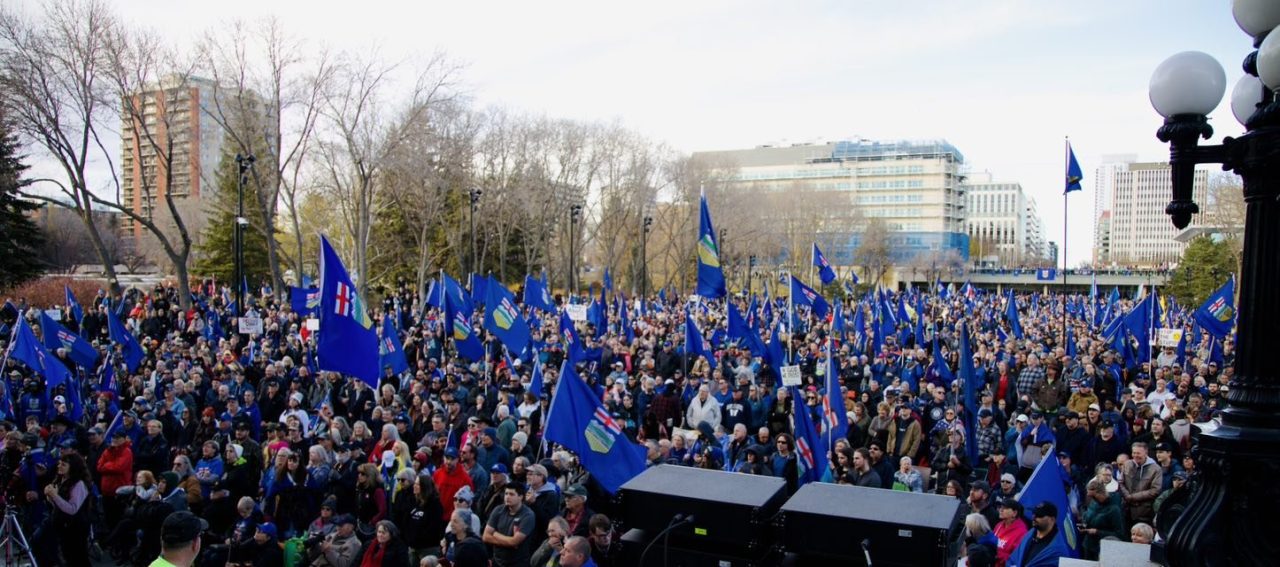
Her government has twice passed legislation that made it easier for separatists to put the cause of Alberta independence to a referendum on October 19.
In May 2025, Smith’s government introduced Bill 54, lowering the threshold for initiating a constitutional referendum and increasing the time limit for collecting signatures.
In December, a day before the Court of King’s Bench was to rule that an independence referendum was unconstitutional, the province passed Bill 14, which eliminated a prohibition on referendums that violate the Canadian Charter of Rights and Freedoms or Indigenous rights.
Smith has also added a raft of other referendum questions. Some seek Albertans’ blessing for the province to try to amend the Canadian constitution to hand provinces more power. Others would introduce anti-immigrant measures: giving Alberta “increased control over immigration for the purpose of decreasing immigration,” and allowing Alberta to withhold provincial services like health and education from immigrants.
Smith’s proposed constitutional changes are unlikely to get off the ground—even if they are passed by referendum, they probably won’t receive the necessary support from other provinces, and will get tied up in the challenging mechanics of actually amending the constitution.
But since immigration is a shared responsibility between the provinces and feds, Smith’s anti-immigrant proposals are far more likely to become a reality.
These developments have occurred alongside broader assaults on public health care, transgender rights and organized labour that have served to increase the Premier’s power by punching down at marginalized Albertans.
The separatist threat “opened our eyes to what’s going on,” Chief Allan Adam of Athabasca Chipewyan First Nation (ACFN) in Treaty 8 told The Breach. “It’s a white supremacist movement. I hate to say it that way, but there’s no other way to say it.”
And indeed, Mitch Sylvestre, who is leading the independence referendum petition drive with a group called Stay Free Alberta, has complained about white Albertans being “replaced” by immigrants.
Chief Adam, who recently called for Smith to resign, called for collaboration between First Nations and other groups targeted by Smith’s policies. “We’ve got to tell the minorities from Alberta that you better jump on ship with the First Nations and we all band together, because, if not, they’re going to start picking us off one by one,” he said.
The oil and gas industry’s biggest champion
Behind Alberta’s separatist movements is a drive for endless and growing fossil fuel extraction.
Separatists paint a picture of an Alberta with its hands tied by former Prime Minister Justin Trudeau’s “anti-resource policies,” and burdened by his purported “disastrous open-border policies.”
The Alberta Prosperity Project, the separatist group that initiated the independence referendum, claims that separation would see Alberta’s economy double within 20 years, growth that would be driven largely by a twofold increase in oil production.
Canada’s oil and gas giants haven’t supported Alberta’s separation—their bottom lines are better served by the stability of a united Canada than by the volatility of a small and isolated Alberta. But the threat of separation alone has given Smith new leverage to advocate on oil and gas corporations’ behalf. Largely to ease tensions with Alberta, Prime Minister Mark Carney inked a deal with Smith for a new privately-owned bitumen oil pipeline.
But Treaty rights exist in tension with Canada’s powerful fossil fuel industry, which wants its development to proceed unchecked and its impacts on the land to go unscrutinized in Alberta. Though the Treaties have often been broken by Canada, a growing body of recent court decisions have affirmed their right to halt runaway resource extraction.
In 2020, the Alberta Court of Appeal overturned the regulatory approval of a tar sands mine next to Moose Lake in Treaty 8, arguing that Alberta’s energy regulator failed to consider the project’s potential impact on Fort McKay First Nation’s way of life. In a concurring opinion, Justice Sheila Greckol warned against turning Treaty rights into an “empty shell.”
Another Treaty 8 signatory, Blueberry River First Nations, won a precedent-setting case when the Supreme Court of B.C. ruled in 2021 that the cumulative impacts of forestry, oil and gas, and mining on their traditional lands had negatively impacted their Treaty rights.
In Treaty 6, Beaver Lake Cree Nation launched the “Defend the Treaties” case in 2008, arguing that oil and gas development has taken up an estimated 88 per cent of its traditional lands, inhibiting its members’ ability to engage in their traditional practices. That case is expected to be heard this year.
Chief Sheldon Sunshine of Sturgeon Lake Cree Nation (SLCN) told The Breach that Smith’s empowering of separatists is part of a broader set of UCP policies putting corporate profits over Treaty rights.
These include the transfer of Crown land to rural municipalities for agricultural and industrial development, and legislation that enables the transfer of water between basins at the Cabinet’s discretion. None of these were done with First Nations consultation, which breaks both Alberta’s Treaty obligations as well as the United Nations Declaration on the Rights of Indigenous Peoples (UNDRIP).
“We’ve had numerous requests for meetings with the premier, because some of the legislation that they have passed is going to affect us long-term, and [received] no response from her office,” he said.
Sunshine said that he learned of celebrity businessman Kevin O’Leary’s plan for the world’s largest AI data centre, to be built on former Crown land near Grande Prairie with the premier’s enthusiastic support, through a press release. That project will draw 24 million cubic metres of water from the Smoky River and need 538 billion cubic feet of natural gas to operate.
Sunshine emphasized that his First Nation isn’t against resource development, but that its members want to be seen as “Treaty partners,” not “obstacles.” “We’re the true owners of these lands, and it’s time that both levels of government understand that and start treating us that way,” he said.

See you in court, Smith
First Nations have played a leading role in mobilizing against the spectre of separatism, with four court challenges against the independence petition launched by SLCN; the Piikani, Siksika, and Kainai bands of the Blackfoot Confederacy; ACFN; and Mikisew Cree First Nation (MCFN).
Orlagh O’Kelly, an Edmonton-based lawyer representing MCFN and SLCN in court challenges against Bills 54 and 14, told The Breach that since the Treaties were signed by the Crown and First Nations, they can’t be altered by the provinces or individual referendum-pushers.
“You can’t start any process for this discussion without including the First Nations, and certainly not [one] triggered by private individuals,” said O’Kelly.
The First Nations court challenges aim to stop the referendum before it happens. SLCN, the first to launch a lawsuit, is suing the provincial government for passing Bill 14, which permits unconstitutional referendums, as well as the elections commissioner and federal government for allowing the separatist petitioning to occur. They’re asking the court to halt the collection of signatures for the Stay Free Alberta petition. MCFN, ACFN, and the Blackfoot nations have followed suit with their own lawsuits.
The federal Clarity Act, which set out standards for a province’s secession from confederation in the wake of the close 1995 Quebec referendum, only requires negotiations with First Nations after a referendum is successful. By not mandating First Nations’ consent before entering discussions about altering their Treaties, SLCN argues that the Clarity Act relegates “Indigenous Peoples to an afterthought” and is therefore unconstitutional.
O’Kelly emphasized that the legal avenue is an early intervention aimed at preventing, or at least delaying, a referendum. “The further you go down this process, the more political and the less legal it becomes,” O’Kelly explained. “We’re at the very early stages.”
Separatist leaders know that Alberta’s independence will ultimately need not legal right, but economic and military might. Dennis Modry, co-founder of the Alberta Prosperity Project (APP), has said that if the separatists win a referendum they should unilaterally declare independence and obtain recognition from the United States. He was part of an APP delegation that travelled to the U.S. three times last year to meet with State Department officials, raising concerns about foreign interference in the referendum process.

‘A crisis of political legitimacy’
Matt Wildcat, a Native Studies scholar at the University of Alberta, cautions that regardless of whether an independence referendum is successful, the real long-term threat to Treaty rights is a mainstreamed separatist movement, which contains “elements that are very hostile to Indigenous people.”
“There’s a whole spectrum of outcomes which look bad if they are to continue to gain power,” Wildcat explained.
Separatist leaders have been making big claims that First Nations would actually benefit from Alberta independence. Separatist lawyer Jeffrey Rath, who has twice been sanctioned by the Law Society of Alberta for his dealings with First Nations, has said that First Nations leaders would be able to pursue a “new and enhanced treaty relationship with an independent Alberta.” He claims that an independent Alberta would have a “constitutionalized resource revenue-sharing agreement” with First Nations, which would bring great wealth to First Nations.
For Wildcat, this is a fundamental misunderstanding of Treaty rights. “The vision now being put forward by the Albert separatist movement is a very narrow vision of understanding Treaty as a contract or a land sale, essentially,” he told The Breach. From an Indigenous perspective, he says, Treaties are a long-term commitment to sharing, rather than a transaction.
He cautioned against taking an overly legalistic approach to the separatist threat. After all, there’s only so much that Canadian courts can do to hold off separatism, when separatists’ entire goal is to be free from Canada’s checks and balances.
“We have to treat this as a crisis of political legitimacy,” said Wildcat. “The best way to respond to it from a First Nations standpoint is through a political process.”
This would involve the chiefs establishing a commission to “collect people’s ideas and try to generate a consensus or some shared understandings of what we think about the separatist movement, and then put it on paper and have it go through some sort of formal process to get approved as an expression of political sovereignty on behalf of First Nations,” explained Wildcat.
Such a process, which would hear testimony for multiple days, would provide a “counterbalance” to the separatists’ framing of the debate as one of “political sovereignty,” he added.
“To a large extent, First Nations would be doing this outside of the authority of the Canadian state and as such, they would be more firmly entrenching the idea that Indigenous sovereignty is something that exists apart from and distinct, in relation to Canadian sovereignty,” said Wildcat.
Having a formal Indigenous-led process registering unified opposition to separatism would make it harder for the provincial government to ignore First Nations opposition, he explained.
In the meantime, four First Nations-led lawsuits are trying to stop the Stay Free Alberta petition in its tracks, an outcome that Wildcat agrees is necessary to protect Treaty rights.
Court hearings for the lawsuits filed by Sturgeon Lake Cree Nation, Athabasca Chipewyan First Nation, and the Blackfoot Confederacy are happening this week in Edmonton.
“We should be doing everything in our grasp right now to prevent a referendum from happening to begin with,” said Wildcat.

“It’s about getting to the bottom of things. It’s about unveiling who has the power and what they’re doing with that power.”
Linda McQuaig, journalist and author
As a non-profit, free from powerful corporate interests, we invest in investigations and uncover the cover-ups. Sustain our journalism for transformation.
Trans Rights | A Prairie alliance of trans advocates and unions should be a national model
Indigenous Rights | ‘Economic reconciliation’ is a false promise for Indigenous peoples

Oil Industry | Alberta’s anti-energy inquiry aims to undermine First Nations opposition to Tar Sands
1 comment
Comments are closed.


May the First Nations, involved in these legal cases, win spectacularly and stop the illegal and just plain stupid Alberta separatist project in it’s tracks. Hopefully, these people will all just move to the US and never be heard from here in Canada again! That’s my opinion, from someone who loves all the provinces in this wonderful country, including Alberta.