We have passed a grave tipping point in the war in Sudan: The RSF paramilitary has captured a key Sudanese army stronghold in Darfur, trapping civilians inside the city of El Fasher and committing massacres so widespread that pools of blood are visible in satellite images from space.
Behind Sudan’s catastrophe lies a web of international enablers, and Canada is one of them. Canadian-made weapons, mining interests, and restrictive refugee policies have contributed to the current atrocities in North Darfur.
It’s past time for Canada to end its complicity in the genocide—closing the loopholes that keep arms flowing, widening pathways for Sudanese refugees, and steering the conflict toward a civilian-led resolution.
Since April 2023, two factions have been battling for control of Sudan’s government: the Rapid Support Forces (RSF) and the Sudanese Armed Forces (SAF). The two groups previously collaborated to commit a genocide against indigenous Darfurians in the 2000s, before turning on each other in the latest conflict. In these two-and-a-half years of bloodshed, up to 400,000 people have died. More than 12 million have been displaced. Half of the population is facing acute hunger while diseases like cholera, measles, and dengue run rampant.
Last month, the RSF took full control of El Fasher, the capital of North Darfur, after an 18-month siege. Over 150,000 civilians remain trapped inside the city as the RSF carries out brutal executions, targeting indigenous non-Arab communities.
Canadian-made weapons have been seen in the hands of RSF fighters as they commit these massacres.
The paramilitary group owes this conquest in large part to the logistical and military support it receives from the United Arab Emirates, in exchange for Sudanese gold and other resources. For years, Sudan has been a cornerstone of the UAE’s strategy to expand its power across the Horn of Africa using billion-dollar investments in land, ports, and mining.
Canada exported $7 million in weapons to the UAE last year alone. And Canadians’ pension plans are invested in arms manufacturers like Lockheed Martin and General Dynamics, which supply weapons including missile launchers, automatic cannons, and Black Hawk helicopters to the UAE.
While the UAE insists that those weapons aren’t flowing to the RSF, there is plenty of evidence to the contrary.
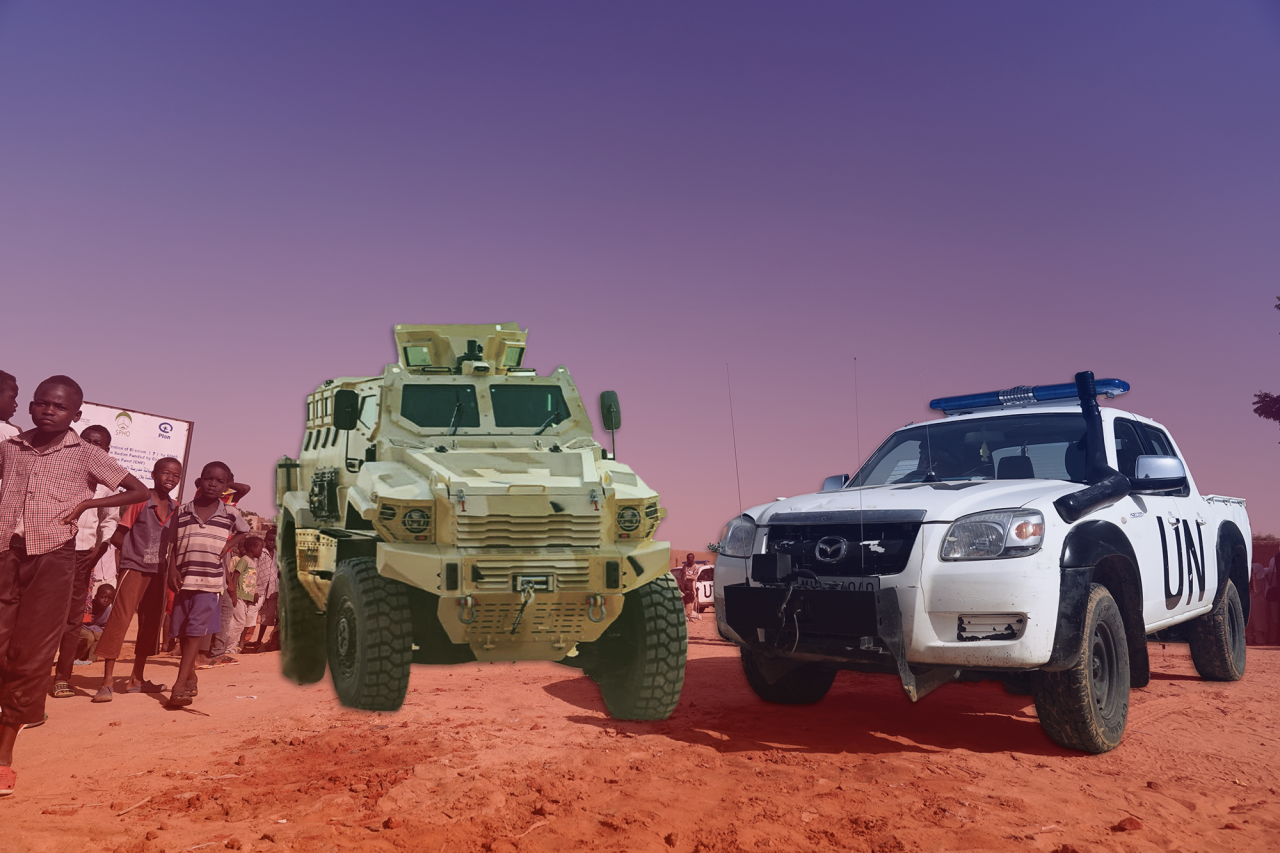
Photos and videos posted to social media show armoured vehicles produced by a Canadian company, the Streit Group, being used by the RSF during the siege of El Fasher. Streit’s main factory is in the UAE, and the company has repeatedly been found to be selling weapons to Sudan and other countries sanctioned by Canada. RSF fighters have also posted photos of themselves carrying rifles bearing the logo of a B.C.-based manufacturer called Sterling Cross Defense Systems.
It’s not the first time Canada has been tied to atrocities in Sudan. A Montreal-based PR firm called Dickens and Madsen, headed by an ex-Israeli intelligence officer, was hired to sanitize the image of the RSF just before a massacre it committed alongside other security forces against pro-democracy protesters during Sudan’s 2018-19 revolution.
And if you’re familiar with the history of Canadian mining companies in Africa, it’s no surprise that the industry has made profits hand over fist, at the expense of Sudanese lives.
Two executives from the Lundin Oil Company, which was part of a group of mining and energy companies headquartered in Vancouver, were recently charged with aiding and abetting war crimes in what is now South Sudan between 1999 and 2003. Lundin executives asked Sudan’s government, then led by President Omar Al-Bashir, to clear oil exploration fields, aware that this would mean bombing civilians, burning their villages, and displacing them from their land. This “clearing” took place just months before the 2003 genocide in Darfur began, perpetuated by the RSF’s predecessor, the Janjaweed.
In 1998 the Canadian oil company Talisman—which bought Lundin Oil in 2001—joined a consortium of companies that provided key funding for the Al-Bashir regime while it massacred resistance fighters and civilians during the war against the South.
These harmful practices haven’t been left in the past. In October of 2021, just days before a joint RSF-SAF military coup derailed Sudan’s transition towards democratic elections, the Canadian mining company Orca Gold finalized an agreement with the Ministry of Minerals to develop a large commercial gold mine in Northern Sudan. This agreement helped to legitimize a military coup regime, and undermined Sudanese aspirations for civilian rule and self-determination.
Canadians and the Canadian government must take immediate action to end our complicity in massive human rights atrocities, and to support an end to the war in a way that empowers civilian governance rather than military rule.
Stem the flow of arms
As Nicholas Coghlan, Canada’s former ambassador to Sudan noted, “If the squeeze had really been put on the UAE a year ago—before they had ramped up all of the arms sales—we would not have had the genocide that is, I would say, indisputably underway in Darfur.”
The UAE is not the only foreign power fuelling this war—on the other side of the battlefield, Egypt, Saudi Arabia, Iran, and Turkey are supplying weapons to the SAF. But the UAE is a major actor in the conflict, and a trade partner that Prime Minister Mark Carney is keenly courting.
To ensure that Canadian arms are not being used to commit genocide in Sudan, Gaza, and elsewhere, Canada must adopt Bill C-233, a bill proposed by NDP MP Jenny Kwan that is being debated in Parliament. The bill would close the loophole that allows arms exports to the U.S. to bypass review and enables the U.S. to divert Canadian weapons to the UAE.
To avoid fuelling the trade in conflict gold, Canada should restrict the import of gold from the UAE. With no gold mines of its own, the UAE’s gold comes largely from Africa—including Sudan, where the RSF provides the precious metal in exchange for arms and support.
And Canada could use diplomatic pressure to call for an immediate ceasefire in Sudan and impose an arms embargo on the UAE, pushing its allies like the U.S. to comply. Together, such measures would send a clear signal that Canada is willing to sever its ties with the UAE until it stops sending support for atrocities in Sudan.
Toward a civilian-led peace
The areas beyond El Fasher are filled with hundreds of thousands of internally displaced people who have managed to escape the captured city but are in desperate need of food, shelter, and medical care.
While international aid organizations struggle to reach Sudanese civilians, local responders in Sudan have been far more effective at providing food and first aid. Yet less than 1 per cent of international aid funding reaches Sudan’s mutual aid groups. Instead of relying on UN agencies or large international NGOs, Canadians should donate directly to the local volunteers that have been leading relief and evacuation efforts.
This war is ultimately a counterrevolutionary effort by military elites and their international partners to foreclose any possibility of civilian rule and popular democracy. By continuing to only center the warring parties and their civilian elite representatives, the path towards civilian rule becomes ever more elusive. Canada can use diplomatic pressure to ensure that members of civil society who are unaffiliated with either the RSF or SAF—including feminist groups, mutual aid groups, and resistance committees, among others—are a major part of future peace negotiations.
Canada’s anti-Black refugee policies
Over 12 million Sudanese have been displaced by the ongoing war, yet only 2,890 refugees have been admitted to Canada. By contrast, 300,000 Ukrainians have been admitted to Canada since Russia launched its invasion in 2022. Canada cannot continue policies that ration safety based on race.
In February of last year, Canada launched a program enabling Canadians to sponsor their Sudanese relatives to come to Canada. But the program is prohibitively—and sometimes fatally—expensive. A sponsor must have at least $9,900 in funds to sponsor a Sudanese relative, plus a processing fee of $635 for each adult and $175 per child. Families who spent small fortunes applying to sponsor their family members are still waiting for their applications to be processed. Some of those relatives have since died in a war that shows no sign of abating.
In its 2024-2028 Anti-Racism Strategy, the Canadian government committed to “advancing racial equity in immigration” for Black asylum seekers and migrants. Yet anti-Black racism is underwriting the government’s approach to the war in Sudan. The Canadian government must create a robust refugee program for Sudan, accepting more refugees and expediting applications, as it did for Ukrainians fleeing war.
Canada’s weapons, investments, gold imports, and immigration policies all leave fingerprints on a conflict that is destroying millions of lives. Simply put, Ottawa’s half-hearted measures do not meet the scale of the crisis.
Responsibility, however, does not lie with the government alone. We implore ordinary people living in Canada to pressure your MPs to honour these demands. Attend a local protest, or donate to local mutual aid groups providing food and shelter to survivors. If you are an academic or cultural worker, sign on to the academic and cultural boycott of the UAE. Join the global movement to free Sudan of its elite oppressors and their international partners.

I often hear that I’m lucky to have a full-time job in journalism.
Critical, bold journalism that isn’t beholden to media monopolies should be the norm—not the exception.
By supporting The Breach, you’re supporting a more robust, progressive media. Join us today.
– Katia Lo Innes, Associate Producer, The Breach
Foreign Policy | Canada must not be complicit in Israel’s war on Iran
Foreign Policy | Dismantling the Haitian state (feat. Canada)
Mining | Leaked report accuses Canada of covering for mining companies in war-torn Ethiopia
1 comment
Comments are closed.
This article seems to be deliberately misleading when taking about the refugee information. It raises the fact that many more Ukrainian refugees have been admitted to Canada than Sudanese ones and then brings up the cost of sponsorships for Sudanese refugees implying that the cost is less for Ukrainian refugees. This is not the case and it is in fact more expensive than the costs they provide for Sudanese sponsorships. It blames the difference in refugees accepted on racism but ignores the fact that there was simply far more media coverage of the Ukrainian war and far more grass roots efforts to assist Ukrainian refugees in Canada. You could try to argue that this was due to racism but you’d be arguing that without any actual evidence. The Ukraine War was just more consequential to global geopolitics due to Russia’s involvement and effects to food supply chains. It also ignores that refugee approvals are down across the board due to the ridiculous immigration policies of the last few years needing to be scaled back.
Also, hate to break it to you but Canada not selling arms to people would make zero difference to any country that wants to start a conflict. There are plenty of other places for them to get weapons.