Dru Oja Jay: A few years ago, a movement with hundreds of thousands of participants achieved a stunning climate justice victory, one of the world’s biggest examples of leaving fossil fuels in the ground.
The action that took place right here, young people perched on tripods blocking roads, or locked to the gates of oil distributors, was just one step in the vast movement that shut down oil and gas extraction in this province.
In 2022, Quebec became the world’s first government to ban oil and gas drilling. A determined social movement made it happen. Here’s Quebec’s playbook for beating Big Oil.
Step one: Use research to clarify what’s at stake
In the early 2010s, Quebec’s oil consumption was around 350,000 barrels per day.
But the fossil fuel industry’s plans would have made the province into an expanding oil-and-gas hub, transporting four times that amount over its lakes, rivers and seaways.
Researchers saw this expansion coming.
They identified harmful chemicals that would be used in fracking, deep-sea drilling, and pipelines. Then, they mapped which waterways would be at risk for spills and leaks.
Armed with this information, local organizers effectively communicated about the potential local impacts, as well as the implications for the climate worldwide.
Step two: Develop a wide, mobilized base
In kitchens, churches, and community centres, deep mobilizing reached every sector of society. A variety of organizations helped turn onlookers into supporters and supporters into activists.
Step three: Build alliances (even if you disagree about some things)
Organizers built relationships across cultural divides and fault lines.
And the movement was made up of smaller local struggles unified by a single vision. Whether it was shale gas in the St. Lawrence Valley, oil drilling in Anticosti, or undersea drilling near Îles de la Madeleine, each group focused on local concerns but saw themselves as part of a larger movement.
Step four: Organize civil disobedience to spook investors
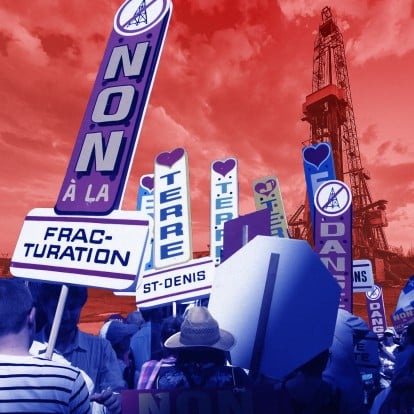
Organizing and deep mobilizing set the stage, but it was the possibility of direct action that threatened the financial viability of these extraction projects. Local groups planned mass non-violent direct actions to physically stop extraction. Some blocked pipeline sites, risking arrest and placing their bodies in the way of machinery.
But for every protester willing to go to jail, dozens were there to offer their support.
That support took the form of donations for legal aid, places to stay, or as one person put it, “tiny sandwiches.”
Step five: Create a culture of resistance…literally
Artists and musicians created common experiences and a language of resistance that spread deeper into public consciousness than any activist press release could. Bands performed to keep activists and their resistance lively.
But some of Quebec’s high-profile acts also took a stand, whether it was Les Cowboys Fringants, or future provincial party leader Gabriel Nadeau-Dubois, who donated a $25,000 literary prize to a movement group dedicated to stopping fossil fuel extraction.
Local artisans even launched an anti-pipeline beer.
Step six: Move from opposition to proposition
The movement didn’t only say, “No.” It offered an inspiring “Yes.” A wave of student climate strikes was followed by a giant climate demonstration attended by 500,000 people in Montreal.
Quebec has a unique history and context.
Without using it as a cut-and-paste plan, their playbook for beating Big Oil offers us plenty of inspiration at a time when climate action will determine our future and that of future generations.

I often hear that I’m lucky to have a full-time job in journalism.
Critical, bold journalism that isn’t beholden to media monopolies should be the norm—not the exception.
By supporting The Breach, you’re supporting a more robust, progressive media. Join us today.
– Katia Lo Innes, Associate Producer, The Breach
Social Movements | 15 movement victories in 2023 you may not have heard about
Climate Crisis | A group of B.C. towns want to sue Big Oil over the climate crisis
How Quebec won the world’s first ban on oil and gas extraction
3 comments
Comments are closed.
That is all well and good, but it would not be possible for Quebec to place moratorium’s on oil and gas extraction if the Billions they receive in transfer payments each year were to suddenly be cut off. As it is they conveniently go down this path because they realize that every dollar generated by resource extraction would result in a 97 cent reduction in their transfer payment. Talk about being addicted to welfare.
I hope you all freeze to death 💀 when you can’t heat your house.
I live in Alberta and it is 30 below here. We need our oil and gas and should not be punished for driving to work and heating our homesll