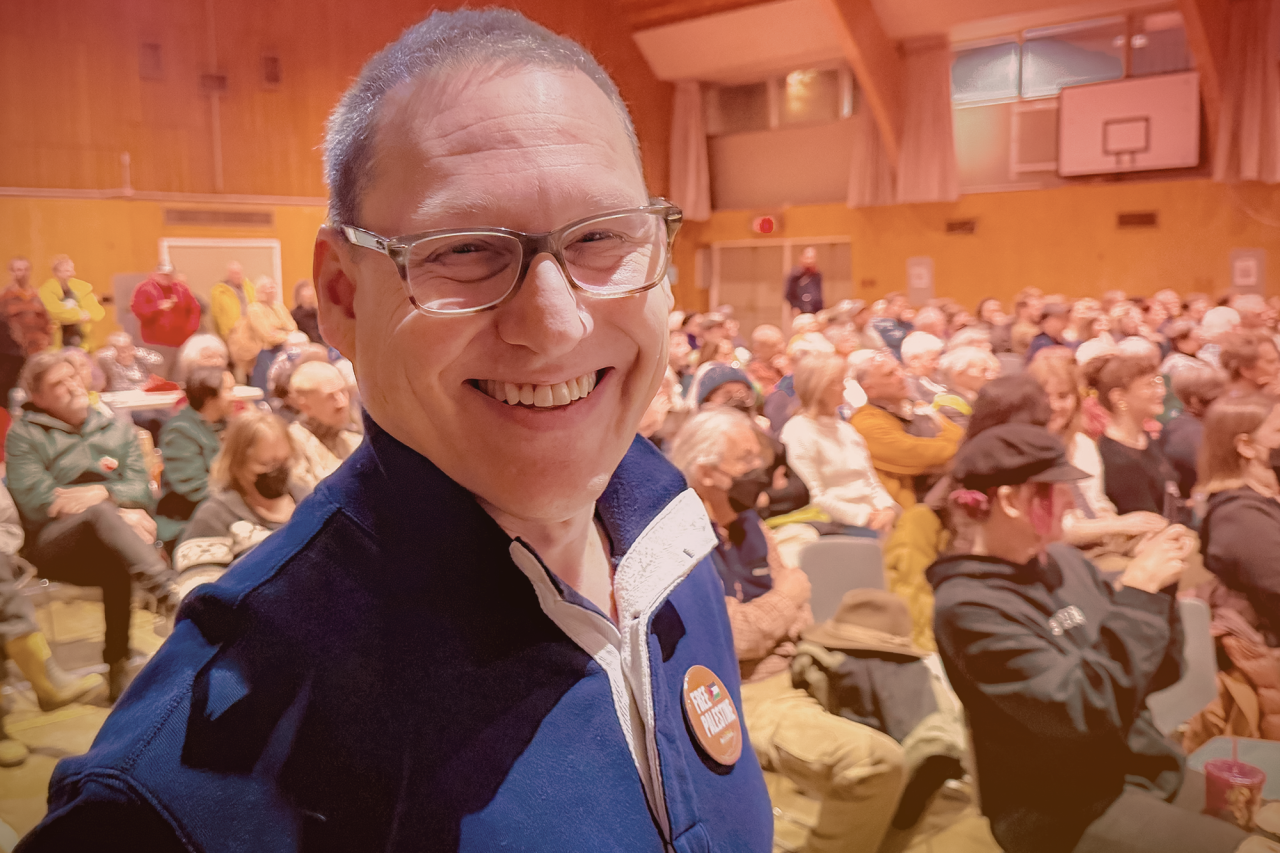
Packed venues with lines stretched down the block. Smashed fundraising records, fuelled by small donors in every part of the country. And as excitement has grown, so have the attacks by the corporate media—from open hostility to studied erasure.
The Canadian left is in desperate need of a victory and a boost, and signs are emerging that one may be within reach: the campaign to make Avi Lewis the next leader of the federal NDP.
On the heels of its recent collapse, the party has a once-in-a-generation opportunity—not merely to recover lost ground, but to remake itself entirely. A revitalized NDP could inject bold climate, anti-war, and socialist policies into mainstream Canadian politics, super-charge the reach of social movements, and ensure a distinctly progressive electoral option roars back to relevance. There’s less than a week left to buy a party membership to help make that possible.
Imagine: instead of cautious politics most attuned to Ottawa pundits, the party could unapologetically champion the causes of movements, trade unions, and a multi-racial working class. Instead of a fixation on a leader’s personality and single-minded electoralism, it could broaden its focus to include year-round education and campaigning. And instead of being controlled top-down by a consultant class that rotates between party headquarters and corporate lobbying firms, it could empower and unleash the energy of a grassroots base.
At the moment, there seems to be every reason to be depressed about the left’s prospects. Donald Trump is launching naked power-grabs across the hemisphere. The Liberal government—capitulating to the U.S. President at every turn save for rhetorical defiance at Davos—is slashing public services while pouring billions into the weapons and oil industry, goaded on by a hard-right Conservative Party that is still riding high in the polls. The NDP has been reduced to a rump, and the organized left is weak. All this while a cost-of-living crisis grinds along and climate breakdown becomes more destructive.
Yet there are also powerful reasons to be hopeful about a left-wing comeback.
There is widespread discontent with the status quo—which is why every leading politician of the past decade, whether Trudeau, Poilievre, or Carney, has tried to pass themselves off as agents of change.
A firmly progressive common sense exists among wide swathes of the Canadian population, and is even growing among young people. Two-thirds believe the “economy is rigged to advantage the rich and powerful,” and half say that capitalism “does more harm than good.” Super majorities back policy responses like a wealth tax, a Green New Deal, or more federal investment in public services like health care. And this outlook is also anti-racist: a majority think racism is a systemic problem, and that governments should get consent from Indigenous peoples for projects that affect them.
But this progressive common sense will amount to little without an organizational vehicle that can express it politically—and lend it collective strength and power. We now have an opportunity to create just that through a Lewis-led NDP.
Nobody thinks such changes can happen easily—after all, this sort of movement-oriented party has never really emerged in Canada, though such currents have always existed within the NDP and its precursor, the CCF. The starting point today is a party hollowed out of democracy, while attempts to move in this new direction will face counter pressure from entrenched insiders, elite media, and the corporate establishment. But we have an opening, and Avi Lewis has stepped into it.
The left cannot afford to sit this one out.
A megaphone for movements
Just think of the limits of our existing movements today. The struggle for Palestinian liberation, for instance, has been an extraordinary development, shifting public opinion, forcing important symbolic policy changes, and triggering the start of deeper cultural transformation. But much like recent movements before it—Black Lives Matter, Idle No More, anti-pipeline climate organizing—its sporadic victories have fallen far short of the wide-ranging structural reforms it hopes to achieve, and which can only come about with an electoral vehicle that can win and take office.
In the meantime, such a vehicle could bring fragmented struggles under a common banner. The left, especially in English Canada, has almost no presence in the mainstream: no voices on news panels, no federal party to amplify movement demands or translate them into policy. All this could change with a Lewis-led NDP reaching ever wider layers of the population with left-wing ideas and forcing the media to give airtime to them.
His campaign is already showing how this might be done. It has named the corporate culprits of our crises, whether mega landlords, grocery giants, oil barons, big banks, or the media conglomerates who try to sweeten the status quo. It has advanced concrete improvements to the immediate problems people feel, whether the rising cost of everything, broken systems of provision, soaring inequality and climate breakdown—through wealth taxes, a rent cap, public options in groceries, cellphones, and housing, head-to-toe health care, and a Green New Deal that can transform our energy systems while creating a million well-paying climate jobs.
Such ambitious eco-socialist or eco-populist politics are also what can motivate large-scale organizing. And it’s the campaign’s focus on mass organizing that is the most promising sign of how it could revitalize the NDP, and give a boost to the broader left. Using the same tools that helped power Zohran Mamdani’s campaign—an app called Solidarity Tech that automates regular contact with potential volunteers—it has seeded more than a dozen chapters around the country and helped turn out people to actions and events. This model could re-energize the NDP’s own often shrunken riding-level associations, and provide infrastructure to outlive the leadership campaign and power future organizing alongside the party.
Lewis has been refreshingly candid about the limits of electoral politics: he is clear that without stronger mass movements and trade unions mobilizing year round on the outside, politics on the inside can win only incremental improvements but not transformative change. As we’ve seen with Jeremy Corbyn’s leadership of the British Labour Party, Bernie Sanders’ runs in Democratic primaries, and now Mamdani’s mayoral victory in New York, such clarity can be a catalyst for broader left organizing, filling the ranks of movements, unions, and progressive organizations with new members and energy.
Welcoming the establishment hatred
While Lewis has put the stress on the “we” rather than “me,” he also happens to be a terrific communicator who has worked respectfully alongside movements for decades and can make a left-wing agenda accessible. (I’m admittedly biased: I’ve worked with him for ten years as a collaborator and advisor, including on this campaign). But judge for yourself: watch this debate between him and Doug Ford, conducted just before the latter became Ontario premier, in which he punctures Ford’s mystique so effectively that by the end the supposed “champion of the little guy” is praising the heavens for the billionaire Weston family. Now imagine Lewis going up against Poilievre or Carney.
As for those who question his ability to win a seat, the criticism is misplaced: he has run in two ridings in British Columbia that have never in their history been won by the NDP. In 2021, he nearly doubled the NDP’s previous result on the Sunshine Coast, and in the second effort, in Vancouver last spring, he was swept away by fear of Trump just like most NDP incumbents, despite building huge enthusiasm among a volunteer base.
This time around, the same energy has helped build enormous momentum in just a few months. Several hundreds are now turning out to townhalls, the campaign has broken Jagmeent Singh’s former fundraising records, and viral videos—like this one showing Lewis humorously revealing the greed of bankers on Bay Street—are spreading the campaign’s message far beyond party members. All of it has the makings of a potential new force in Canadian politics.
So it’s no wonder the attacks are coming. Corporate media have mocked the campaign’s boldest proposals, like public grocery stores, and condemned Lewis’s principled anti-war positions, including his defence of Palestinian liberation. Some of the harshest attacks have come from NDP insiders, for whom a genuinely left-wing mass party is a threat to be resisted. These attacks will only grow more coordinated and louder.
But a win for Avi Lewis is by no means guaranteed. The deadline to sign up to become a member of the NDP in order to vote is a week away—January 28—and you can do it for as little as $10.
This campaign has offered us a chance to shed despair and turn hope into action. Now it’s the turn of the Canadian left to seize the moment.

I often hear that I’m lucky to have a full-time job in journalism.
Critical, bold journalism that isn’t beholden to media monopolies should be the norm—not the exception.
By supporting The Breach, you’re supporting a more robust, progressive media. Join us today.
– Katia Lo Innes, Associate Producer, The Breach
Right-Wing Politics | Quebec’s government has launched a ‘shock and awe’ assault on workers and the vulnerable
Social Movements | Who can revive the NDP and take it leftward?
Socialism | What Canada can learn from Zohran Mamdani’s victory in New York
5 comments
Comments are closed.

Why was the conflict of interest worth pointing out in your podcast covering the race and not this piece?
It may not be immediately obvious, but the article does say, “I’m admittedly biased: I’ve worked with him for ten years as a collaborator and advisor, including on this campaign”.
he does say this: “(I’m admittedly biased: I’ve worked with him for ten years as a collaborator and advisor, including on this campaign)“
i didnt listen to the podcast, though.
I agree about Avi Lewis! You can simply tell when a person is conscientious. Some friends from Toronto asked me to look him up, and shortly after the Canadians for Justice in Palestine and the Middle East (CJPME) organized a debate that included him. Canadian friends thought that as a Lebanese, I would have an issue with his jewish background, and this is where I always explain; our issue is not with a religion, not any of them, but with Israel’s settler colonialism and its genocide of Palestinians. Avi Lewsi stands up to Israle as it were, and also believes in not torching our planet!
Avi Lewis has lost every election he’s ever contested.