The NDP leadership race could turn the party into a vehicle for bold left politics—or cement its decline.
Martin Lukacs and Desmond Cole analyze the various campaigns and some of the emerging themes, from “purity tests,” to class war salvos, to candidates flouting race rules.
The Breach Show is our podcast featuring sharp analysis on politics and social movements in Canada. Subscribe to the podcast on Apple, Spotify, Iheartradio, Youtube Music or your favourite service.
Desmond Cole: Welcome to The Breach Show, featuring sharp analysis on politics and social movements in Canada. I’m your host, Desmond Cole.
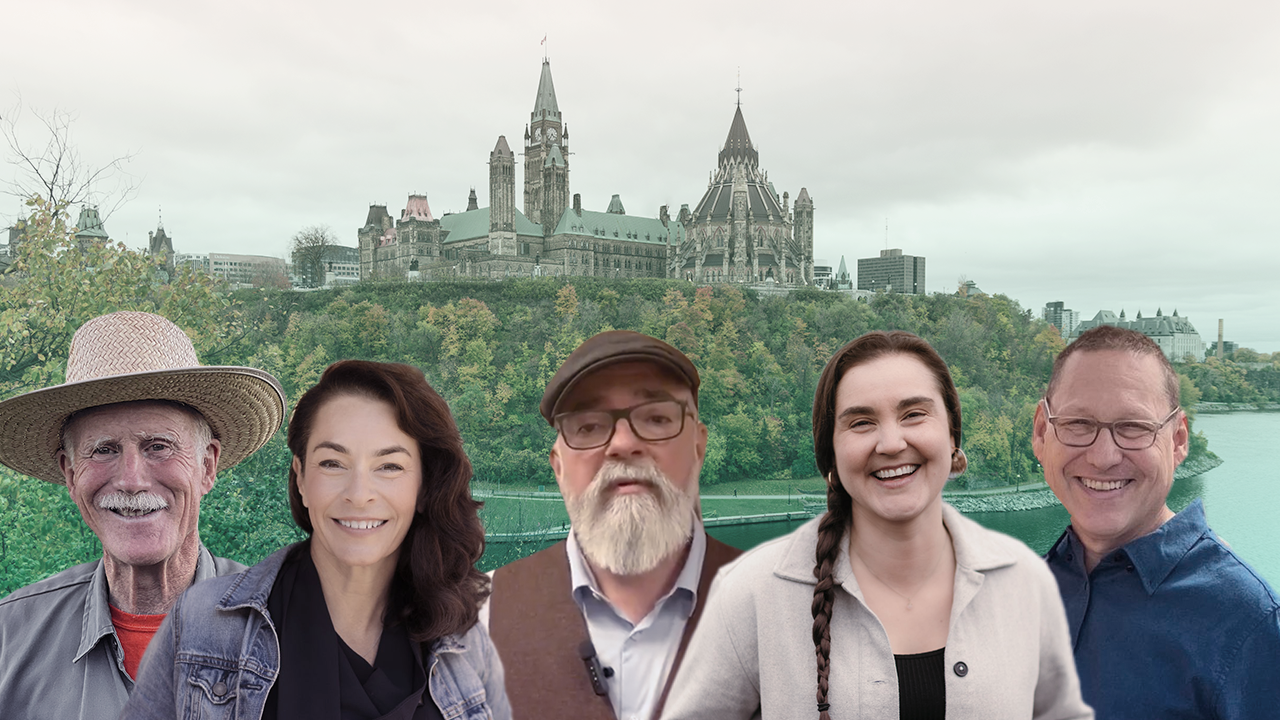
The race to choose a new leader for the federal New Democratic Party, the NDP, is now underway. Five candidates have been approved so far, and they’re making their pitches to members and to people that they hope to sign up during the March 2026 convention.
Today we’re going to talk about the candidates, about their visions for a party that lost a lot of ground in the last election, and about the campaign teams that they’ve assembled to contest the leadership.
And to do that I am joined today by Martin Lukacs, the managing editor of The Breach. Hey, Martin.
Martin Lukacs: Hey Desmond.
We’re just over a month into this race now and on this program we have talked a lot about the connection between politics—like capital P party politics—and our social movements in this country.
Martin, what do you think that this race means for left wing movements in Canada?
I think the question that has been foremost in my mind is this paradox that we have to deal with on the left, which is that the left—especially in English Canada—is organizationally very, very weak, and yet our ideas are extremely popular.
Across the board, people want the wealthy to pay more. They want a Green New Deal that transitions Canada off fossil fuels. They want to see our social programs strengthened, defunding the police, honoring treaties and doing right by Indigenous peoples.
Majorities or super majorities of Canadians support these kinds of policies and they are popular among a multiracial working class, among immigrants, Indigenous peoples, and young downwardly mobile graduates.
While we’ve had several really vital and vibrant movements emerge in this country in our generation, whether it’s Idle No More or Black Lives Matter or the student movement, they’re often a flash in the pan. The labour movement as well has been showing signs of increasing militancy, but it’s still mostly fighting defensive battles.
We have this potential social majority for these progressive ideas, but they need to be organized into a political majority, one that actually sees itself as connected, has a common adversary and can actually build the kind of collective power and strength that we need to win these transformations in society.
Part of the problem—besides the lack of unified strength among social movements—is that we don’t have a political vehicle to advance that project. And the question is, can the NDP be that vehicle? I’m not certain. But I think that experiment needs to be undertaken.
I think too many of us kind of have a moral approach to politics. They want the NDP to be a perfect reflection and expression of their politics. But the thing is, we don’t need to write Valentines to the NDP. The NDP is an institution. It’s a site of struggle through which we might be able to advance some of our causes and some of our politics.
We can’t just snap our fingers and manifest the perfect vehicle, especially electorally, but I do think we can fight to transform it, and a leadership race is a chance to do that. These chances really come around once in a decade, sometimes once in a generation.
Parties that are as top down as the NDP can only really, I think, be transformed from the top down and then opened up to social movements. I think we have a moment now where we could potentially turn the party into a lever of popular political mobilizations, a party that champions the causes of social movements and actually offers a more distinctly radical governmental perspective on change.
I think there’s a real urgency to the task because we have a rightward racing government in Mark Carney that will do nothing really, I think, to transform the daily economic crisis that people are living in this country.
If we can’t mount a left populist alternative via the NDP, I do think that the the forces that will benefit will be the right in Pierre Poilievere. And I think that will ensure a very dangerous and disastrous next few years for Canada.
You make an interesting point about people wanting a political party to be perfect, or at least ideal, before they decide that they’re going to get themselves involved. I’ve definitely seen that and experienced it a lot in my life too.
But I think the other factor is that people like being invited into something and welcomed into something. And I think the challenge for political engagement in this way is that people just don’t feel like they’re welcomed or invited to be parts of these big political institutions.
I’m talking about all political parties and a lot of our big institutions generally in Canada. The mentality that you’re talking about is a lot more about seizing an opportunity that is there within a political party rather than waiting to be invited in, and I think that’s counter intuitive to a lot of people. But, I take your point about how it’s never going to be perfect. We have to make it what we want it to be.
Certainly the NDP in the last few decades has been far from offering an invitation to the left and social movements—it’s been the opposite. It’s gone out of its way to alienate movements.
It’s been part of this long-term transformation of the party into one that’s focused on the personality of the leader, focused on trying to moderate its politics, chasing this shifting mirage of the political center.
What it has meant is that the NDP in its current state, both federally and provincially, is almost entirely cut off from the energy, the ambition, the politics of social movements—which to my mind are always the driving force of transformation in this country.
When we last talked about the NDP race in the summer and we were looking forward to the moment that we’re in now, the leadership of the party was deciding what the rules of this campaign were going to be.
There was quite a remarkable feat for the grassroots left wing of the party over the summer.
The party’s establishment had been very interested in having as short a race as possible with as high an entrance fee and potentially a voting system that stripped members of their “one-member-one-vote” democratic system.
I think the intention was to ensure that a more establishment-friendly candidate would be able to rely merely on the existing and diminished base of the party’s membership and that they would just be able to tie it up very quickly. Whereas the grassroots left of the party was interested in having a lower entrance fee and as long a race as possible to ensure that potentially insurgent candidates could make their case not just to the NDP’s existing membership, but to many of the members who have left the party in frustration or many people who are progressive-minded but have never felt a potential home in the NDP.
Remarkably, the federal council, which is the main governance body of the NDP, defied the wishes of the establishment.Usually they have acted as nothing more than a rubber stamp, but in this case the federal council got organized and they actually won a really important initial victory, which was to ensure that this race would actually extend over five to six months.
Instead of wrapping up around September, October, November, it’s going to be continuing until the end of March, which I think gives members and Canadians more broadly a chance to really take a close look and understand what the stakes are of this race and what the different distinct options are.
Now we want to talk about the candidates, but before we go further in this conversation, our audience should know, Martin, that you are not a neutral observer in this leadership race.
So before we talk about the candidates, why don’t you tell us about that?
Definitely. I’m not just an observer. I’m very much a participant in this case, and it’s important to put that on the table.
I’ve known Avi Lewis, one of the candidates, for more than a decade. We’ve worked together on documentary films like This Changes Everything and The Leap Manifesto. I’ve become one of his political advisers, and I am excited about him running.
As for how that impacts the work we do at The Breach, I think we have always practiced a more honest journalism than you get in the establishment media where we’re transparent about our unapologetically left-wing views and values and, in this case, our commitments.
We still try to be rigorous in our reporting and our evidence-gathering and fair in our arguments and judgments, but we wear our politics on our sleeve—and I’m doing that in this case. Then we let people judge our journalism as they will.
The Breach will remain a home for critical viewpoints of the NDP. People should not assume that my position is shared by all people at The Breach.
I want to add that our team shares a general political orientation—a left progressive political orientation that is reflected in the work we bring people every day. But as individuals, we all bring different opinions to this work.
Despite your personal support for Avi, I want to reassure our audience that that isn’t going to change. I’ve personally not gotten involved with any candidate in this contest, and I’m hoping that the way I can contribute is by giving the best reporting and analysis on this race as I can, as we always try to do here at The Breach.
So with that, let’s talk about the five officially registered candidates in this race. I’m going to give people a brief bio of each of them in alphabetical order.
We begin with Rob Ashton. He’s the president of the International Longshore and Warehouse Union of Canada. Those are dockworkers. He’s got over 30 years of experience in union movements.
Rob Ashton’s pitch is basically that working people are being taken advantage of by the ultra rich and that the NDP needs a plain-spoken leader like himself who is in touch with the lives and needs of working people.
Next we have Tanille Johnston. She is a city counselor in Campbell River, B.C., a social worker, and the director of a provincial First Nations health authority. Johnston also happens to be the first woman from a First Nation to run for the federal NDP leadership. She’s a member of the WeWaiKai First Nation. Her campaign is focused on those who feel left out of the NDP.
Martin, you were mentioning before people who might be in some ways aligned with the NDP but don’t feel involved. That’s what Johnston is focusing on in her campaign. She’s talking about First Nations, Metis, and Inuit people, disabled people, members of the 2SLGBTQIA+ communities, veterans, and seniors. I think her campaign is sending a clear message of inclusion for people who should feel connected to the NDP, but maybe don’t.
Next we have Avi Lewis, who is a journalist, an activist, and university professor. He is the son of former Ontario NDP leader Steven Lewis. He’s also the grandson of former federal NDP leader Leader David Lewis.
Avi Lewis’s message in this race is a decidedly populist one. It’s basically that the economy is working well for the corporate class and against the interests of working people, and he would like to change that.
Next, we have Heather McPherson. Heather McPherson is a New Democrat member of Parliament for Edmonton Strathcona. She’s been in that role since 2019, and she’s also the former executive director of an international development agency.
If people know of Heather McPherson already, it’s probably because she was a loud voice within the NDP advocating for Palestinian solidarity and an end to the siege on Gaza by Israel.
Her main message in her campaign seems to be that the NDP needs to be a bigger, broader tent and that its current messaging is sometimes alienating for ordinary Canadians. She’s presenting herself as a kind of uniting figure to expand the reach of the NDP.
Finally, we have Tony McQuail. Tony McQuail is a farmer and environmentalist, former Board of Education trustee in Huron County in Ontario, and he’s also the former staffer to an Ontario NDP minister during Bob Rae’s government in the 1990s.
McQuail says he wants a merger between the federal NDP and the federal Green Party, and he’s also trying to reach out to potential voters who feel disillusioned with politics. He’s featuring environmental stewardship quite heavily in his campaign.
Those are the five candidates who have registered thus far. There’s still time for candidates to register, we will see if any more do.
Out of those five, the three that have the biggest profile and seemingly the biggest machine behind them right now are certainly Heather McPherson, Rob Ashton, and Avi Lewis.
Martin, you’ve been obviously paying attention here. What would you say the campaigns of those three are offering in terms of policy and general vibes to the community?
I think Rob has brought a very refreshing table-thumping class war spirit, which we desperately need in our politics in this country. He’s been crystal clear about how, whether it’s Liberals or Tories, it’s the same old story. They take turns screwing people over and serving their corporate masters. That has excited a lot of people.
I do think he has, at the same time, avoided any clear articulation of policy positions, going so far as to avoid questions around more contentious issues like pipelines. He has said those policies are issues that he will defer to the caucus on.
Next we have Heather McPherson, the MP from Edmonton Strathcona, who is perceived—I think fairly—by many to be the frontrunner in this race.
She has the most political experience in terms of capital P, as I like to call it, politics.
She’s been an MP for three terms now, and, as I mentioned before, a loud voice advocating against the Israeli siege on Gaza.
It’s clear that her argument shapes up to be: “I’m ready to do this job right now. I have the experience. I’ve been doing the work.”
In a party that has been reduced down to almost a handful of actual caucus members, Heather McPherson is saying: “I survived. I’m ready to help rebuild this party, and I know what it takes because I’m still here after a really devastating election in the spring.”
I think Heather has been an incredibly principled and outspoken voice on Palestine, and I think she has played an important role in shifting the NDP from its previously quite tepid support for Palestinian liberation.
Besides that, she has often been true to her Alberta NDP roots, and the Alberta NDP is a far more centrist political formation than even the federal NDP. When Heather was first elected in 2019 and the battle over the Trans Mountain pipeline expansion was underway, she was the only caucus member supportive of it. Even more than that, she initially floated the idea of serving in the Liberal cabinet.
That’s an indication of the political and ideological overlap that exists between Alberta NDPs and federal Liberals.
My sense is that, much like Rob Ashton, her initial campaign launch has been really focused on the vibes rather than the policies.
I think it’s fair to say, Martin, for all of these candidates that it’s very early on in the game. We’re hoping to hear more concrete proposals from all of them, and asking them more about specifically what they want to do.
Let’s move on to Avi Lewis, who’s campaign you know very well. He launched in Toronto recently, and he was a little more explicit about some of the specific kinds of proposals and directions he has for the party. Let’s start there.
What we’ve heard from Avi has been a more clear-cut diagnosis of the problems we face in Canada.
There are a lot of overlaps, I think, between him and Rob in terms of naming very clearly the corporate culprits that have rigged the economy in the interests of the rich and powerful.
I do think both of those approaches will do far more to undercut the appeal of a Pierre Poilievre fake worker-friendly charade that he had ridden so successfully to very high poll numbers, up until Donald Trump threw a major curveball at Canada.
I think what sets Avi apart is that he’s also already rolling out bold policy options that connect with where a lot of people are. One thing that really distinguishes him is that there is a clear articulation that the transformational changes that we need will only happen through mass mobilizing and organizing.
Now, I would say that the challenge for Lewis in trying to win over support is that people want you to walk the talk. He has lost two consecutive attempts at becoming a New Democrat member of Parliament, and in the last election this spring, he came third behind a Liberal and a Conservative.
I think the obvious question a lot of people are going to have when you talk about organizing and bringing people in is, “Can you really do this, Lewis, when you’ve tried to do it locally in British Columbia and Vancouver Center and you haven’t been able to get there twice?”
That’s a legitimate concern and criticism, and I do think it takes on a different light when you realize that the two ridings that he ran in were extremely hostile territory for the NDP.
They’ve never in their history been won by the NDP.
Jack Layton had also lost twice in his attempts to run federally before he became leader, so when he ran for leader, he didn’t have a seat. In fact, he didn’t even have any support within the NDP caucus apart from Libby Davies and Stan Robinson.
A lot of the criticisms that are being levied at Avi are the same ones we heard about Jack. “Can Jack actually win?” Then of course, Jack became an incredibly popular leader.
Jagmeet Singh also didn’t have a seat when he first became the leader of the New Democrats.
That’s true.
And there’s our current prime minister, Mark Carney, who of course never had a seat and just came in on the manufactured media narrative about him being our saviour, and look how that’s gone so far.
Pierre Poilievre famously lost his seat in Ottawa and had to seek the safest Conservative seat in probably the country, in Alberta, to get back into the House of Commons. This is an ongoing theme across politics.
This maybe leads us well into what the kind of strategy and orientations toward movements are for each of these candidates. What’s their pitch to party members and to people who are on the outskirts of the party, but who might be watching this?
Rob Ashton is very clearly saying, “I’m the labour movement guy. I’m the person who understands social movements in this country. I’m the most connected to them.”
If Rob can really validate the rank-and-file labour tendencies in the labour movement—the more grassroots, militant-driven ones—I think that would be incredibly important for the NDP in reanimating it as a more progressive force in Canadian politics.
I think it will be key to see who exactly in the labour movement is supporting Rob.
Right now, Avi Lewis, by contrast, I think is making a more decided pitch outside of the traditional membership of the party on the left, saying that the party needs to grow.
We’re hearing that from several candidates who are saying, “There are people who probably should have been part of the party who are not right now.”
Avi Lewis is definitely trying to go after those people, to go after people in movements and to say, “This is the party for you.” It’s an attempt to reposition the NDP as part of a common front of social movements in this country in response to Mark Carney’s shock doctrine attacks on everything from Indigenous peoples’ rights to our climate commitments to the obscene amounts of military spending he’s pledging.
We’ve started to see, I think, that this is a new era of social movements trying to interconnect and knit together their struggles. I think if this conception of the NDP as a partner to social movements can move beyond just theory into actual practice, it would be a tremendous contribution to the interests of the broader left in this country.
Then we have Heather McPherson, who is, I think, making the most clear pitch to the existing membership of the NDP, such as it is across the country. She has a line she’s mentioned often that the NDP has been doing too much purity testing, which keeps people who need to be in the party out of it, and that the way to keep the tent it already has and to expand it is to welcome in the different stripes and shades of the NDP that already exist.
It’s clear that Heather’s campaign thinks their path to victory will depend on that existing membership.
I think potentially also the more Liberal-leaning membership that Naheed Nenshi, the current leader of the Alberta NDP, signed up in his own leadership race.
I do think that we’ve heard a lot about purity tests. I do think it’s worth dissecting that term because it is a term that really was innovated by the corporate Democratic establishment in the U.S. and elite liberal media there.
The history of its use has been very clear. It’s been used to chastise and attack the left and pressure people into supporting more centrist or even right-wing politics.
Barack Obama was one of the first to use that term in his own attacks on a multiracial, anti-racist Left, which he called an “obsessive” ideological fanaticism that was going to set up the Democratic Party for failure.
We saw it with Hillary Clinton. When Bernie Sanders suggested that politicians shouldn’t take corporate donations, she accused him of establishing a purity test, saying that under his definition, Obama is not a progressive because he took donations from Wall Street.
The amount of corporate money that was flowing into Obama’s campaign was a very good indication of just exactly where his allegiances would lie.
I personally got a taste of this as well. I was on Front Burner on CBC debating Cheryl Oates a few weeks ago. Cheryl Oates is a former communications director for Rachel Notley’s NDP government, and she’s a supporter of Heather.
When I was talking about how the corporate elite need to fork over some of their obscene profits to ensure that working people can have a dignified life in this country, she suggested that was a purity test.
Basically like, “Whoa, you need to have more empathy for corporations. They’re part of our coalition too.”
I do think this notion of purity tests is a dog whistle. It’s a bad faith framing that attempts to paint a portrait of credible centrists as opposed to inward-looking leftists who are demanding ideological purity.
Ultimately, it’s an attempt to defend more status quo politics. People like Leah Gazan have come out already, criticizing this notion.
That’s Leah Gazan, the MP for Winnipeg Center, one of the other remaining handful of NDP members of Parliament who survived this big purge of the last election, who you just mentioned.
Before we end this episode, Martin, there is another person who is not yet officially a candidate for the NDP leadership. We’re waiting to see if they will ever become an official candidate. But they have been making a lot of noise, especially online, with a very strange pseudo-campaign, I’m going to call it, and that is Yves Engler.
Yves Engler is a Montrealer. He is the author of many, many books. He’s been an activist for many years, and he’s also a journalist who’s made himself well known in online circles by going to places where members of Parliament and other important public officials are and holding a microphone up to their faces and challenging them about things.
In particular, if you’ve been online following the Palestine movement in Canada for the last two years, you’ve probably seen videos of Yves Engler going up to Liberal MPs in particular and asking them why they support the genocide of Palestinians by Israel. He is extremely well-known for that kind of work.
He announced a couple months ago, really before anyone who’s in the race now, that he was interested in seeking the NDP leadership. Certainly, he has frequently represented himself as kind of already part of the race and as somebody who is actively contesting to become the leader of the federal NDP.
There’s just one problem, though, which is that he has not submitted his nomination.
This has been a big controversy because Yves Engler has been suggesting the party actually hasn’t accepted his nomination yet.
The CEO of this leadership contest, Éric Hébert-Daly, has come out recently to the media and clarified exactly what Yves Engler’s status is within the race: “It has recently come to my attention that Mr. Yves Engler has been sharing with the media that he has not yet been approved to stand as an official leadership candidate. I would like to clarify that we are not in receipt of an application from Mr. Engler, and as such, he has no current standing within the leadership contest.”
Hébert-Daly also said in a piece from Mark Ramsey in the Toronto Star: “They have told people who are interested in running, don’t start talking about anything related to your candidacy until it’s actually been approved, and also don’t start fundraising because if you fundraise before we’ve approved you as a candidate, you could be in contravention of the election rules.”
Yves Engler has blown past all of this, Martin, and he’s been defending himself recently online in what I’m going to say is a kind of unconvincing way.
I think it is fair to say that he has misled a lot of the people who are excited about his prospective campaign and that now he’s being forced to do damage control.
It’s been interesting to watch his “campaign” unfold. The way leadership rules are set up, and as a political party, the NDP gets to make these rules on their own. If you want to be a leadership candidate, you have to abide by them, as all other leadership candidates do.
One of the rules is that you have to fundraise through party forms, and those party forms are regulated by Elections Canada. We have regulations in this country for a very good reason when it comes to party financing. Unlike in the States, where there are mountains of corporate money that flows into political parties, that’s not possible in this country.
What Yves did was to start fundraising for his campaign before he was approved as a candidate. What that meant is it gave him a several weeks head start on raising money as he claimed he was a candidate, and those donations happened in an unregulated way.
They were accepting donations through e-transfer—in other words, in a way that contravened the rules.
All other candidates had to wait until they were approved. So he got a two-month headstart and was able to start campaigning in a coordinated way, whereas other candidates weren’t able to do that.
The thing is, too, that there’s no way for Elections Canada to adjudicate the legality of those donations. I’m not going to speculate about where those donations came from. I don’t doubt that they were probably from lots of well-meaning supporters. But unless Elections Canada is overseeing those donations, you can’t know for sure.
I think Yves also clearly misled people about whether in fact he was a candidate. He had this exchange with a reporter with The National Post that the reporter shared publicly.
He thinks it’s probably the exchange that triggered that announcement from the CEO of the campaign.
Yves was asked by this National Post reporter: “Have you received word that you know your approval for a candidacy is forthcoming and your name will appear on the leadership ballot?”
Yves answered: “We haven’t received official approval yet,” which makes it sound like he actually submitted his approval.
Here’s the thing: Engler’s response has been to say that this has been a concerted strategy on their part, and I think it’s worth assessing what that strategy is and its merits.
I think it’s clear that he did mislead people. He hasn’t actually submitted his candidacy and so he couldn’t therefore be approved. But he was saying that they are delaying their application form because they’re worried the party will not vet them.
That is a concern for any left-wing candidate with the history that the party has, especially under Mulcair, but even to some extent under Jagmeet Singh, where they did not approve for candidacy candidates that have been really outspoken on Palestine. It is a legitimate concern.
That being said, if that was the case, then you shouldn’t simultaneously be fundraising and misleading people into thinking you’re a candidate, taking their money with the knowledge that if you were to become a candidate, all those people would have to have their money returned and they would have to properly and legally re-donate that money through Elections Canada portals.
Let’s say hypothetically he puts his papers in for approval in January as he says he’s going to do, and then gets approved. Is he going to return the $85,000 to people?
No, he’s probably already spent it because he’s been traveling around the country claiming to be a candidate for the NDP, complaining about how he has not been allowed into the forums that the party and provincial parties have been hosting for candidates, making it seem like the party is excluding him. When, in fact, he hasn’t even put his candidacy in and had the chance to be excluded.
To my mind, it all has a whiff of grifting to it. If he has concerns about him not being vetted as a candidate, he needs to put forward his candidacy. Then, if he doesn’t get vetted, he can expose to the light of day, as he effectively does on many foreign policy issues, precisely why he has not been approved for candidacy.
My sense is that he is concerned that a number of political skeletons will be pulled out of the closet when the day comes that he actually submits his candidacy.
I just want to clarify for everybody that we’re recording this podcast on October 17. This news about Engler not having registered through the NDP came last week, so it’s possible that, during that interim period, he has submitted. As you said, Martin, he tells us he wants to submit in January.
It was very clear when he was interviewed by The National Post that basically, “I’m going to submit my candidacy when I’m good and ready,” which I think is just such an awful thing to say after you’ve really led people to believe that you’ve already done so.
But there’s a bigger point that I want to make here, too. I mentioned how much advocacy Yves Engler has been doing about the Palestine solidarity movement in this country.
Obviously that’s something that we at The Breach care about a lot, and he, I think, is to be commended in many ways for the visibility that he’s helped to bring to that issue.
At the same time, I see a lot of people—particularly young people—who have really become interested in the idea of an Yves Engler candidacy for that exact reason: because they care about Palestine, because maybe even their entry into politics in this country has been through advocacy for Palestine.
I think the real betrayal to me about what Yves Engler has done here is that it is a potentially disillusioning force for people who were like, “Maybe he’s going to bring that to the NDP. Maybe the NDP is going to become a bigger place for conversations about Palestinian statehood, about the end of the siege, etcetera.”
What risks happening now is that the people who invested in him personally to do that work are going to become disillusioned with the political process more generally if and when his prospective candidacy falls apart.
I will just say directly to those people—if any of you are in our audience here—that there is a lot more to that work than the one person you see in the street being very loud and drawing a lot of attention to the issue. I hope that if you were hoping that Yves Engler was going to be a vehicle for bringing that issue to the fore in this country, that you won’t just abandon the entire political process if his candidacy never materializes.
Because, Martin, to go back to where we started, people do have to take it upon themselves to get involved, to become engaged. We can’t necessarily wait for that invitation.
I would hate to think that people would give up on that because of, quite frankly, the antics that Yves Engler has been pulling, using the NDP’s brand name when it’s convenient for him to do so, and then disassociating himself and distancing himself when he’s held to account for the rules.
CORRECTION:
Desmond Cole described Tanille Johnston as the first Indigenous person to run for the leadership of the NDP. In fact, Romeo Saganash was the first Indigenous person to run for the leadership of the NDP in 2011.
Martin Lukacs said Yves Engler had ‘a two-months head start on raising money.’ In fact, his campaign says it only started fundraising on September 4, several weeks ahead of other candidates, though there is no way to prove their claim, since the donations are not being regulated by Elections Canada through an official NDP fundraising portal. Yves Engler did in fact have a two month head start on campaigning before other candidates, since he launched his campaign without having been vetted and approved by the NDP, as happened with all other official candidates.

“It’s about getting to the bottom of things. It’s about unveiling who has the power and what they’re doing with that power.”
Linda McQuaig, journalist and author
As a non-profit, free from powerful corporate interests, we invest in investigations and uncover the cover-ups. Sustain our journalism for transformation.
Social Movements | To start winning in Canada, here’s how the Left can organize the suburbs
History | The NDP’s untapped radical potential

Social Movements | Saving the NDP from party insiders

9 comments
Comments are closed.
I appreciate your discussion of the NDP candidates, in particular the candidacy of Yves Engler., which has not been given the coverage it warrants……especially the complex issue of his misleading his supporters about whether he has yet submitted his application to the NDP. I think his refusal to “submit to the official process” does discredit his integrity, though he may be doing so deliberately to increase his integrity.
Not sure how the Breach will be able to continue with coverage of the NDP leadership should Engler be accepted as a candidate. You’ve already called him a grifter and described his activities as antics or worse. Where do you go from here? Can anyone consider your coverage as even handed? Also curious that your coverage did not mention socialism or would that be purity testing?
Just to note that Tanille Johnston is not the first First Nations person to run for the leadership of the NDP – Romeo Saganash ran in the leadership race to replace Jack Layton, although he did withdraw shortly before the convention.
This article is what I would expect from CBC, CTV, or the National Post. The Breach has really showed a side of themselves that was unexpected. The Bias shines loudly and clearly. If you are going to write what you did about Yves Engler, it would have been proper to actually interview him, not rely on the National Post. Wait, am I on the National Post website?
“Journalism for transformation”, indeed. The Breach is more than meets the eye.
Please, either do journalism or be a political advisor, not both. I don’t care how you try to justify your position here. It stinks of another pseudo-alternative news site trying to be a gate keeping wannabe mainstream media outlet.
You can still sort this out if you really want to. I sure hope you do.
Who has ever made a donation to a leadership candidate through an ‘elections Canada portal’?! What are you talking about? Finishing your nice podcast with a sloppy smear is beneath journalism. I’ve been a part of the campaign and the NDP vetting is a problem and Yves campaign has been totally transparent to us and following all of election Canada’s rule. You need to correct this because you torqued Yves’ campaign into something it is not… and nobody is making me right this either.
Would it not have been appropriate to have at least mentioned that Yves Engler is the nominee of the NDP Socialist Caucus (https://ndpsocialists.ca)? Given his long record of publishing his ideas, perhaps a presentation and analysis of them would also have been appropriate in trying to ascertain “Who can revive the NDP and take it leftward?”.
And what, precisely, is the “NDP Socialist Caucus” beyond Barry and five of his lost followers from the Revolutionary Workers League days?
The Breach should be ashamed of this dirty slanderous hit-job on Yves Engler. You are lying about his donation campaign. He is the most principled and anti-war person even thinking about running for your leadership. If the NDP can’t develop and articulate an anti-war anti-intervention platform, ie STOP THE UKRAINE SLAUGHTER, STOP THE GAZA SLAUGHTER, you will never be relevant again.
The headline for this Martin Lukacs podcast should read: Smears, Vetting, and the Politics of Distraction.
It’s telling when an “independent” journalist—who moonlights as a campaigner for another candidate in the same NDP leadership race he’s supposedly analyzing—makes zero effort to engage with even a shred of substance. Instead, he opts for bizarre insinuations that are laughable if you know the man he’s smearing. I mean, really—painting an anti-capitalist, anti-Zionist campaign as some kind of financial heist? Are we supposed to believe that volunteers and donors (like me) are confused or worried about their contributions being misused? That’s not just absurd—it’s insulting. Comme moi, ce candidat humanitaire et authentique, doté de courage moral, parle effectivement français, et pourtant vous avez oublié qu’il s’agit d’une campagne nationale dans un pays officiellement bilingue ?
Yves Engler has spent decades building a principled record of activism, writing, and policy work. He’s actively collaborating on a bold platform that brings youth and disillusioned voters into a party that’s been hollowed out, with barely six people holding the fort. Maybe it’s time to stop guarding the gates and start opening them.
Engler has followed Elections Canada’s rules to the letter. The real issue is the NDP’s shifting internal rules—changing without notice, dodging accountability, and pivoting with the political winds. The grassroots momentum clearly rattled the party’s establishment, whose opaque vetting process is run by three insiders who themselves remain unvetted. Their role seems less about upholding standards and more about suppressing dissent. This isn’t journalism—it’s mudslinging masquerading as concern. Let’s call it what it is: a distraction from the real issues. “Blocking candidates from nomination races because they express different opinions is a fundamental threat to party democracy.”
— Yves Engler
As Noam Chomsky reminds us: “The smart way to keep people passive and obedient is to strictly limit the spectrum of acceptable opinion, but allow very lively debate within that spectrum.”
This smear campaign is a masterclass in that tactic—ignore the substance, amplify the noise, and hope no one notices the rot behind the curtain. Let’s bring the conversation back to what matters: policy, integrity, and the democratic right to challenge entrenched power.