On Friday evening a cab drops me, my sister, and my mother off at the Canadian Museum for Human Rights in Winnipeg. We are here for the opening of the exhibit Palestine Uprooted: Nakba Past and Present. This opening is the culmination of what Rana Abdullah, a local Palestinian human rights advocate whose family story is included in the exhibit, describes to me as “nearly two decades of persistence, dialogue, determination, pushback, disappointments, and obstacles.”
The source of some of those obstacles is represented outside the museum that evening. Hundreds of protestors have gathered by the entrances, many holding signs denying the Nakba, as elderly survivors, young families, and members of the Palestinian community and their supporters walk past.
For the past two years, every week, through minus 30 degrees Winnipeg winters, Palestinians gathered outside the Manitoba Legislative Building to protest the genocide in Gaza and to call for a ceasefire, as Canada’s major institutions averted their gaze. Now, for once, they are the ones welcomed inside.
The protest was called by the Centre for Israel and Jewish Affairs (CIJA) after months of attempts to have the exhibit canceled or delayed, with their efforts being joined by groups like B’nai Brith and an Israeli legal organization who threatened an injunction. There is a notable lack of the heavy police presence that is usually deployed against Palestinian protests, and so volunteers from Independent Jewish Voices are present, offering to escort attendees into the building. In another of the night’s ironies, CIJA has previously advocated for “bubble zone” laws restricting protests outside of religious and cultural institutions, as well as calling for the government to shut down Al-Quds day marches, citing the risk of spreading hateful messages and intimidation.
As calls to shut down the museum exhibit from pro-Israel groups, the Israeli ambassador, and a blitz of right-wing media have failed to have its intended effect, CIJA are now resorting to protesting the opening ceremonies.
Among the protestors, holding a sign that reads “Nothing About Us Without Us” is Gail Asper, daughter of Israel “Izzy” Asper, who initially conceived of and funded the museum as an institution to commemorate the Holocaust. That sign in many ways sums up a controversy manufactured by the national media. It insists that the story of Palestinians can only be told through the lens of Israel. It claims that Palestinians’ experiences are a threat to the Jewish community. And it positions Palestinians’ very existence as a matter to be decided, and decided alone, by Jewish people.
Despite all that, the joy in the room at the opening, intermingling with grief, is palpable. All the negative media, the opportunistic political statements, the condemnations have missed this. After nearly 80 years of having Palestinian stories silenced in Canada, this exhibit marks a breakthrough.
“It was a beautiful night,” Palestinian community organizer Ramsey Zeid told me in the aftermath. “It’s a big thing,” said Marlow Reimer, a Palestinian-Canadian attending with her daughter. “Growing up my parents told us not to tell anyone we were Palestinian because of the hatred and racism. So we grew up telling people we were Lebanese. It’s only been six or seven years that I’ve felt able to tell people that I am Palestinian. So it’s nice to be able to say that. And it’s pretty amazing that my daughter is here today, seeing it.”
***
Rana Abdullah
I felt a responsibility to tell my story of my parents and my grandparents. But there’s always intergenerational trauma. When your family is forced to leave, when their village and life transformed suddenly.
My mother tells me, “I found myself sleeping in a tent, and I look around me, who are those people? Why am I sleeping like this? How did this world around me vanish suddenly?”
As a child you bury those memories, but they never go away. You suppress them as children do, but they never go away. You never forget who you are and where you come from.
The stories become part of you. And they feel inherited, very personal, part of your identity, and that is what intergenerational trauma is for us Indigenous Palestinians. You hear this also with the Indigenous people here, the same thing. You learn through stories, through memories. Every generation that follows. Now, my grandchildren, they know the village they came from. Each one of them, they know.
And now their stories are finally acknowledged in a national museum.
***
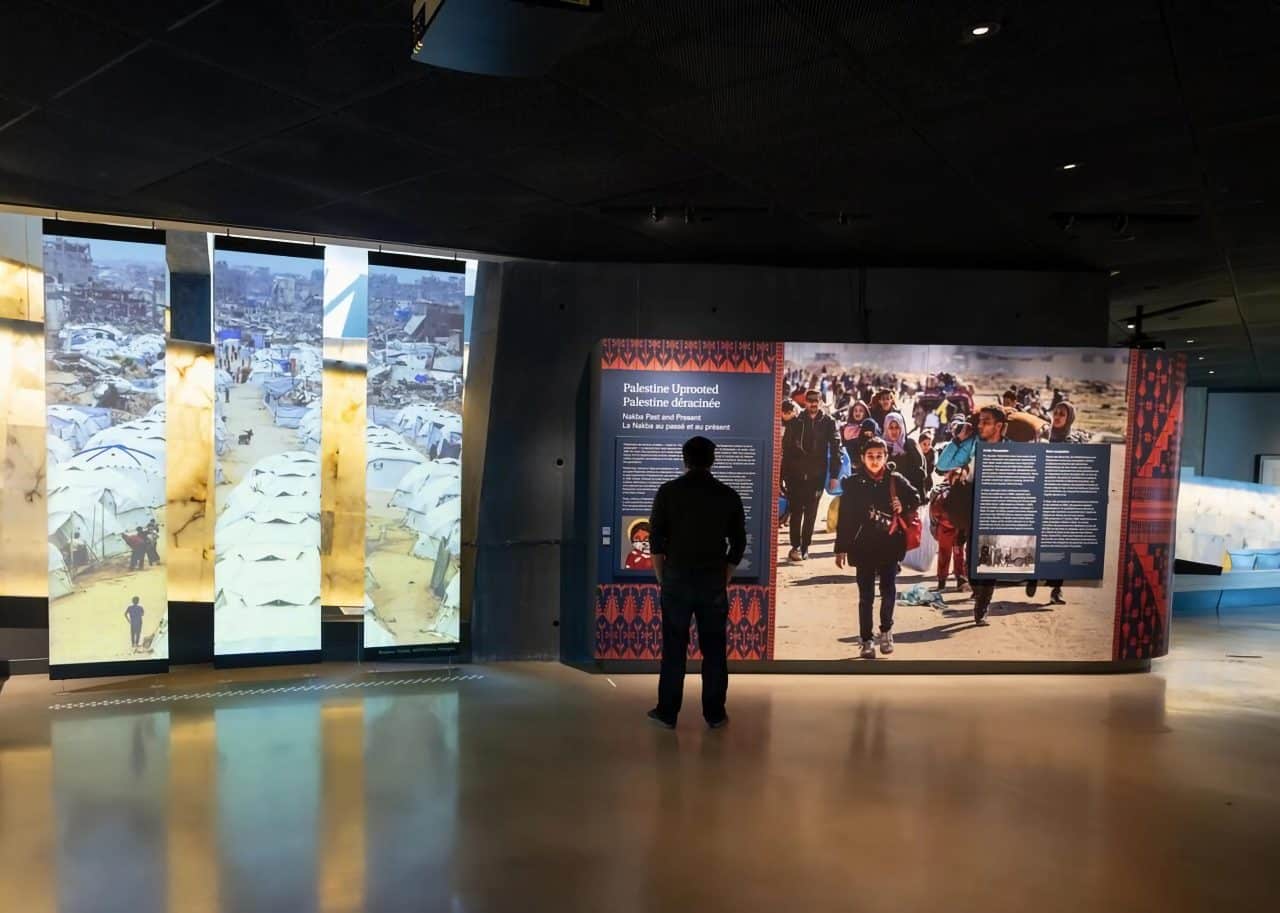
After weeks of hysterical articles, allegations of Palestinian foreign interference in the media and in parliament, the resignation of a Jewish trustee from the board of the museum, and claims that the exhibit would lead to “discrimination, bullying and even assault targeting Jewish students,” the size of the exhibit comes as a surprise.
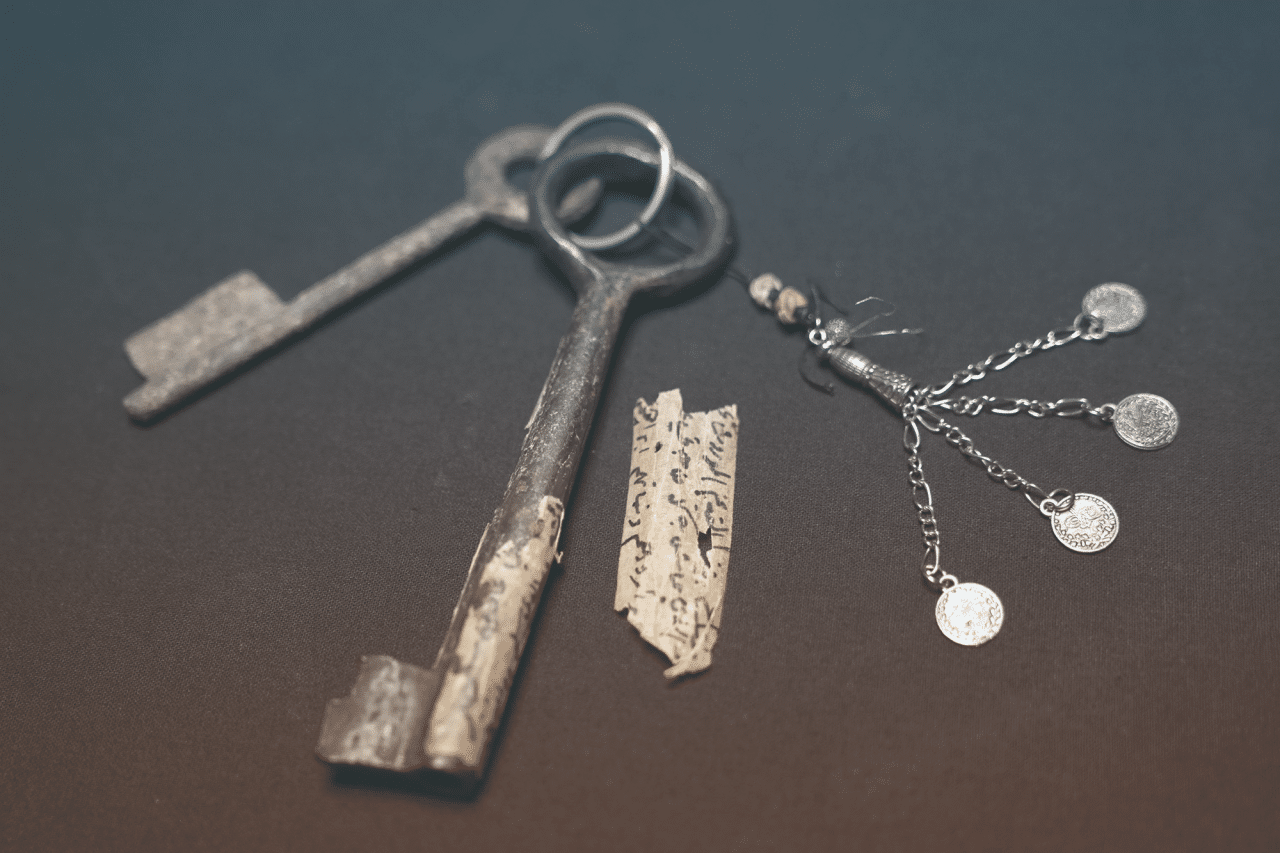
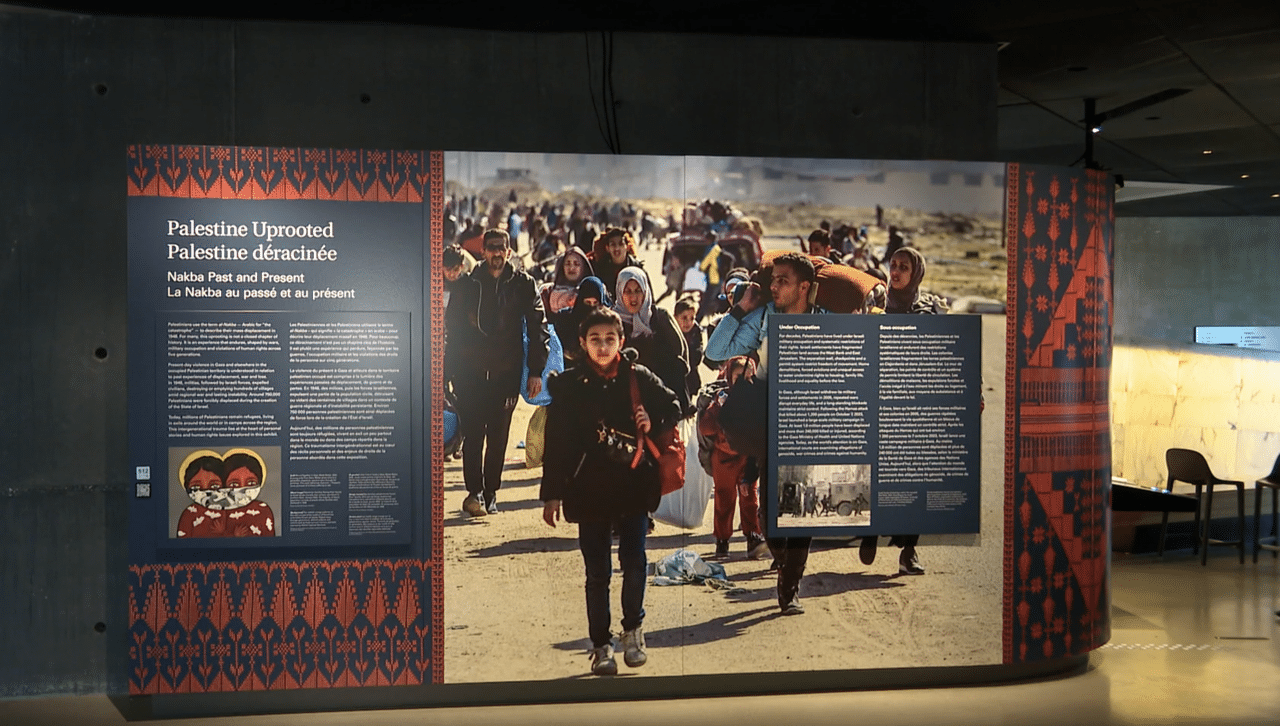
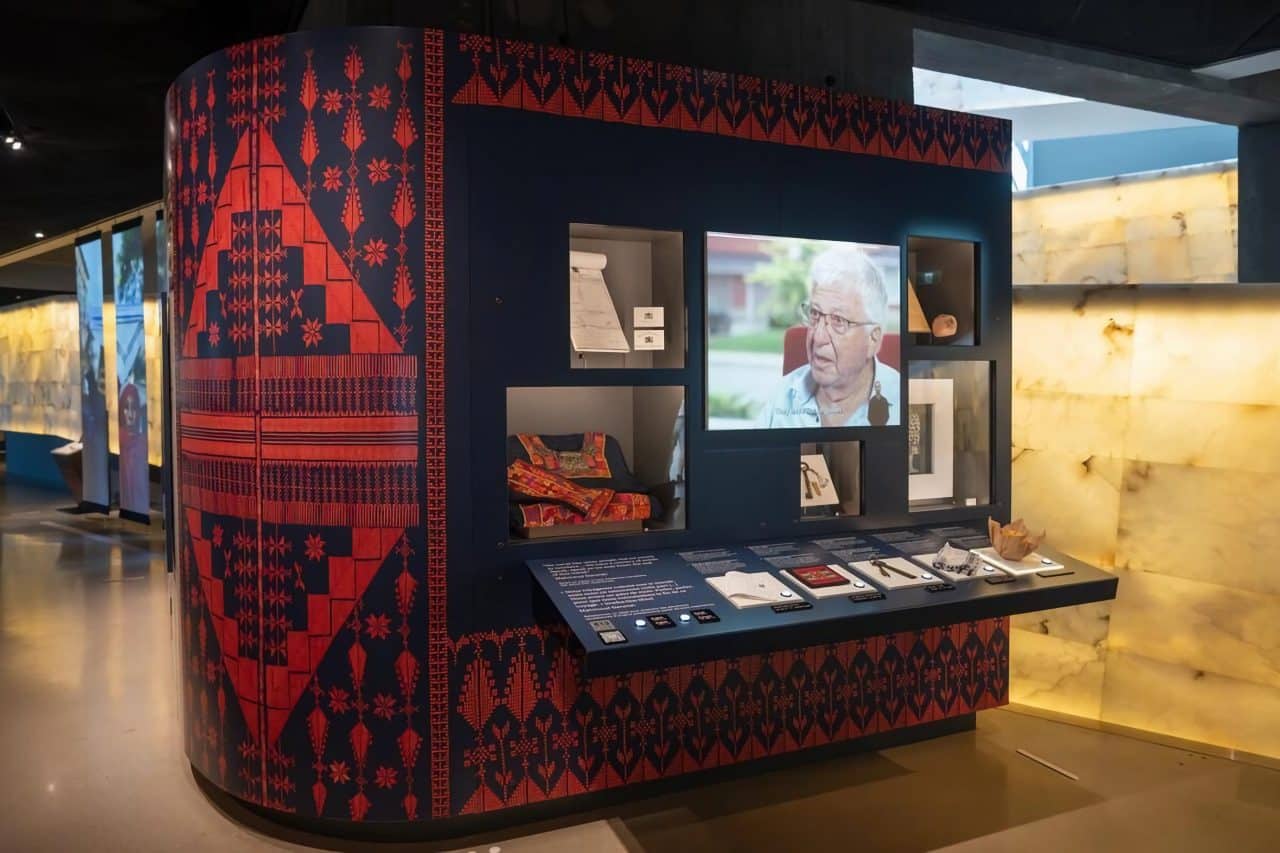
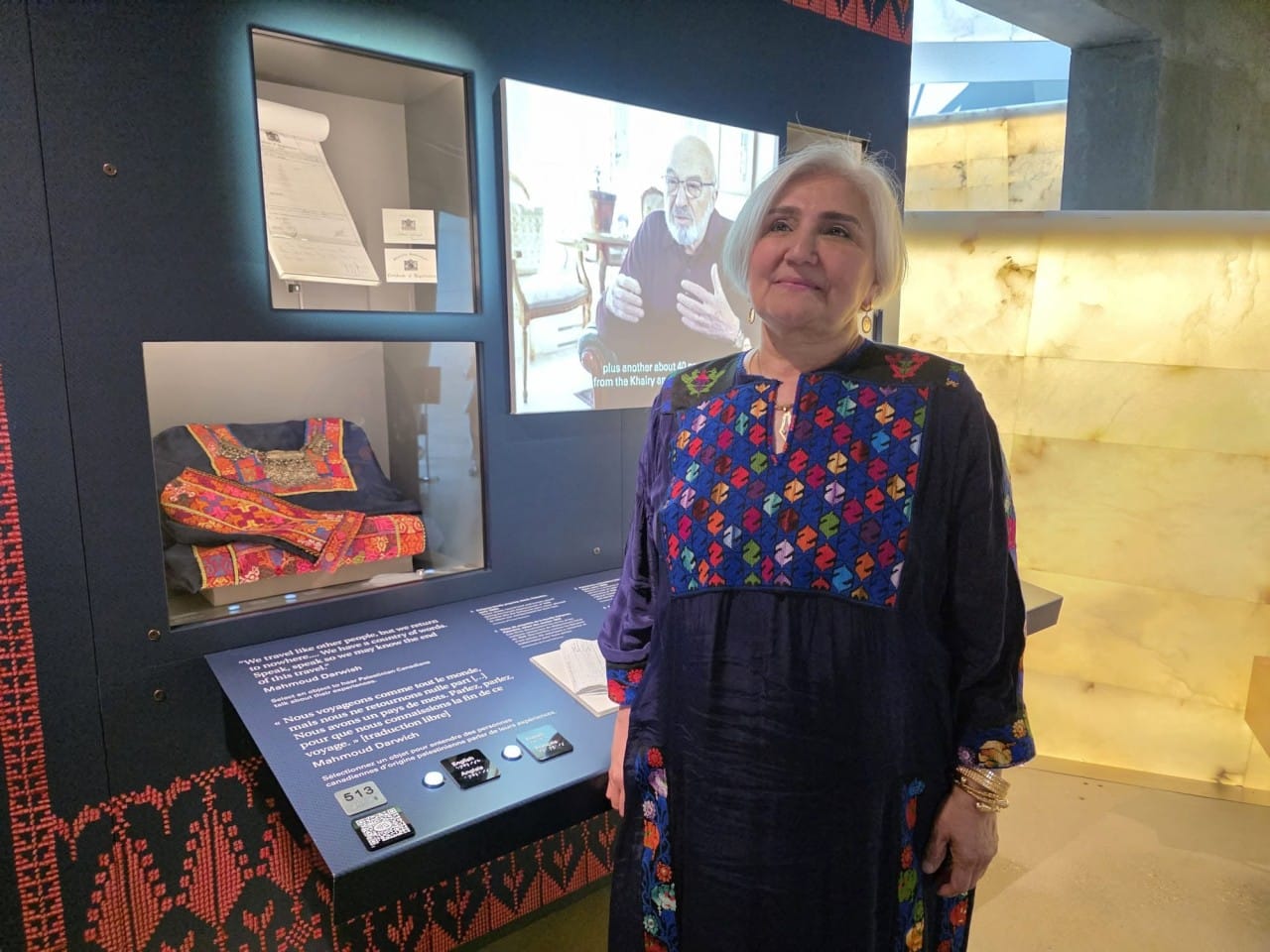
Taking up just twelve metres of an existing gallery, the exhibit consists of a couple of placards, artwork, and a screen surrounded by artifacts including an embroidered dress, a land deed, the keys to Rana Abullah’s family house, and a keffiyeh. All of it comprises approximately 250 words of historical context in one small corner in a vast 7 floor museum.
The language describing the Nakba is notably passive and restrained. Palestinians are “shaped by wars” in which the perpetrator is not named. One gets the impression that the wording has been carefully designed to avoid the word “Israel,” except when absolutely necessary. Palestinians “remain refugees” with no mention of the denial of their right to return. “Present-day violence” simply “occurs,” as if it emerges untethered from any culprit. Palestinians experience “intergenerational trauma” as if that trauma is not enhanced by the Canadian government exploiting loopholes to send weapons to Israel that kill Palestinians; by the accusation that to speak of the genocide of their relatives is hateful and antisemitic; as if the people outside the museum organized by CIJA and other Israel advocacy groups are not trying to perpetuate that silencing and erasure.
On Monday, Heritage Minister Marc Miller said the museum “should change how it portrays the current conflict between Israel and Palestinians.” Miller criticized in particular the language on Gaza, stating “There are some words in there that are regrettable. Not identifying Hamas as a terrorist organization is, I think, a failure. And not clearly stating that, for example, Hamas intended to kill Jews is, I think, an unfortunate error in curation and should be rectified.”
Miller has not called for similar language on terrorism to be applied to the mention of Jewish militias in the exhibit, nor has he demanded that documented atrocities such as the Deir Yassin massacre be included in the exhibit. He certainly is not insisting language be added to state that the IDF intentionally kills Palestinians, including civilians, journalists, children, women, aid workers, athletes, and medical staff.
Community organizer Bassam Hozaima questions this demand for the Palestinian story to be vetted by those who seek to silence and negate that very story. “The notion that Palestinians should not be able to tell their stories of displacement, suffering, and oppression without the approval of their oppressors is bizarre and a clear example of the racism and chauvinism that the Palestinian community is constantly being subjected to,” he observes.
To Hozaima, the exhibit “is just a tiny, tiny, capsule of something that’s been ongoing for nearly a hundred years. The Nakba has got so many layers to it. The exhibit just barely touches on the collective impact on the Palestinian people, the destruction of culture and history and the people’s generational ties to their land, to their cities, towns and villages.” How do we begin to reckon with the Nakba? Hozaima reflects, “The entire museum could be filled with stories.”
***
Bassem Hozaima
What do I remember from Gaza? My fondest memories are of the sea. We lived within walking distance to the sea,
Whenever we could we’d go to the shore and the beach and spend the day there. And the other memories that I have is we lived right next to an orange grove. A big orange grove.
My grandmother had this beautiful garden that she’d established when she was displaced there in 1948. There were rooms that were built around the courtyard, and in the middle of the courtyard she had a lime tree and then she had a garden just outside the courtyard where she had fig trees, banana trees, and she had a beehive. She loved to garden,
Then in 1967 the Israeli authorities took the village and moved us farther inland. They built these cinder block houses that they moved us into.
The experience of losing this beautiful house! And,you can imagine the kind of houses that people had in the original villages. Like, this is something that my grandmother had set up in maybe 10, 15 years. Imagine what they had where their families had been for hundreds of years.
***
The size of the exhibit is hard to miss.
“I know that there were a lot of people at the exhibit saying, it’s a lot smaller than I thought,” Ramsay Zeid, President of the Canadian Palestinian Association of Manitoba, tells me. “I mean, I would love to have a whole floor. I would love that,” he says. “But it’s not about the size of the exhibit, it’s what the exhibit represents.”
To Zeid, the significance of what he calls the “baby steps” of the exhibit is found in its location. “This is an exhibit in a federally recognized international museum,” he points out. “Our federal government doesn’t officially recognize the word Nakba. Now we have a federally-recognized museum that’s using the word Nakba, so now it’s on the record.” Zeid believes that it is precisely that possibility of broader recognition of the Nakba in Canada that has prompted the outsized reaction, relative to the display’s actual scope.
Beyond government policy, Zeid notes, “Thousands and thousands of schools take trips there to the museum. Little kids are going to see this exhibit, and they’re going to ask questions about it. Zionists have spent so much time and so much energy trying to erase the Nakba from people’s memories.. If you can have one person a day asking about it, they’ve lost.”
***
Ramsey Zeid
Before the Nakba, my family lived in the village of Beit Nabalah. In 1948, the family was expelled. Nine months pregnant, fleeing with young children and whatever she could carry in her arms, my grandmother went into labour and gave birth to a baby girl. Weak from the labour, already struggling to keep her other young children alive, she could not carry the baby. And so, she had to make a decision no mother should ever have to make.
She wrapped her baby in a blanket and left her under a bush, praying that someone else would find the baby and be able to care for her.
Further down the road, her sister asked her, “where is the baby?” My grandmother told her, “I couldn’t carry her.” But her sister said, “we have to go back.” And so they went back towards the soldiers, risking their lives. They found the baby and brought her back. They named her Rahela which means “to travel.”
Today, the land where our village once was is part of Israel’s Ben Gurion airport.
***
The Canadian Museum for Human Rights, located on Indigenous territory at a historical meeting place where the Assiniboine and Red Rivers join, opened in 2014. The Museum, which began as a private initiative by CanWest founder Israel Asper, was initially envisioned as an institution devoted to remembrance of the Holocaust.
In 2007, then Prime Minister Stephen Harper announced that the federal government would recognize it as a national museum. With the injection of federal funding, the museum adopted a mandate “to explore the subject of human rights, with special but not exclusive reference to Canada, in order to enhance the public’s understanding of human rights, to promote respect for others, and to encourage reflection and dialogue.”
The museum’s location in Winnipeg reveals many of the contradictions of human rights discourse and the ways it is wielded in the national Canadian narrative. Embodied in the Winnipeg General Strike of 1919, Winnipeg has a storied history of radical labour activism. In fact, the night before the opening of the Nakba exhibit, the United Jewish People’s Order (UJPO), a Jewish socialist organization, was holding their hundred-year-anniversary celebration at the Ukrainian Labour Temple in North End Winnipeg. UJPO, along with Independent Jewish Voices and the Jewish Faculty Network, released a statement in support and solidarity with the “historic moment” of the Nakba exhibit.
In tension with this radical strain of grassroots human rights activism, and perhaps specifically in response to it, Winnipeg has also developed human rights institutions that substituted “fairness” and “dialogue” for substantial criticism and action.
That a human rights posture was still, in 2007, considered a viable, however-cynical move for Stephen Harper’s Conservative government speaks to a stark shift in the way Canada now projects itself in the world, and the hypocrisy of Western nations in their willingness to abandon even their cosmetic investments in rights and law in service of abetting Israel’s genocide.
By 2026, only weeks before the Nakba exhibit opened, Prime Minister Mark Carney would call the war in Iran “worth it,” even though in February, following the U.S. bombing of a girls’ school in Iran, he had acknowledged that “it appears that these actions are inconsistent with international law.”
This was in many ways the perfect stage-setting for the controversy around the exhibit: a country that has abandoned even the pretence that violations of international law matter, that deems any atrocity “worth it” as long as it fits our geopolitical goals. In this world, two panels acknowledging the Nakba could cause infinitely more outrage, headlines, and claims of looming violence than a prime minister jettisoning international norms and justifying war crimes.
Such is the state of human rights under Canada’s current Liberal government.
***
From its beginning, the Canadian Museum for Human Rights was the site of what academics would call “contested space.”
As noted by Erica Lehrer, a professor of history at Concordia University, there are traces of injustice and inequality in the building itself. In order to build an aqueduct to supply Winnipeg’s urban residents with clean water, Shoal Lake No. 40 First Nation was cut off, leaving its community members to drink boiled or bottled water. The design of the $351 million museum would end up “featuring the theme of ‘healing waters’ to invoke Indigenous values,” Lehrer writes. “Nowhere in the museum, however, [was] there a reference to the dark side of these ‘healing’ waters—the life-threatening burden placed on the Shoal Lake No. 40 community so that clean water is at the fingertips of Winnipeg residents.”
Olena Hankivsky and Rita Kaur Dahmoon describe early battles over which human rights abuses the museum would commemorate. Eventually, the museum “propos[ed] one permanent gallery focusing exclusively on the Holocaust, and another entitled Breaking the Silence… includ[ing] the five genocides recognized by the Canadian Parliament.” Those genocides were the ones conducted by Serbian forces in Srebrenica, Bosnia and Herzegovina; the Holodomor; the Armenian Genocide; and the genocide in Rwanda.
Other groups, including Black Canadians, protested their exclusion and diminution in the space. Palestinian-Canadians also, from the beginning, found themselves completely absent.
It was a two decade struggle to change that. “In 2009, the museum just opened its doors, and they said, ‘okay, now time for consultation,’” Rana Abdullah said. “We believed that this is a museum dedicated to human rights, so it would naturally include the Palestinian story.”
She remembers her early motivation for advocating with the museum. “I thought they want to learn, they want to include us, and our story belongs here, belongs to all Canadians, and it’s the right place for us, it’s our responsibility,” she said. “It was a fond hope that people will hear our voices, and finally people understand what the Nakba is. Nowhere in the Western world was this being acknowledged.”
She took survivors of the Nakba to the museum, many of whom have since died, and gathered a substantial archive of memoirs, eyewitness testimony, photographs, and oral history. Often her daughter went with her.
But when the museum opened in 2014, Palestine was nowhere to be found.
According to Abdullah, museum staff at the time suggested potential content like “Israeli children playing football with Palestinian kids.” It was not until 2020, when Isha Khan was appointed as the CEO of the museum, that things changed and plans for an exhibit slowly developed. On the night of the opening, Khan would remind the audience that “rights matter most when they are most contested.”
Abdullah recounts the long journey to the opening. “I found myself defending our existence at some times. It was really, really challenging,” she said. “But my strategy throughout the time was, I persisted. My belief is that we have to tell our own stories, because we always have to prove our existence as Palestinians.”
“This exhibit doesn’t call for hatred, it doesn’t call for erasure of Jewish suffering, it does not deny the Holocaust, it just simply allows the Palestinians to tell their story. Why are we afraid of presenting Palestinian voices the way they are?”
***
Rana Abdullah
You grow up on memory, you inherit memory, you inherit grief, you inherit stories, people you never see. You grow up listening to stories about the orange groves, the olive groves, the stone houses, the olive harvest, the village life, what we do in weddings.
At the same time, you hear about all the horrors that happened in 1948 and in 1967, because my husband also had to flee Palestine in 1967. He went to Kuwait, then went to Algeria to study. So, this was my window on the colonization, the dispossession, and what it means to lose a homeland.
I’m an artist, so my art was developed around refuge. I’m in between two places, I’m always temporary. This is how, when I grew up, how it happened. But if 1948 didn’t happen, I would still be in Palestine. I would be raising my children in Palestine and my family. This is where I would likely be, but this is not accessible to me.
***
Along with a static installation, there is a piece of the exhibit that visitors are encouraged to actively engage with and take home. It is a poem by Palestinian poet Mahmoud Darwish. Titled “Think of Others,” it urges us to “become a candle in the dark.”
As you prepare your breakfast, think of others
(do not forget the pigeon’s food).
As you conduct your wars, think of others
(do not forget those who seek peace).
As you pay your water bill, think of others
(those who are nursed by clouds).
As you return home, to your home, think of others
(do not forget the people of the camps).
As you sleep and count the stars, think of others
(those who have nowhere to sleep).
As you liberate yourself in metaphor, think of others
(those who have lost the right to speak).
As you think of others far away, think of yourself
(say: “If only I were a candle in the dark”).
After this text, a blank box prompts visitors to reflect on the ways they can be more compassionate and empathetic. I wonder if Marc Miller picked this card up. I wonder what this politician, the same one who had a Palestinian mother arrested for protesting outside his office for her dead daughter in Gaza, would write in the blank space.
If he did, I think he missed the poem’s message: the rights of some are not diminished by acknowledging the rights of others.
This story could not have been written without the assistance of members of Independent Jewish Voices-Winnipeg. Thank you to Harold Shuster and Tami Gadir as well as the many Palestinians who generously shared their time and stories.
I often hear that I’m lucky to have a full-time job in journalism.
Critical, bold journalism that isn’t beholden to media monopolies should be the norm—not the exception.
By supporting The Breach, you’re supporting a more robust, progressive media. Join us today.
– Katia Lo Innes, Associate Producer, The Breach
Campus Activism | ‘Never learn to stay silent about injustice’
Palestine | CBC has whitewashed Israel’s crimes in Gaza. I saw it firsthand
Israeli Apartheid | Lobby group pushes Canada to conflate anti-Zionism with antisemitism
5 comments
Comments are closed.
Isn’t it an amazing feat of hypocrisy that Jews in the West cry victim continuously, screaming about the fear they live with. The same people who continue to support a genocide and 80 years of brutal occupation, murder, illegal imprisonment, apartheid, corruption, ethnic cleansing and the instilling of FEAR in the Palestinian population. How does it feel? REAP WHAT YOU SOW!!!
Congratulations! May this just be a beginning as more and more Canadians become aware of Palestinian existence, dispossession and today, genocide.
I love this informative article. I attended the exhibit on its opening day and having read about the protests, criticism, etc., was struck by its small size and focus on memories of Palestinian daily life. I appreciated that focus and the involvement of the Palestinian community. When I was there I saw young Palestinian women teaching exhibit goers how to do Palestinian embroidery. A threat to the Jewish community — I think not! Important stories for people to hear — I think so!
Thisn article with its quotes from some who lived through the Nakba, is beautifully done. I am thankful this exhibit was finally able to open.
This is a beautiful and important article about what sounds like a beautiful and important exhibit. Thank you!
Is there something missing in the last paragraph though? I’m struggling to figure out why Marc Miller reflecting on how to be more empathetic would mean he’s missed the point of Darwish’s poem. Wouldn’t it be the opposite? Or am I misunderstanding something?