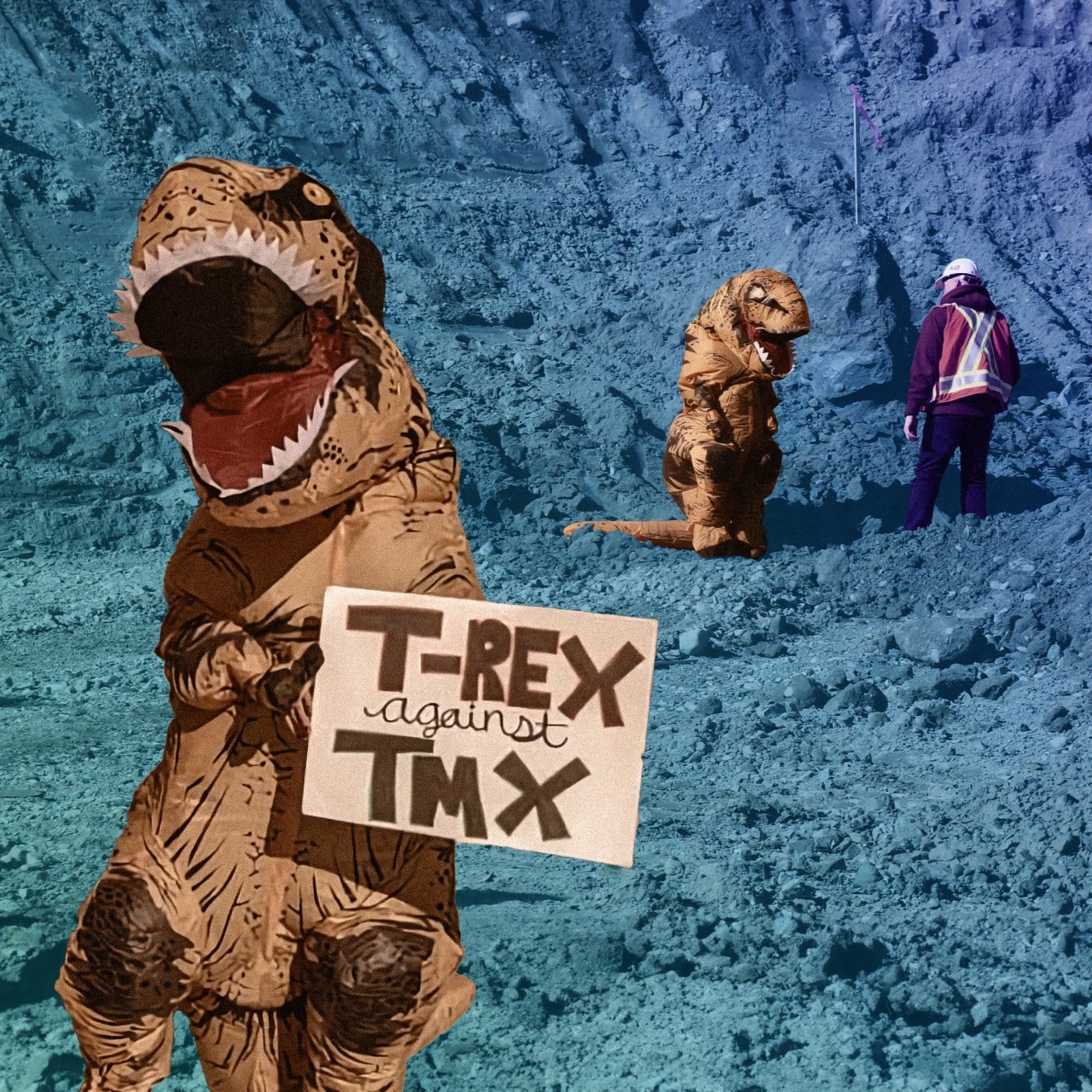
As I was being handcuffed and placed in the back of a police wagon last spring, my first thought was: I wonder if anyone else has ever been detained wearing an inflatable T-Rex costume.
About a half hour before, a friend and I had donned the dino suits and scaled a fence in Burnaby, B.C., at a worksite of the contested Trans Mountain pipeline expansion project (TMX). It proved difficult to hop the fence, not only because of the cumbersome suits, but also because we were carrying a badminton net, two rackets and a birdie (and the costumes, like women’s pants generally, had no pockets).
Our intention was to set up a friendly and peaceful game of badminton, which would happen to take place in a pipeline construction pit.
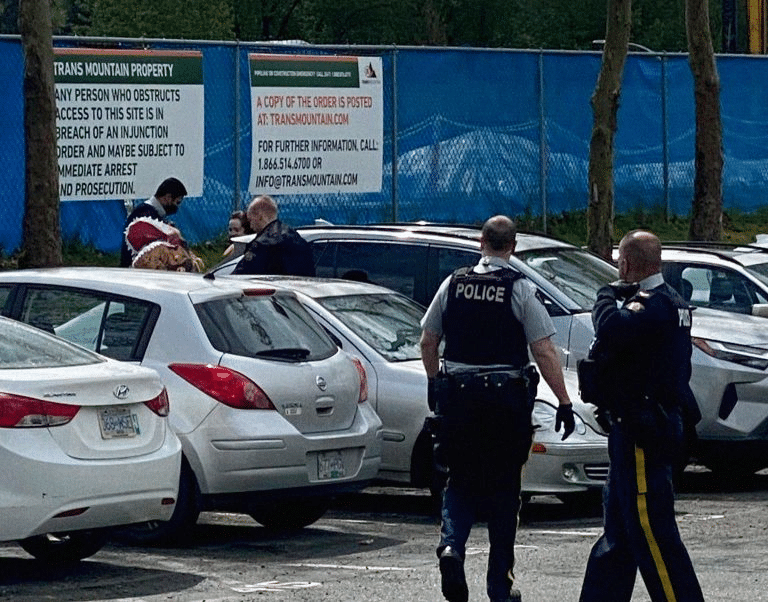
The site had been marked as an injunction zone, with signs warning that a breach was grounds for prosecution. After some time playing badminton, accompanied by supportive honks from cars passing by, TMX’s private security surrounded us. They waved the injunction in our faces, and told us that the police were on their way and any attempt to leave would be met with physical force.
When the RCMP arrived, our wrists, still covered by the short little dinosaur arms of our T-Rex outfits, were handcuffed, and we were placed in a police wagon fully costumed. We were charged with criminal mischief, though this would later be replaced with criminal contempt of court.
We are not the only ones who have been arrested—since protests first began in 2018, more than 250 people have been detained across British Columbia, according to Kris Hermes, a legal advisor with Protect the Planet who has been documenting the arrests.
It’s part of a growing movement of resistance to TMX, which if constructed would allow the government to export 890,000 barrels of tar sands oil to the coast every single day. The associated increase in carbon emissions would be like putting another 17.8 million cars on the road.
In B.C. and elsewhere across the country, people are increasingly willing to take direct action to prevent the ongoing expansion of fossil fuel infrastructure—as well as take the leadership of Indigenous peoples. As the movement grows, it’s demonstrating the power that Indigenous rights pose to endless resource extraction.
The protest hasn’t been diminished by the federal Liberal government’s decision to buy TMX from Texas-based oil company Kinder Morgan in 2018. But as resistance has grown, so too have attempts to deter it.
Shackled and handcuffed
When you receive a jail sentence, you don’t get the chance to say goodbye to your loved ones.
After receiving a 21-day sentence, I was immediately taken from the courtroom in handcuffs and ankle shackles to the Alouette Correctional Centre for Women (ACCW) in Maple Ridge. We traveled on a prisoner transport bus, with concrete benches and no seatbelts.
When I arrived, I was placed in solitary confinement for three days before being moved into the regular living unit 72 hours later. Those days in that desolate concrete room were the longest three days of my life—but at least it made the rest of my sentence easier by comparison.
Among the others who have been arrested in resistance to TMX, more than 200 have been convicted of criminal contempt of court, with more than 50 getting jail time. The sentences have ranged from four days to five months. A few have also been put under house arrest, and a large number have received a sentence of community service or fines up to $3,000 (my case was the first time that the sentence included both jail time and a fine—$1,240 payable directly to the Trans Mountain Corporation).
The cost of the publicly-owned pipeline’s construction has skyrocketed over the years, from an estimated $7.4 billion when Trudeau purchased it in 2018 to $30.9 billion—making TMX the most expensive industrial project in Canadian history. Even the Parliamentary Budget Office itself has stated that the project will never turn a profit, and the majority of Canadians are opposed to spending more money on TMX.
Yet our tax dollars are being siphoned into escalating construction costs, and more covertly, being wasted on incarcerating peaceful land defenders who are desperate to help our society transition off oil and gas.
Here in the Lower Mainland, a coalition of Indigenous and environmental groups has formed under the banner “Protect the Planet – Stop TMX,” who have been organizing to halt pipeline construction through the deployment of non-violent direct action since August 2020. The majority of those 250-plus arrestees have been members of this coalition.
Many of these arrests have been relatively high-profile, and Indigenous people are receiving the harshest sentences. Most recently, there was the “Secwépemc Eight,” a group of four Indigenous land defenders and four settler allies who received sentences between 28 to 32 days this past February as punishment for conducting a water ceremony to stop drilling under the Secwépemcetkwe (Thompson River) in unceded Secwépemcul’ecw.
One of these land defenders, Chief Sawses (Henry Sauls), is a Secwépemc Hereditary Chief and a survivor of the former Kamloops Indian Residential School. There was also Will George, a Tsleil-Waututh land and water defender who was sentenced to 28 days in May 2022 for conducting a ceremony on his own unceded homelands on Burnaby Mountain—even though TMX was on an official work stoppage at the time. And Dr. Tim Takaro is a public health expert and SFU Professor Emeritus who served 30 days in June 2022 for sitting in a tree along the Brunette River in Burnaby, as part of the “Brunette River Six.”
To my surprise, the action that had landed me in jail hadn’t gone unnoticed by inmates at the correctional centre. They had seen the story on the news and read about it in the papers that were delivered daily, and recognized me on my arrival. We shared laughs about how my action had landed me (a 24-year-old with no previous criminal record) in jail. The conversations transitioned from disbelief to thoughtful discussion about how governments handle social justice movements.
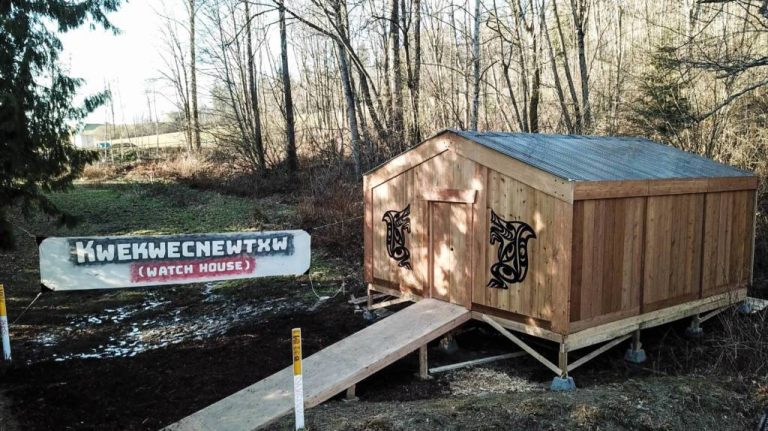
Constructed by members of the Coast Salish nation, the Watch House has traditionally been a space used to protect communities from external threats. Credit: Facebook/Kwekwecnewtxw – Coast Salish Watch House
A frontline of Indigenous resistance
The Watch House (Kwekwecnewtxw) on Burnaby Mountain east of Vancouver stands in a sheltered clearing surrounded by cedar and maple trees, just off one of the public walking trails behind Forest Grove Elementary School.
Beyond the wooden building, with its garden out front and solar panels on top, Trans Mountain’s signature blue metal fencing, injunction signs, and security cameras guard the tank farm site—which is being enlarged to accommodate the pipeline expansion. Gigantic cylindrical steel vats store bitumen here before it gets loaded onto shipping tankers at Westridge Marine Terminal, and white bird-shaped kites are tethered to each tank, coasting eerily with the wind to deter actual birds from entering this toxic industrial zone.
Anishinaabe Elder Jim Leyden (Stem-may-kochx-kanim) is the Watch House Elder—where his role is to keep the peace and watch for threats to the territory, of which the pipeline poses a massive one.
Since the Watch House was erected in 2018, he has seen hundreds of people come by, many of whom have then gone on to be arrested. When asked what it’s been like to watch so many people be arrested for protesting the pipeline, he laughed and said, “It’s great.”
“What we say to them every time one of us gets arrested is, we will not lay down,” Leyden said. “We will not surrender. Some people get mad at me for saying it, but understand that when you go to jail for telling the truth and standing up to industry like this, that’s a badge of honour.”
Unlike environmentalists, Indigenous peoples have constitutionally and internationally protected rights to resist unwanted resource development on their territories. Indigenous title is held in the collective by each sovereign Nation, which was confirmed by the Supreme Court of Canada in the 1997 Delgamuukw decision (and others since). And Indigenous resistance to these sorts of projects is robust, with Indigenous people often on the front lines of these fights—with the most to lose.
A 2021 report by the Indigenous Environmental Network concluded that Indigenous resistance to fossil fuel infrastructure projects in North America had diverted 587 billion tonnes of CO2 from the atmosphere. This is equivalent to 24 per cent of the annual greenhouse gas pollution of the United States and Canada combined.
As a Red River Métis woman, there were many reasons I was compelled to resist the pipeline’s construction. My environmental studies degree gave me a deep understanding of the threats we face with the continued expansion of fossil fuel infrastructure, and I am required by the history and culture of my people to fight for what is right—just as my ancestors did.
I have been taught by my Elders to always act with the next seven generations in mind. By allowing this pipeline to go through despite opposition from First Nations and despite the threats it poses to destroy our nonhuman relations and the lands and waters across B.C., we are not living by the value of wahkohtowin—our kinship to all our relations. We are certainly not thinking seven generations ahead.
In the case of TMX, a diverse Indigenous resistance has emerged to block a pipeline route that crosses and threatens to destroy many sacred sites and waters for First Nations in B.C. In 2017, the Treaty Alliance against Tar Sands Expansion was signed by 122 First Nations banning TMX specifically and other pipeline projects like it. The Secwépemc Tiny House Warriors are a group of Indigenous women near Blue River who are constructing tiny homes in the path of the pipeline expansion. The Tsleil-Waututh Nation took the government to court three times over the failure to adequately consult them about the impacts to their territory surrounding the Burrard Inlet.
While it is true that many band councils and Indigenous groups (including my own, Métis Nation of BC) have signed Mutual Benefit Agreements (MBAs) with the Trans Mountain Corporation, these entities signing these agreements are not the rightful title-holders. MBAs are not the same as Free, Prior, and Informed Consent under the UN Declaration on the Rights of Indigenous People (UNDRIP). Band councils’ jurisdiction is limited to the 0.2 per cent of surface area of the province comprising reserve territories, and in the case of MNBC, they have no title rights along the pipeline corridor in B.C. at all, as it runs wholly outside of our traditional national homelands.
The United Nations Committee on the Elimination of Racial Discrimination has even issued Canada four warning letters over the past few years to cease construction of the TMX pipeline until Free, Prior, and Informed Consent has been obtained by the rightful collective title-holders along the route, and to immediately withdraw all policing or private security forces defending the pipeline construction.
The Canadian government—which loves to paint itself as a harbinger of human rights on the international stage—has ignored these warnings.
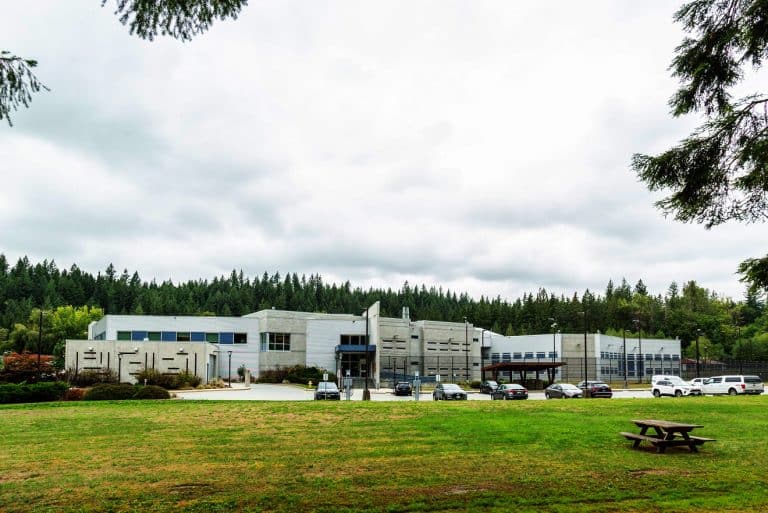
B.C.’s Alouette Correctional Centre is the only all-female centre of the province’s 10 provincial correctional facilities. Credit: BC Mental Health and Substance Use Services
Fires to focus our minds
Once I was moved to the regular living unit at the correctional centre, the days went by much faster.
Each cell had a TV inside, mounted to the wall and encased in a security box. I would wake up and catch up on the news, which I remember being saturated by stories about the “Chinese spy balloon” that was eventually shot down off the coast of South Carolina. The drama of this supposedly existential national security threat seemed like a major distraction, considering how little airtime is given to the ecological crisis that had landed me in jail.
A friend had told me about the “T-Rex Against TMX” a few months before—a group who was dressing up in inflatable dinosaur costumes, attending protests and solidarity rallies against the pipeline in addition to occasionally blocking access to work sites. The T-Rex would appear with signs bearing slogans like “keep me in the ground” and “leave my bones alone,” a reference to how bitumen from the Alberta tar sands—and all other fossil fuels—are literally fossilized dinosaur remains. The dinos would reference the fact that they had experienced a mass extinction before and it sucked, and they wanted to help humans avoid the same fate they had encountered 65 million years prior.
It was winter when I served my sentence, so there weren’t wildfires consuming the country. Fast forward a couple months to August 2023, and some of the most dangerous wildfires the continent has ever seen are tearing across Canada, burning 13.4 million hectares and making this the worst wildfire season ever since we began keeping records—and we haven’t even hit the end of the season yet.
In 2021, B.C. was ravaged by wildfires that burned down the entire community of Lytton, a heat dome that killed over 600 people, and flooding that threatened livelihoods, all as a consequence of rising global temperatures. The difference between a 1.5 degree warmer world and the current trajectory of four degrees warming by the end of the century amounts to preventable catastrophe for future generations.
Jim Leyden told me he often thinks about this devastation directly related to the burning of bitumen and other substances like it.
“People like to come in and listen to the politicians and vote for them, and then not have to think about politics for another four years,” he said. “Well, that luxury is gone. That luxury was burnt down with the fires. Washed away with the floods. We have to stand up and say, it is really simple. You can’t fight global warming with dirty oil.”
I agree with Jim: people will need to force the government to take the climate crisis seriously to keep people from dying and to offer young people like myself any chance at a safe and secure future that isn’t marred by constant catastrophe, suffering, violence and upheaval.
While I was incarcerated, construction on the pipeline continued. In the interior of the province they were laying pipeline through mountainous sensitive ecological habitats, while in the lower mainland, drilling continued under the Fraser River.
Today, Trans Mountain claims to have close to 80 per cent of construction completed (although the in-service date has been yet again pushed into 2024).
People had been trying the more conventional and government-sanctioned avenues of expressing dissent, like petitioning their MLAs and even launching legal action, but it was clear that the government had no intention of listening to these well-reasoned concerns. Invoking Edmund Burke, Jim reminded me, “the worst kind of anarchy is bad law.”
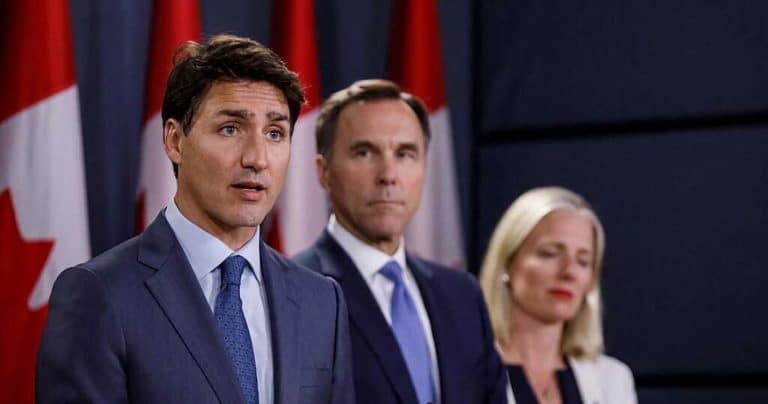
In 2018, Prime Minister Justin Trudeau’s announced that it would purchase the Trans Mountain Expansion project. Trudeau stated the pipeline’s construction and a commitment to fight climate change were “complementary” goals for his government. Credit: Liberal Party of Canada
Whose rule of law?
“It is manifestly clear that she has no remorse for her actions. It is also manifestly clear that she has no respect for the rule of law. She doesn’t seem to understand or agree that the rule of law applies to her.”
That was B.C. Supreme Court Justice Shelley Fitzpatrick’s conclusion at my hearing in Vancouver this past January.
Although our actions had not caused any violence or harm, it was for this disregard for the rule of law—and to deter others from doing the same thing—that we were punished and incarcerated.
Little had I known I would be labeled a renegade in need of punishment back when I had first been invited to sport the T-Rex costume in the spring of 2022. We had been under the impression that the RCMP had to go through a five-step process before arresting anyone for breaching an injunction, which included reading you the injunction aloud and giving you an opportunity to leave.
Unbeknownst to us, the Trans Mountain Company had previously applied for an amendment to their injunction, which was granted by the court, that the five-step process was optional. So legally, they hadn’t violated due process, so we had no way to avoid conviction and jail time.
Like Jim, ultimately I was fine with that. Because while Judge Fitzpatrick held the colonial rule of law above all else, we and growing numbers of others were loyal only to the rule of natural law.
On lands that colonial governments had never acquired legal title to, in an effort to defend the egregious expansion of fossil fuel infrastructure, this Vancouver courthouse had no capacity to recognize the reality of the natural law of this land, nor that it predated their system by tens of thousands of years. But if we do not respect this law, the price we will ultimately pay is far greater than a three-week jail sentence—and the recent fires, floods, and heatwaves are only the first signs of what is to come.
But if Judge Fitzpatrick couldn’t understand a certain fact, I took heart that many more increasingly do: there’s no greater disrespect for the rule of natural law than to incarcerate those who uphold it.

I often hear that I’m lucky to have a full-time job in journalism.
Critical, bold journalism that isn’t beholden to media monopolies should be the norm—not the exception.
By supporting The Breach, you’re supporting a more robust, progressive media. Join us today.
– Katia Lo Innes, Associate Producer, The Breach
Climate Crisis | As Alberta burns, we need a political vision to extinguish the flames
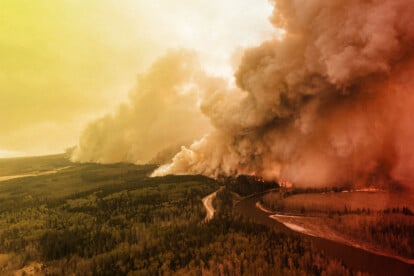
Climate Crisis | How Trudeau learned to stop worrying and love the Alberta carbon bomb
Oil Industry | Alberta’s anti-energy inquiry aims to undermine First Nations opposition to Tar Sands
1 comment
Comments are closed.

First off full disclosure. I am a center leaning Conservative supporter. Having said that I’m all for electric cars and weaning off fossil fuels. Not to change the climate, that’s not going to happen in our lifetimes or our children’s lifetimes, but just simply to have cleaner air to breath, to have cleaner rain which leads to cleaner soil. What I and no doubt others would like to know is, what is the difference between extracting oil and using it as fuel and extracting precious metals and minerals to produce green energy? Activists love to pound the “ban oil” drum while ignoring the carbon footprint of the extraction and manufacturing of the materials needed to produce “green” energy. Is a single windmill even carbon neutral when the whole process of manufacturing and installing is taken into consideration?