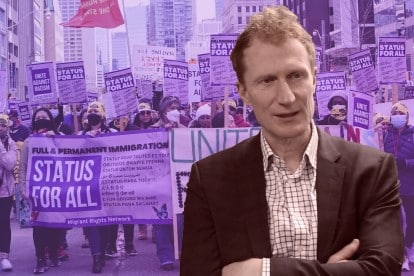
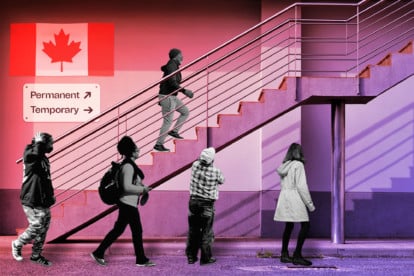
Migrants are being blamed for everything from the housing crisis to hospital wait times to joblessness —and it couldn’t be further from the truth.
Frontline migrants and migrant advocates help debunk the myths.
Harrison Faulkner, Juno News: This is a major crisis and mass immigration is to blame.
Danielle Smith: People are worried. People are very nervous.
Ezra Levant: They want to cause chaos.
Doug Ford: Students from around the world taking our kids’ seats.
Pierre Poilievre: Radical, uncontrolled immigration are partly to blame for joblessness, housing, and health care crises.
Syed Hussan, Migrant Workers Alliance for Change: We are in a moment, in this country and around the world, where people are struggling and want change. They are looking to identify who’s responsible for the crisis they’re in.
For most people, they know, in their heart of hearts, it’s the elite. And the way to distract people is to tell them that the fault is your neighbour, the person who is the working class other, the racialized person, the immigrant and the migrant.
Sarom Rho, Migrant Workers Alliance for Change: Many of us are hearing that migrants are somehow responsible, but when we look at the actual numbers and see who’s making profit off of this myth, it’s simply not true.
Myth #1: Migrants are a drain on our economy and public services
Maximiliano Ferrera, Migrant worker: If you lose your status, you don’t have access to a lot of things. You can’t apply to the government day care. They need you to prove you have a status, like a work permit or a temporary resident.
Dev, Former international student: Undocumented migrants are never able to get full health care because it’s not available.
When I was international student, you still have to pay the medical bills, so it’s not like someone is getting free medical access or public services.
Hussan: So it’s not that migrants are using up our social services. They are paying for it, but they’re not actually taking it back. They are underwriting the entire system.
Because if you build a tempory revolving door immigration system, each year you get 1.2, 1.5, 1.7 million people coming in with money, because they’re paying into large sums of tuition, with labour.
Migrant workers who are in the temporary foreign worker program are paying all of their taxes, not getting health care, not getting access to CPP, to EI.
Their families are not with them, so they’re not sending their kids to school. They’re actually not getting most services. You don’t give them rights, which means they come, they spend, they leave.
And then you get a whole new pool of people coming in. So you simultaneously underwrite your social welfare system. You have this massive GDP growth because you’ve got people bringing in money and resources.
This is what Canada is doing, the U.S. is doing, the U.K. is doing. What people need to understand is that, though broken as they are, social services in this country, for at least the last quarter of century, would have collapsed without this massive pool of money being added into it by people who cannot access it.
According to the IMF, Canada has managed to avoid two recessions over the last two years. How has it done it? It’s done it by focusing on temporary migration.
Myth #2 : Migrants are causing the housing crisis
Dev: If every international student is coming here buying a
house, then you can say, “Oh, millions of students came and they bought a million houses.”
No, they are just sharing rooms. They are living in basements.
Gaurav Sharma, Former Dollarama employee: We can live in one room, husband, wife, and children. The other room is one people, husband, wife and two children. So, they have no choice.
Jhoey Dulaca, Former care worker: With the minimum wage, we’re not even competing to buy a house. We are living in our employers’ houses.
Rho: For the past 12 months, we have heard the federal government say that international students are responsible for the housing crisis.
But by their own findings, a report in May 2024 by Statistics Canada showed that the people who are in some of the most substandard housing conditions were overwhelmingly international students themselves.
Hussan: We’ve all been miseducated. We believe that we live in a free market, where supply and demand is all, rather than the fact that we live in an oligopoly, with monopolies controlling every fact of our life.
Rho: We also know that housing prices are being set by speculators and investors and not actually by supply and demand.
It’s speculators who are leaving tens of thousands of rental units empty in order to manufacture scarcity.
Hussan: If you follow immigration levels and housing prices over the
last forty years, you see that there is no correlation between the two,
proving that immigration has never been the decisive factor in rising prices.
We know in 2020, Canada closed its border to immigrants, and yet housing prices went up.
This is the same conversation in Australia, in the U.K., in New Zealand, in the United States.
Donald Trump: We also cannot ignore the impact that the flood of 21
million illegal aliens has had on driving up housing costs. That’s why my plan will ban mortgages for illegal aliens in California.
Hussan: This link between people and housing is global. It’s synchronized. It is being coordinated by right wing populist factors.
Myth #3: Migrants are stealing good jobs
Emelyn, Care worker: They can actually apply for that job too, if they want. I don’t think they want our jobs.
Dulaca: They were hiring migrants from outside the country precisely because nobody wants to do it.
Fererra: Who can clean this bathroom? I know an immigrant is going to say, “Me.”
Rho: We can look left and right, and we see that the people who are stocking shelves overnight in grocery stores, handling packages at warehouses, delivering food, doing the work that a couple years ago everybody was saying was the most essential and frontline to ensure our communities were sustained, are migrant and undocumented people.
Emelyn: You have to be able to cook. You’re supposed to able to multitask.You have to have the initiative to do stuff that are without instructions.
Sharma: The Dollarama work is to make a pallet, put the box in the pallet and make a seven-feet pallet
They’re saying, “Okay, you did ten pallets or eight pallets, but your ratio is down. So today, you will do more work.”
Dulaca: Every day, I work at least 12 to 15 hours, but I’m usually paid only for 35 hours a week.
Hussan: If you have a life where you have to work 16 hours a day, why would anybody want to engage in that?
So migrant workers don’t want to do those jobs. They are forced into those jobs by virtue of the permits that they have, by virtue of the fact of global centuries of colonialism that forces people to come here to find work.
Immigrants are coming in. Their work experience is not being accredited. Their education is not being accredited or valued. They’re being shuffled into these jobs.
Rho: There has been an explosive boom of temporary migration in
Canada over the past 20 years. There has been a 615% increase in the number of temporary permits that Canada is issuing every year.
There are so many different programs that bring in people on
temporary permits and deny them equal rights and protection, simply on the basis of immigration status.
To give you an example, I’m supporting some folks to organize at a school.
The janitors in that school, who are hired by the employer, the university, are paid a decent wage. Right in the next door over, the employer is subcontracting janitorial work out to migrants, often migrant women, who do this kind of gendered, domestic work. And they’re getting more than $10 lower.
Ferrera: A lot of people receive verbal abuse, physical abuse, sexual abuse.
Dev: Employers, and the people who hire, they know that they have a advantage over them, because they don’t have a permanent status. It’s like an easy target for them. They can fire them anytime.
Rho: There is a huge power imbalance that migrants are caught in when they are denied permanent resident status. And in order for us to fix this, we simply need a pragmatic and simple step, which is to ensure that all people have the same rights as everybody else.
‘A better world that is more free’
Ferrera: They need to go out from her office, his office, and see the truth on the streets.
Rho: When we talk to the people in our lives who are migrants, we’re your neighbours, we’re your friends, we’re your classmates, we’re your co-workers.
Sharma: My honest opinion is, if they come to see the hard work of these people, they can realize that, yes, these people are not stealing, they are contributing.
Rho: Not only the stories of abuse, mistreatment, and exploitation that migrants ourselves face, but also the ways that we are fighting back, and we’re fighting not only for better rights and protections for migrants, but simply a better world that is more free, where we can all breathe, where we all have the same rights as everybody else.
Emelyn: I’m not the only one, so that’s that’s the reason why I told myself “I have to fight for this.” It’s not just for me.
Hussan: Because those at the top, prefer that we are fighting, in a state of chaos and conflict, rather than a state of dignity and justice and freedom and liberation for our communities.
And this is only going to continue, unless and until we can show people that it is only through unity across the working class, regardless of immigration status, can we actually achieve the world we want to live in.

I often hear that I’m lucky to have a full-time job in journalism.
Critical, bold journalism that isn’t beholden to media monopolies should be the norm—not the exception.
By supporting The Breach, you’re supporting a more robust, progressive media. Join us today.
– Katia Lo Innes, Associate Producer, The Breach