
In 2020, after decades of government budget cuts had plunged Canada’s post-secondary institutions into a financial crisis, the University of Alberta hired a consulting firm to find a way to slash its costs. The firm, called the Nous Group, had earned a name in its home country of Australia as experts in finding “cost efficiencies” inside austerity-riddled universities.
That name was “Nousferatu”—coined by one Australian MLA because of Nous’s reputation for being “this kind of vampire that comes into universities, sucks them dry and leaves them worse off for teachers and students.”
The University of Alberta (U of A) was just the first university in Canada to hire Nous Group to conduct restructuring. Nous has now worked with more than 20 Canadian universities, including many in Ontario, thanks to significant support from the Doug Ford government. Its cookie-cutter model—slashing staff and services, amalgamating faculties, replacing humans with online portals—has brought accusations that the firm is pushing public institutions toward a corporate model. Now, it’s looking to expand into another weakened public sector in Canada: health care.
Nous has quietly become one of Canada’s foremost enforcers of austerity in institutions that are broke, vulnerable, and desperate for solutions.

The Nous formula
The U of A was in a dire situation: the year before, the Alberta government had cut the grant it provided to the university, which meant the university was looking at a net loss of about $135 million.
So it sought out Nous (pronounced like “mouse”) for a restructuring built around $95 million in projected savings. In the internal document Nous prepared for the university in July 2020, the firm proposed two main reforms: cutting some of the university’s 18 faculties, and amalgamating administrative services.
“There will likely be substantial opposition,” Nous wrote, “which is not always a strong argument to stop.”
The reason for the opposition quickly became clear: when the U of A announced the changes to cut over $100 million from its operating budget, they included “at least 1000 full time equivalent continuing positions [that] would have to be lost through layoffs, attrition, and retirements.”
Founded in 1999 by Tim Orton, a former McKinsey consultant, Nous Group began as a general management consultancy in Australia. Its restructuring of the University of Sydney in 2016, in which the firm helped shrink 16 faculties into five faculties and three schools, quickly became the firm’s signature case study. It soon led to million-dollar contracts with the University of Melbourne, Monash University, Griffith University, and the Australian National University.
When staff at the U of A caught wind that their university had hired Nous, they held a workshop with faculty and staff at the University of Sydney to find out what their school was in for. Their Australian counterparts warned that a Nous restructuring meant “job loss, deskilling for those who retain their positions, increased class sizes, and decreased diversity of course offerings,” reported the U of A student paper.
The Breach approached Nous for comment, but did not receive a reply by publication time.
Nous has now found a new pool of customers in Canada’s desperately underfunded universities. Its first Canadian contracts were in 2020 at the University of Alberta and York University. In subsequent years it has been hired by Queen’s, Laurentian, and the University of Ottawa, among others.
At York, the university signed a three-year, $7.8 million contract with Nous. The resulting report was withheld from faculty before pressure from the York University Faculty Association forced its release. What the report recommended, and what followed, would become familiar to campuses across the country: centralize power, cut services, reduce staff, and replace human resources and IT departments with online portals.
At Laurentian University in 2022, Nous recommended investing millions in a “major transformation program” even as the university was under bankruptcy protection, cancelling 69 programs and terminating 110 teaching positions.
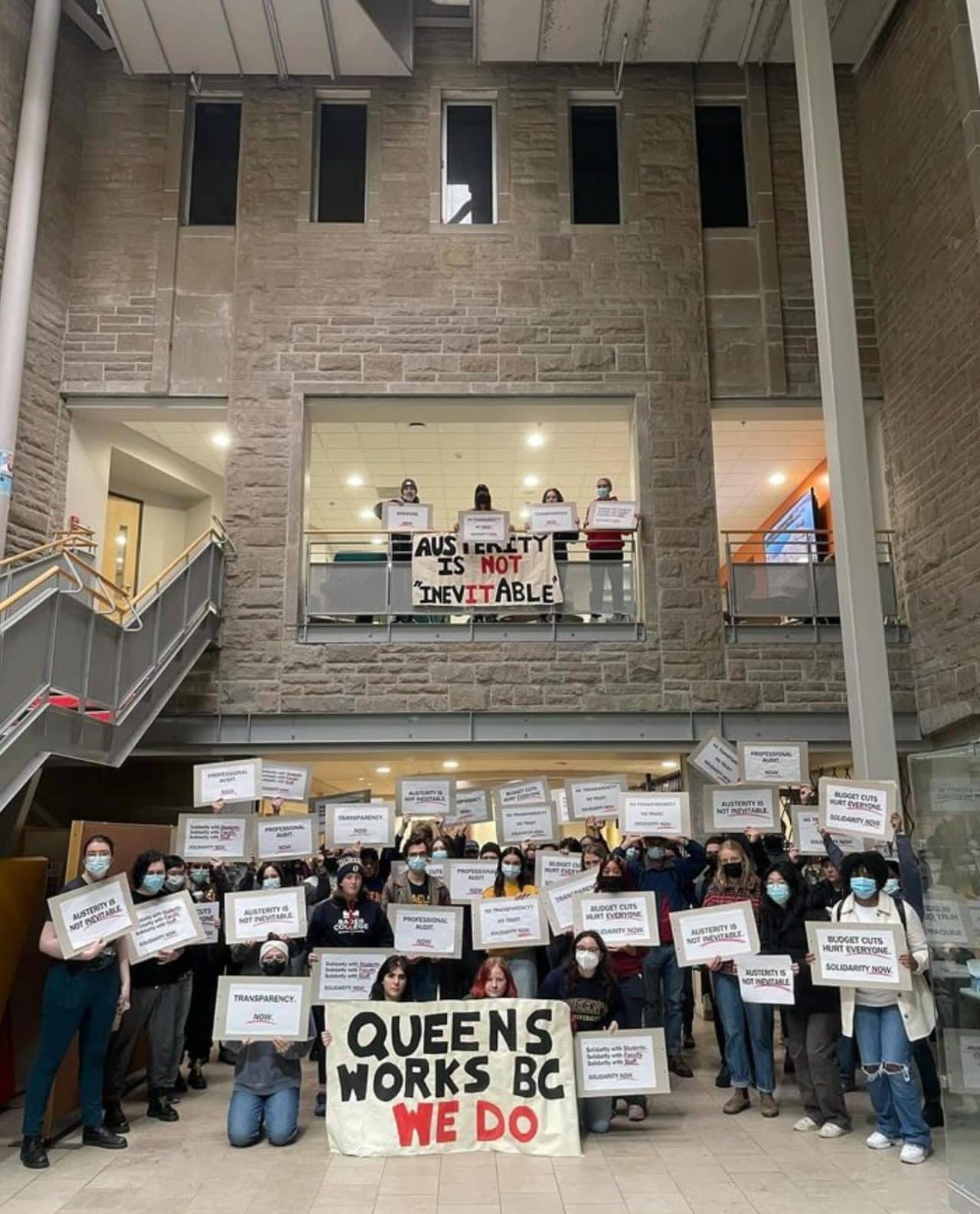
At Queen’s University, a $325,000 Nous contract, signed in 2023, introduced surveys that operate like a negative feedback cycle, two Queen’s faculty told The Breach. Services already weakened through years of underfunding got poor ratings, which justified further cuts.
Then Nous got a huge leg up into the Canadian post-secondary sector. In 2023, the Ontario government released the findings of the Blue-Ribbon Panel on Postsecondary Education Financial Sustainability, a committee convened by Ontario’s Minister of Colleges and Universities to address the sector’s mounting financial crisis. Nous was the primary consulting group the panel met with.
“Our discussions with Nous suggest there is considerable room for improvement in these universities’ cost efficiency that could reduce administrative costs by as much as 10%” the panel wrote. “Areas identified by Nous with the potential to reduce costs … include administrative services, space utilization, IT services, and other non-labour costs. Some of these benefits could be realized through increased levels of automation.”
“That page reads like an advertisement for Nous,” Robert Kristofferson, president of the Ontario Confederation of University Faculty Associations (OCUFA), told The Breach.
The Ontario government made $15 million of funding available for “accountability and efficiency reviews” at Ontario universities. The money was to be spent calling in third-party reviewers to “identify actions institutions can take to drive long-term cost savings.” Nathan*, a source with direct knowledge of the processes, said that universities who accepted those funds were directed toward a government-approved list of preferred contractors. That list included KPMG, Deloitte, and Nous. (The Breach has used a pseudonym for Nathan so he could speak freely without professional repercussions.)
Nous didn’t just begin “double-dipping” between government and university contracts in Canada. In Australia, the firm received government contracts to develop a federal review into higher education; then more government contracts to analyse public submissions on the proposed review and create a system to manage student complaints; then further contracts from universities to help them navigate how to actually carry out all this restructuring.
When the Ontario Public Service Employees Union (OPSEU) got hold of ten reports from the Ontario-approved consultants’ “accountability and efficiency reviews,” they found that “The reports collectively recommended cutting staff, outsourcing public jobs to private contractors, introducing large-scale automation, and, in several cases, merging or consolidating colleges.”
In a remarkably short period of time, Nous Group had successfully positioned itself as the preferred contractor for a sector deep in crisis.

“Like a ghost on campus”
Nous Group—despite the expected opposition to its changes, or maybe because of it—moves quietly.
“They were like a ghost on campus,” said Ellie Perkins, former president of the York University Faculty Association. “Universities don’t announce, ‘We’re hiring this consulting firm to tell us how to restructure, cut costs, and reorganize the institution.’ That’s not how it works.”
“We never actually see them. We don’t know what they’re doing or when they’re doing it,” said Thomas*, a department head at Queen’s University who The Breach has granted a pseudonym due to risks to his job. ”What happens is that every now and then an announcement shows up somewhere through the back channels.”
At Queen’s, staff only became aware of Nous’s activities when a “service effectiveness survey” asking them to evaluate university services landed in their email inbox in February 2024. It sparked concerns about how the results might be used to justify future cuts. “People started asking, ‘What’s going on here?” said Carolyn Prouse, an associate professor of Geography and Planning at Queen’s University.
Nous’s central model revolves around the use of data. One of the most popular products they sell is a data aggregation tool called UniForum: universities pay to access UniForum (a multi-year subscription reportedly costs over $1 million), then use it to survey their students, faculty, and staff about how satisfied they are with university services. That data is then compared to other universities in a benchmarking exercise.
The Breach obtained the survey questions circulated to staff at Queen’s. They asked respondents to rank the importance of services that provide faculty with “clean offices, facilities (labs, sports, etc.), buildings and grounds,” on a scale of “less important” to “critical.” Another question asked how important “a fully functional workplace (furnishings, plumbing, electrical, heating, air conditioning, lifts and other building services)” is.
Once UniForum identifies areas where a university is comparatively “weak,” Nous can pitch their solutions as further paid services.

Perkins questions whether the data Nous solicits is actually worth collecting. “To what extent is the data that the university generates, through all of these mock forms and surveys, actually useful?” she asked.
After calling in Nous, a national audit found that the Australian National University (ANU) had approved sweeping cuts worth $250 million without clear evidence the cuts were needed or likely to have their intended impact, and despite the university generating a surplus of nearly $90 million the same year it declared financial crisis.
Senator David Pocock, who spent months working to hold ANU accountable, told The Breach that the ANU community was outraged over what he called a “manufactured financial crisis.” He described some of Nous’s work as “so divorced from the reality of being at a public institution that is meant to be for the public good.”
It seems that once Nous is on campus, it is hard to get rid of them: Nathan, who has direct knowledge of Nous’s processes, said that staff of Nous were explicitly told to look for more work outside the scope of the original agreement.
This means pitching new projects, finding other “efficiencies” that fall outside the contract terms, and suggesting an expansion of the contract. At York, Nous advised that terminating their contract was likely to result in a “loss of institutional knowledge that Nous team possesses at the end of the engagement.”
It was a warning that Perkins found ironic, given that she felt Nous’s changes had gutted institutional memory of her university.
“In the Office of Research, if you were submitting research expenses, you knew the name of the person who would be opening our emails. We could pick up the phone, call the person,” she recalled. “That doesn’t happen anymore. Everything is routed through portals, forms, ticketing systems, and centralized service centres. That might appear efficient on paper, but it represents a loss of institutional knowledge and a loss of the human relationships that help universities function effectively.”
Nous often works to reduce IT departments, support staff, and department staff. But Thomas, the department head at Queen’s University, argued that the cuts are short-sighted and unevenly applied. “They’ll argue that merging departments saves money,” he said. “But then they need someone to lead the larger [department]. They need more administrative support. They create associate dean positions. So money moves upward from student-facing services into senior administration. That seems to be the playbook.”
This model is repeated ad nauseum from university to university, which explains why Nous’s CV is essentially a closed loop. The firm cites its own past projects as evidence that its model works. The University of Sydney became the model for the University of Alberta, and the University of Alberta became the model for York University, and so on—a self-referential chain of case studies authored and evaluated by the same company.
When a university’s success contradicts Nous’s cookie-cutter recommendation to cut departments and faculties, it sometimes omits them from its infographics. “Note that we have removed the University of Michigan as annual revenue figures were significantly higher than other institutions (but also had the largest number of faculties with a total of 19),” Nous wrote in its internal presentation for the U of A.
On its website, Nous says it works to solve the “most complex strategic challenges.” But across campuses, its solutions look remarkably boilerplate.
The question, then, is not what Nous is selling. It’s why universities keep buying it.
Public austerity, private benefit
Everyone The Breach spoke to emphasized that consulting firms didn’t cause the university funding crisis; firms like Nous just profited from it.
Across Canada, budget cuts to post-secondary education as well as strict new caps on the number of international students (who pay tuition fees four times higher than those of domestic students) have created massive budget shortfalls for post-secondary institutions.
The austerity has been particularly acute in Ontario. In 1980, about 80 per cent of universities’ operating revenues came from provincial funding; by 2017, that had been slashed to less than half, at 38 per cent. Then Doug Ford became premier, cutting and freezing domestic tuition while provincial operating grants fell behind the pace of enrolment and inflation.
“Nous didn’t cause that situation, but they found a way to profit from the austerity,” Kristofferson of OCUFA said. This crisis created a perfect opening for consulting firms: “They seek out sectors where they can find work, and they found that Canadian institutions facing austerity are a promising market for them.”
This playbook, Perkins argues, is deeper than the numbers. “I think the broader issue is that universities are increasingly being pressured to operate like corporations,” Perkins said. “Consulting firms such as Nous are part of that shift.”
Nous’s approach is a fundamental misread of why universities exist, she believes.
“University education is not simply about training people for jobs,” said Perkins. “It’s about helping people learn how to think, communicate, analyze evidence, engage with people who are different from themselves, and participate meaningfully in society. The danger of the consulting model is that it reduces education to a series of measurable outputs and market transactions. That’s not what universities are for.”
After years of financial freefall, Ontario’s universities and colleges are finally seeing some relief: in February, the province announced a $6.4 billion tranche of funding for the post-secondary sector. Nous’ services may soon be in less demand in Ontario.
This may be for reasons that stretch beyond new funding: Australian universities that are a decade ahead of those in Canada are now questioning the sagacity of their restructuring. Thomas was told by colleagues at the University of Melbourne, where 15 faculties were downsized to ten with Nous’ help, that administrators are beginning to reverse the amalgamation and return authority to faculties.
“Five, ten, maybe 15 years into the process, universities are beginning to realize what a mistake it has been,” he said. “They’re increasingly admitting the cost savings aren’t there.”
But in Canada, Nous is already on to the next market. In February of 2025, the firm announced it was opening a new office in Vancouver, mentioning clients that include “the British Columbia Provincial Health Services Authority, Alberta Ministry of Health, Ontario Ministry of Health, Ontario Health,” and “provincial health service agencies across Atlantic Canada.”
Public institutions facing neoliberal austerity are a profitable target.

When I went to journalism school 10 years ago, my parents thought that they would eventually read my articles in The Montreal Gazette. Today, that newspaper is a husk of its former self. But I get to explain that I’m working towards critical, independent, and sustainable journalism.
Want to be a part of the future of journalism? Support our work with a monthly contribution. Sign up here.
– Amanda Siino, Development Director, The Breach
Alberta | ‘Pandora’s box’: Danielle Smith and insurance giants unleash attack on healthcare

Police | A notorious RCMP unit shaped B.C. universities’ reaction to Palestine encampments

Education | Faculty, students fight to hold post-secondary privatization at bay

2 comments
Comments are closed.


> At Queen’s University, a $325,000 Nous contract, signed in 2023, introduced surveys that operate like a negative feedback cycle, two Queen’s faculty told The Breach. Services already weakened through years of underfunding got poor ratings, which justified further cuts.
this is a positive feedback loop in a negative direction. a negative feedback loop destroys itself.
> At Queen’s University, a $325,000 Nous contract, signed in 2023, introduced surveys that operate like a negative feedback cycle, two Queen’s faculty told The Breach. Services already weakened through years of underfunding got poor ratings, which justified further cuts.
this is a positive feedback loop in a negative direction. a negative feedback loop destroys itself.