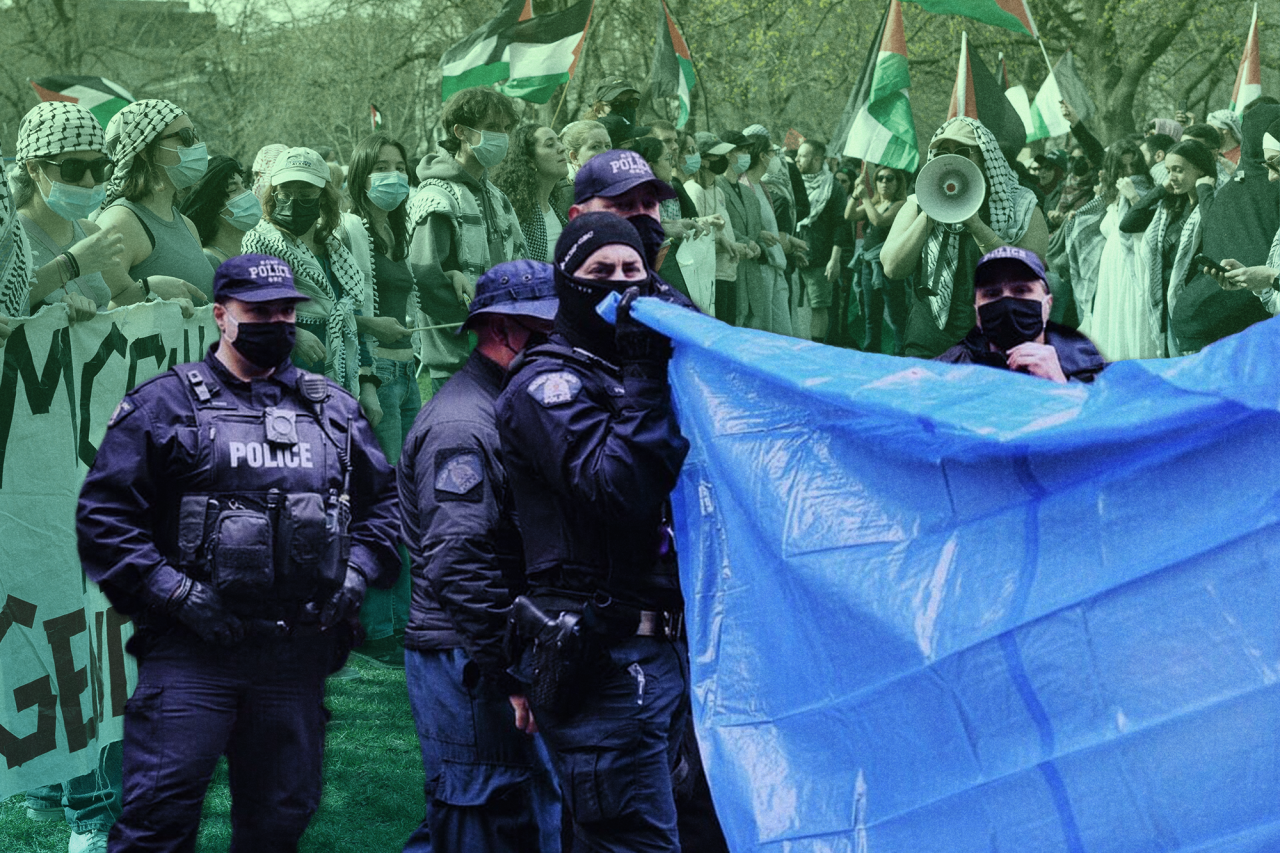
In the spring of 2024, as pro-Palestine encampments were still popping up at universities across the country, a student organizer named Kathy got a text she’d long feared: a notorious police unit was now operating on her campus at the University of British Columbia.
In a chat devoted to monitoring police activity, encampment participants left messages saying they had noticed vehicles with the name of the paramilitary Community-Industry Response Group (C-IRG) unit parked outside, and had seen its officers roaming university buildings.
“C-IRG actually were walking all over the campus, not just at the encampment,” recalled Lamya, another organizer. “They were also at this point entering the student union building, student classrooms, and stationed in them 24/7 with binoculars, staring into the camp.”
Because they fear university retribution, The Breach has agreed not to use either of Lamya or Kathy’s real names.
In the encampment, student protesters were calling for their university to divest from companies profiting off Israel’s genocide in Gaza. They had become aware of C-IRG’s reputation as a secretive division of the B.C. RCMP specifically created to respond to anti-pipeline protests in the wake of Standing Rock.
Just a few months before encampments had sprung up for Gaza, C-IRG had rebranded and expanded its role to include “civil and public order incidents.”
Now operating as the Critical Response Unit (CRU), the unit showed up across B.C. university campuses, including UBC’s campuses in Vancouver (UBC) and Okanagan (UBCO), the University of Victoria (UVic), and Vancouver Island University (VIU).
Not only was the CRU showing up, they were also advising universities on how to respond to them. Documents obtained by The Breach from the universities and the provincial Ministry of Public Safety reveal the significant role that the CRU played in shaping the institutions’ response to a nationwide wave of student activism not seen in decades.
These same records show that the CRU was surveilling student protesters, sharing intel with local police and the provincial government, preparing to clear encampments, and advising universities on how they might punish protesters with consequences ranging from expulsion to criminal charges.
Together, these activities form a picture of how the CRU’s role is expanding, as it positions itself as the go-to militarized force to respond to every protest deemed a “public order incident.”
Conor, whose real name The Breach has also agreed not to use, was a UVic encampment participant who encountered C-IRG when he protested old-growth logging at Fairy Creek on southern Vancouver Island in 2021. He recalled that the unit seemed to operate with “a sense of lawlessness and impunity” beyond what he had seen from regular police forces.
“I think when [C-IRG] was first founded, it was like, okay, you can get away with this in a back road on a logging road somewhere where there’s nobody really around, and it’s out of sight, out of mind for the public,” he said. “But you wouldn’t dare do that on the streets of Vancouver. You wouldn’t dare do it at a university.”
Bringing ‘militarized tactics’ to school
When the UBC students noticed CRU units on their campus, they contacted Maryam Adrangi, a member of the Abolish C-IRG network. Having monitored CRU/C-IRG’s actions for several years, this new turn in the unit’s work was something she’d been worried was coming.
“By that point, there had been coverage on how C-IRG and CRU had been monitoring pro-Palestine organizing,” she recalled. “And so it was only a matter of time before they went to the encampments, especially because in Vancouver, the only place that the RCMP really has jurisdiction is on UBC [campus].”
For Adrangi, CRU’s presence at the encampment “was concerning because C-IRG and CRU are known to constantly escalate situations.”
“They are known for their militarized tactics,” she said. “So it was concerning because you have all of these people who are on a university campus trying to talk about issues, progressive thought—that’s what universities are known for—and then they are being faced with a militarized policing unit.”
Through a freedom of information (FOI) request, The Breach obtained access to meeting reports from a working group where police and the B.C. government shared information about “public order incidents,” including Palestine protests. Dating back to April 2024, records show that every week, CRU would compile a list of “public order events” happening within its jurisdiction. This focused mainly on events relating to “Palestine / Israel Conflict, Anti-Sogi [sexual orientation and gender identity] Protests, [and] Anti-Mandate / Freedom Rallies.” And CRU was deployed to attend weekly pro-Palestine rallies across B.C.
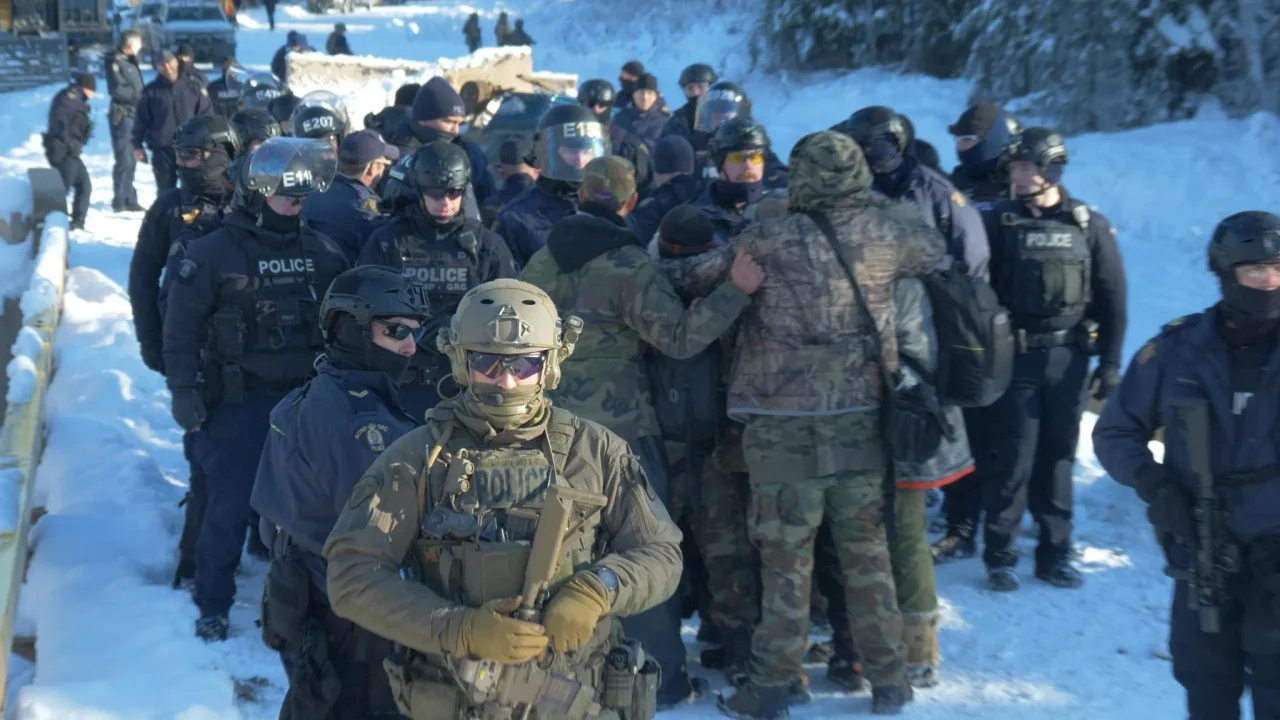
On April 30, 2024, the day after the UBC encampment was established, the same working group called an emergency meeting with several municipal police forces to “share intel and messaging” regarding university protests. The CRU updates were provided by Ken Floyd, the former C-IRG Bronze commander who supervised the arrests of Wet’suwet’en land defenders Sleydo’ Molly Wickham, Shaylynn Sampson, and Corey Jocko. The B.C. Supreme Court later ruled that C-IRG had infringed on their rights.
Internal communications obtained through FOI show the CRU arrived early on to assist local RCMP at the UBC encampment, and dedicated extra resources to monitor the protest on campus. At the April 30 meeting, Floyd reported that “RCMP [are] already seeing people, rhetoric, tactics that are similar to Fairy Creek, TMEP [the Trans Mountain pipeline expansion project], CGL [the Coastal GasLink pipeline],” such as “professional protesters, pallets, concrete, [and] barricades.”
But police were waiting for the university’s lead to determine their next steps.
Joining forces
Internal documents show CRU shared intel and messaging on encampments with local police departments including Victoria PD, Saanich PD, and Vancouver PD. Several police forces expressed a clear desire to stop the encampments from becoming established.
After receiving intel from CRU about the UBC encampment, meeting minutes show that Saanich Police Deputy Robert Warren pre-emptively reached out to UVic security to feel out the university’s position on an encampment response if the situation were to arise in Victoria. He said that the universities might be reluctant to remove protesters, but “police know it’s important to act quickly on these situations before they become too entrenched.”
VicPD Sergeant Jan Malinowsky, whose force was also represented in the meeting, reached out to UVic, offering to use Public Safety Units to remove protesters. He warned the university that, “Once the encampment gets established the harder it will be to remove the protesters. It may even result in the University having to get an injunction.” His colleague Del Manak similarly offered to “roll up his sleeves and help” even though the university falls in Saanich Police jurisdiction.
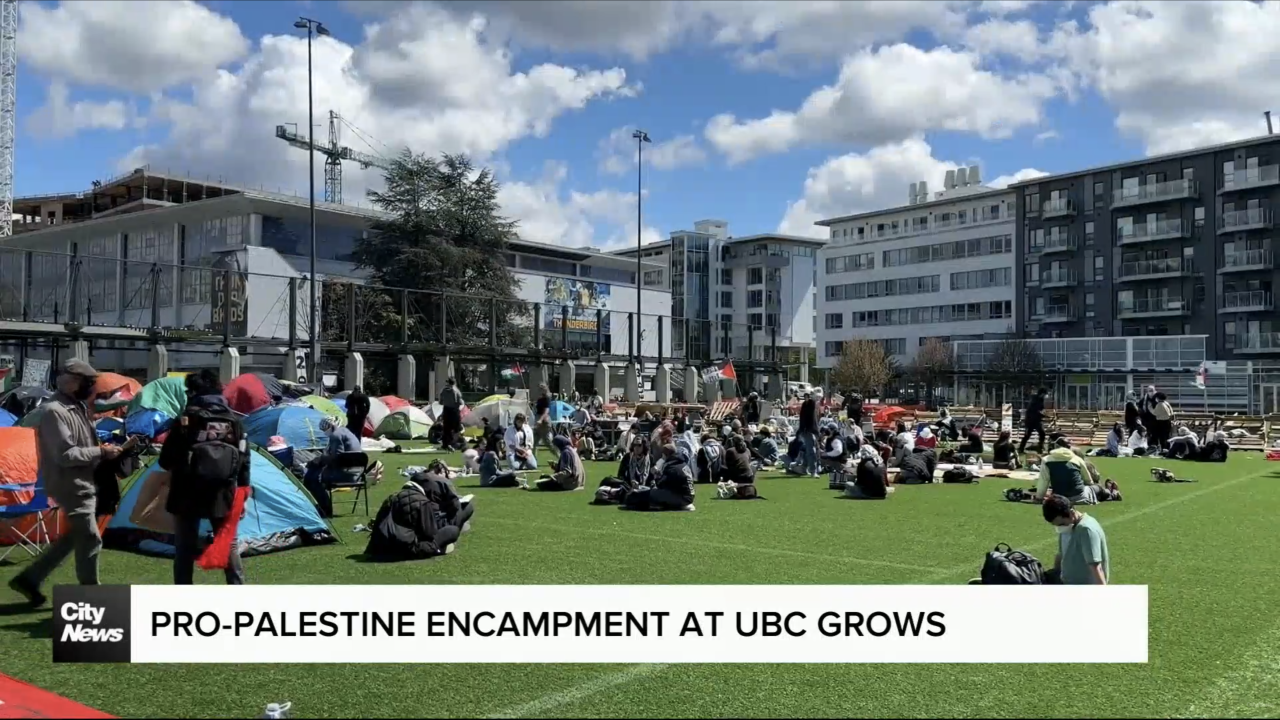
As the encampment at UBC continued, CRU kept getting involved. They sent officers to campus Palestine protests, including a May 11 protest at the campus bookstore, a May 14 protest at the alumni centre, and a June 1 protest at the Nest and Hennings buildings against an event where political parties were attending. During the UBC Vancouver graduation period in May, they took the lead on security because the university was worried about student protesters disrupting graduation ceremonies.
By June 30, 2025, CRU had left UBC campus due to the “inactivity” of the protesters, but left vehicles and equipment on site in case they felt the need to return.
On July 8, UBC students voluntarily dismantled their encampment, and CRU’s equipment was fully removed the following day.
Records obtained by The Breach show CRU was also on-site and “engaging with stakeholders” at the Kelowna UBC Okanagan encampment established on May 13, 2024. And at VIU, records show CRU was preparing to help clear the protest after the university got an injunction to dismantle the encampment, before participants voluntarily packed up and left.
Conor said that dealing with the C-IRG/CRU is different than dealing with local police.
“The local police actually live in the community and have some sense, however thin, of accountability to the community,” he explained. “C-IRG are brought in from wherever and really don’t have any connection.”
“When I see C-IRG at things, I expect more trouble for sure,” said Conor. “It’s a signal of the government’s orientation to it. They wanted them there. It changes your risk assessment of the situation.”
The anti-encampment playbook
As encampments unfolded, B.C.’s Ministry of Postsecondary Education and Future Skills (PSFS) shared a report with universities, with guidance “to help them take preventative steps prior to any situation escalating.” One of its authors was the CRU.
In it, universities are encouraged to work with police liaisons and deploy security to surveil protesters.
“A security presence also provides an opportunity to monitor the encampment and observe infractions and escalating tensions, gather intelligence, and underline the tolerance policy of the institution,” the guidance explained.
For Adrangi, CRU’s prominent role in drafting this guidance is alarming. “C-IRG and CRU aren’t just coming in for emergencies,” she said. “They’re willing to rewrite the playbook for militarized policing and policing in Canada.”
The report warns about so-called “professional” protesters who come from outside the university community to join the encampments. They advise the universities on potential consequences for protesters who violate the institution’s “standards of behaviour,” which include campus bylaw tickets, expulsion, and criminal charges, for which a list of possible offences is provided.
Further down, post-secondary institutions are told to work with legal counsel to determine if getting a civil injunction to clear out protesters is appropriate. This was the route taken by VIU, which filed an injunction after its trespass notice failed to persuade the protesters to leave. After the encampment was dismantled, the university suspended two Palestinian students for alleged violations of the student code of conduct while participating in the encampment.
The Breach obtained the email where the PSFS shared the document with universities. In it, the PSFS Director of Strategic Initiatives and Emergency Support suggested that the guidance can be used for any type of protests “with respect to setting boundaries,” signalling a potential for long-term use.
A ballooning mandate
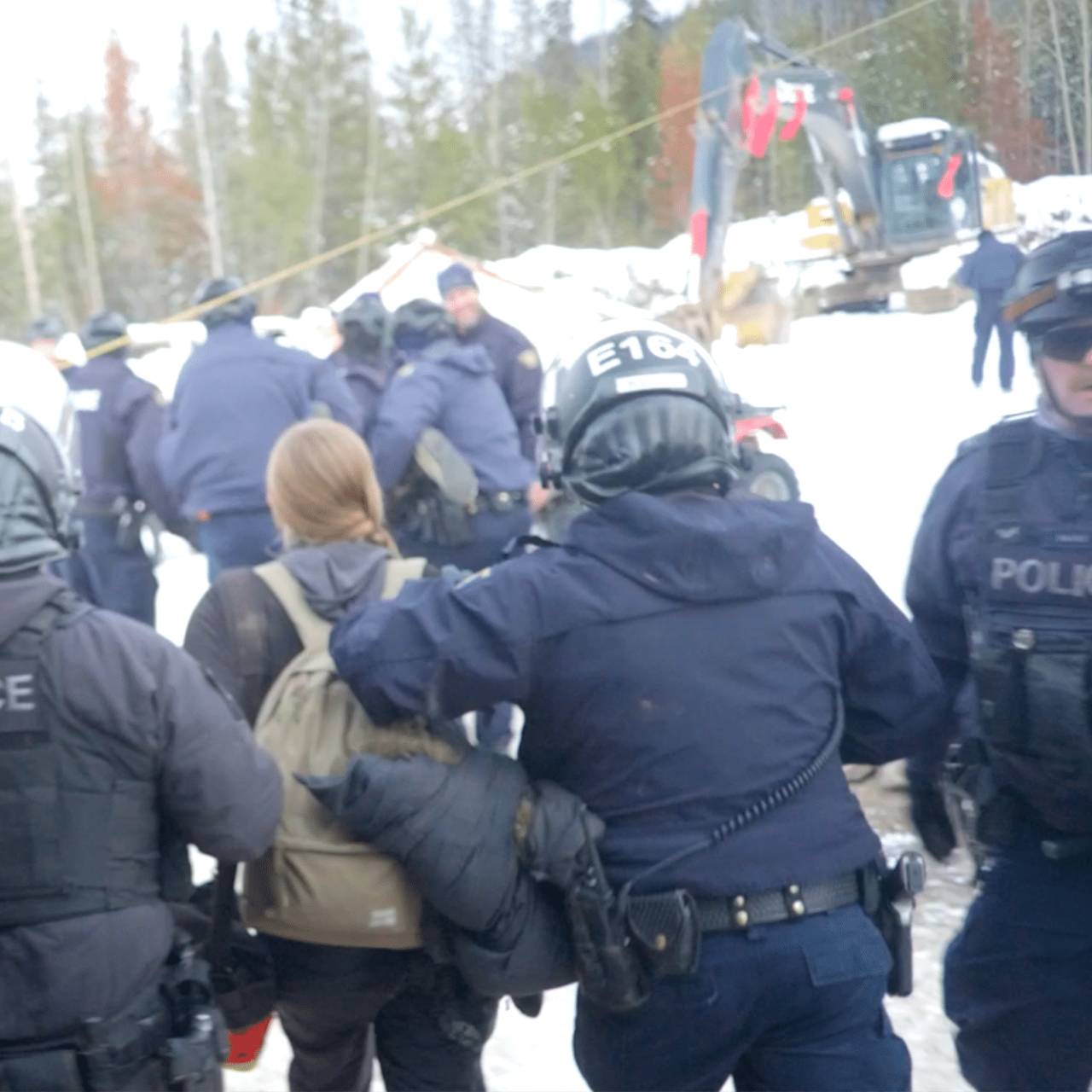
In 2020, news outlets across the world reported on the C-IRG’s militarized police raids of anti-pipeline camps in Wet’suwet’en territory, where First Nations set up a blockade against the construction of the Coastal GasLink pipeline.
The CRU was established in 2017 as an emergency measure to manage Indigenous opposition to pipelines. Gradually, its role has grown to police other types of protest, like forest protection. As its scope grew, so did its budget and staff. In its first five years, C-IRG spent nearly $50 million enforcing injunctions for petroleum and logging companies.
In the years since, the unit has received over 500 complaints citing intimidation, torture, racism, destruction of property, and arbitrary detention at sites including Wet’suwet’en territory and Fairy Creek. Despite these complaints and a federal investigation which found several instances of wrongdoing, C-IRG’s role has only expanded.
In March 2023, the B.C. public safety ministry allocated $36 million to make C-IRG a permanent unit with a mandate to respond to “unlawful” protests and public order events. In January 2024, it rebranded as the Critical Response Unit (CRU), to reflect its role policing civil and public order events beyond just “energy industry incidents.”
What is clear from the B.C. RCMP’s 2023 proposal to make C-IRG a permanent unit is that the “strategic oversight” the C-IRG/CRU has been designed to provide spans a wide spectrum of operations, from surveilling protesters all the way to being authorized to shoot them. With CRU’s transition into a permanent unit, any issue that touches on “civil disobedience” in the province becomes subject to its purview.
Conor became aware of the extent of CRU surveillance when filing a Freedom of Information request to obtain the RCMP’s records about himself.
“After having identified me at Fairy Creek, they identified me at several other places where I hadn’t driven my own car, I hadn’t used my own name, I had been wearing a mask,” he recalled. “It’s quite an extensive and sophisticated information gathering system for them to have known that I was in those places and to be tracking it.”
For Lamya and Kathy, the presence of C-IRG on campus gave the impression that their university saw itself as a corporation that needed to be protected from its own students.
“Seeing that the university would rather protect their interests in investments in genocidal companies than protect their own students’ right to make the world a better place is pretty upsetting,” said Kathy.
Adrangi warned that Canadians should be ready to see more militarized policing techniques employed as CRU carves out a role for itself in responding to public order events.
“They’re going to position themselves as, ‘We are the people to brief any institution that wants to repress dissent.”
This article was written with the support of the OCUFA Mark Rosenfeld Fellowship in Higher Education Journalism.

“We need media that enlarges the sense of what’s possible.”
Naomi Klein, journalist and author
Want to support hope-fuelled journalism? Become a sustaining member.
BDS | A powerful decentralized campaign forced Scotiabank to divest from Israeli arms
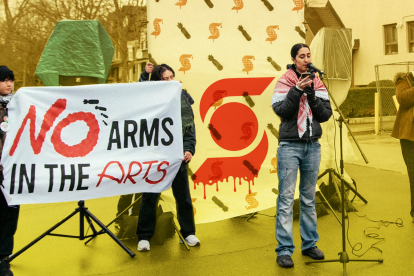
Palestine | Canadian lawyers borrow from U.S. playbook to quash Palestine solidarity
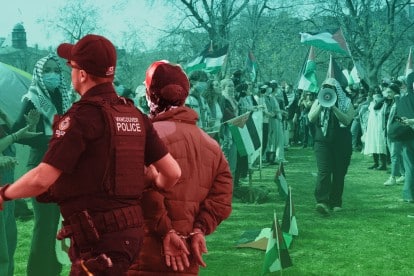
Palestine | Canadian students camping for Gaza aren’t antisemitic—they’re building brave new alliances for justice
2 comments
Comments are closed.
THis is what our elbows up Canadians don’t want to know. We have our ICE equivalents in Canada and they have been getting their training shutting down protests against pipelines. As in the USA, repression starts with indigenous people, black lives that don’t matter, and fossil fuel infrastructure that must be sacrosanct.
In a time of genocide, it ramps up to a genuine secret police that can come for anyone that gets in the way of western hegemony.
Canada is no exception. The secret has just been better kept.
Already posted a comment that was being monitored and has since disappeared. If it doesn’t re-emerge, there will be no interest in supporting this site…….and if we are already doing so, that money will disappear.
Being truly radical in these days isn’t easy, but at 80, I still believe it can be done.