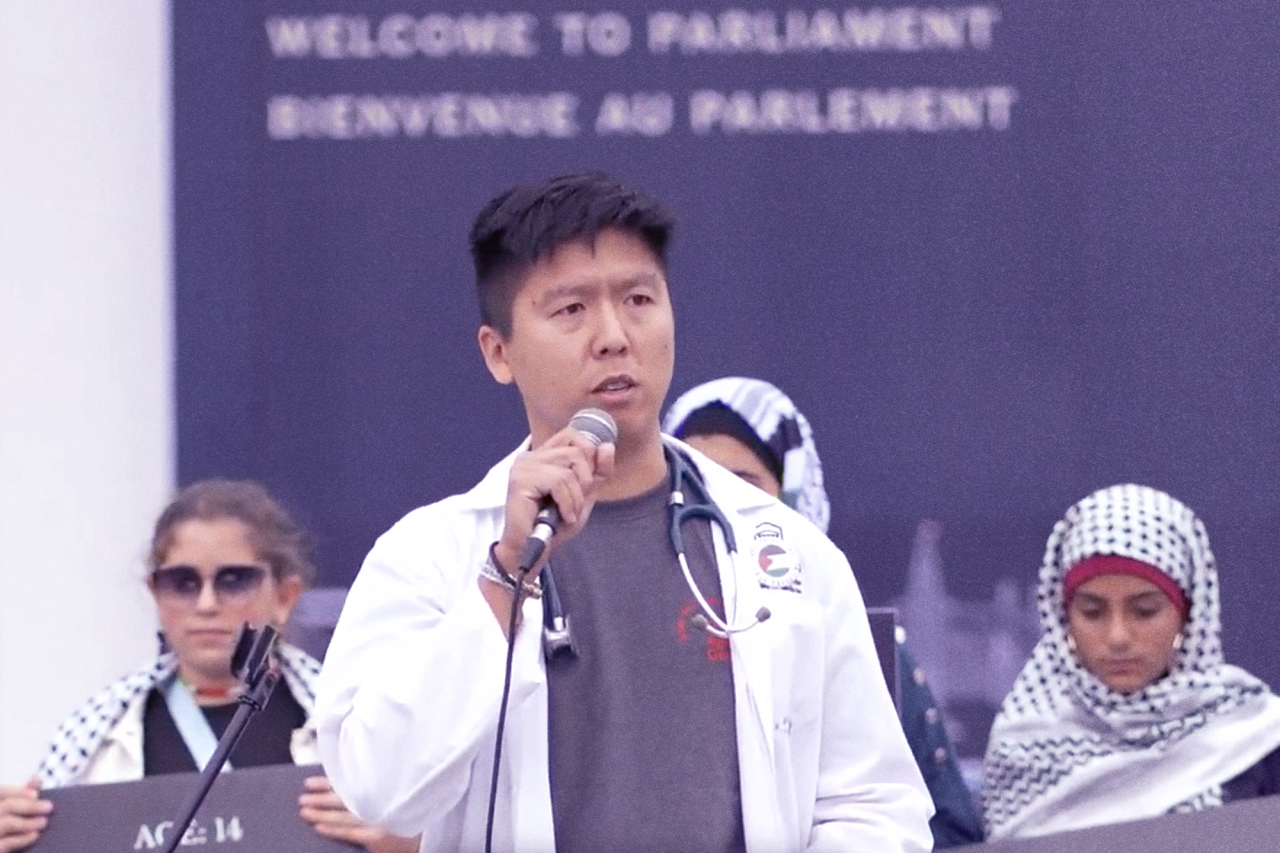
As a doctor, I can tell you that how we treat the most vulnerable members of our society is the measure of a good health care system.
Last week, the Canadian government announced cuts to the Interim Federal Health Program (IFHP), the initiative through which hundreds of thousands of people in Canada are able to afford their health care. It’s a public insurance program that temporarily covers refugee and asylum claimants while they wait to get provincial or territorial health coverage.
The cuts are a costly idea that will result in more newcomers ending up in the ER with untreated preventable conditions. But they also play on the false idea that better care for refugees means fewer resources for everyone else.
By slashing the program, the federal government is punching down at some of the most vulnerable and marginalized people in our communities.
Those who access this program have fled war, genocide, political persecution, and climate displacement—situations that are horrifying and unimaginable to many Canadians. They have sought refuge in Canada after making the impossible decision to leave the place they previously called home, often arriving here with very few resources.
Some of these folks are my patients: people who struggle to get by on a day-to-day basis, who are trying to make a new life for themselves in Canada, sometimes after having lost everything.
In 2012, the federal government under then-Prime Minister Stephen Harper made significant cuts to the IFHP, eliciting huge outcry from physicians. Many groups organized and pushed for the program to be brought back, knowing how important health care is for a thriving society. A 2014 court challenge led to a ruling that deemed the cuts unconstitutional, finding that “intentional targeting of those seeking protection of Canada—an admittedly poor, vulnerable and disadvantaged group” was “cruel and unusual treatment.” Funding was reinstated in 2016 under Justin Trudeau. Last fiscal year, the IFHP cost $900 million, helping 623,365 refugees and asylum seekers.
The new cuts to the program will mean that as of May 1, 2026, refugees and asylum claimants will have to pay a $4 fee when they pick up a prescription, and 30 per cent of the cost of psychotherapy, physiotherapy, dental care, and many other health services. Before the cuts, all of this would have been fully covered by the federal government.
These new costs may sound small, but they add up. The refugees and asylum seekers I treat often have complex medical conditions that require multiple medications. A 30 per cent co-pay for psychotherapy can make going to counselling for their post-traumatic stress disorder something they’ll think twice about. This means people who are already struggling to get by will have to choose between paying for their health care and other necessities like food, rent, or school supplies for their children. It’s a slippery slope, eroding publicly-funded health care in an economy that’s already impossible for so many people.
The argument should stop there—that making health care harder to access for some of the most vulnerable and marginalized is wrong. But the IFHP also makes sense for our overall health-care system. When patients can access outpatient health-care services and afford their medications, it saves the system money down the line. We will see fewer patients showing up to the hospital, clinic, or emergency department with poorly managed chronic diseases or untreated preventable conditions.
In The Globe and Mail last week, columnist Robyn Urback argued that the IFHP has made the public resentful that refugees are getting preferential treatment, since many Canadian citizens and permanent residents don’t get their prescriptions or extended health services covered by the government. She says that cutting programs that make health care more affordable for refugees “helps to ameliorate that wounded perception of fairness.”
What Urback is proposing is a race to the bottom, where nobody gets better health care because nobody can tolerate someone else benefiting first.
The cuts to this program are not happening within a vacuum. They are taking place in a broader context of heightened anti-immigration rhetoric and policies like Bill C-12 that will make it easier for people to lose their status and be deported.
Meanwhile, corporate lobby groups are succeeding in getting governments to spend more on war, with the federal government drawing back on public spending while ballooning the annual military budget to an estimated $150 billion. People who seek refuge in Canada sometimes come from places ravaged by military occupation and genocides that Canada continues to fuel, fund, and arm through its defence spending choices.
Economic inequality in Canada is steadily on the rise. A report by Oxfam Canada showed that the richest 1 per cent in Canada hold nearly $1.25 trillion in wealth, almost as much as the bottom 80 per cent combined. I mention this because the rich and powerful want us to believe there’s never enough to go around—even in a country as rich as Canada. They want us to think that it is a zero-sum game—that Canadian citizens and permanent residents will lose out if refugee and asylum claimants get reasonable access to basic health services. This is a fallacy. Do not let them make you believe that for you to survive or prosper, other people have to be scapegoated.
There are concrete steps the Canadian government could take to ensure health care for everyone.. A wealth tax on the ultra-rich, for example, could raise $121 billion over five years—enough to fund the IFHP annually 20 times over. And, dare I say, it would make it possible to provide everyone in Canada with publicly-funded access to prescription medications, dental care, physiotherapy, psychotherapy, and many other medically-necessary health services.
In a time of heightened political polarization and overlapping crises, we do not have to punch down on society’s most vulnerable and marginalized. We should be lifting everyone up.

When I went to journalism school 10 years ago, my parents thought that they would eventually read my articles in The Montreal Gazette. Today, that newspaper is a husk of its former self. But I get to explain that I’m working towards critical, independent, and sustainable journalism.
Want to be a part of the future of journalism? Support our work with a monthly contribution. Sign up here.
– Amanda Siino, Development Director, The Breach
Migrant Justice | What Canadians can learn from U.S. resistance to ICE terror
Migrant Justice | Canada’s elite are scapegoating migrants—and here’s why they’re wrong

Immigration | The media is blaming immigrants for the housing crisis. They’re wrong
2 comments
Comments are closed.
First off, this is possibly the most biased news site I have ever seen (and I’ve read the National Post!). If you guys love socialism so much, why don’t you try living in a socialist country then report back to your readers how well that’s going for them. It’s simply not sustainable to run our immigration system like a charity. You’ve stated you’re a doctor so perhaps you’re out of touch with the plight of the working poor, who can’t afford the basic necessities of life while asylum seekers are handed those things free of charge. My brother-in-law, who is a mechanic apprentice, works 50-hr weeks had to take out a loan in order to afford his wisdom teeth extraction. Many asylum seekers, especially those from sub-Saharan Africa, never get off social assistance even 5-10 years after arriving . Why accept those who either cannot or choose not to contribute to the very system that enabled them to survive? I’m so tired of hearing how we should just raise taxes on the rich to pay for all these handouts. We’ve already experienced an unprecedented amount of capital flight and brain drain since 2015. It’s general consensus among economists that after a certain point, increases in taxation actually result in a net loss in tax revenue. The only way your suggestion could possibly work is if we nationalize & accelerate our natural resource extraction but I know how much you liberals love oil and gas. You like to point to these eurozone utopias with extensive social services, like Norway, and forget that a quarter of their state revenues come from the petroleum sector. This is why right and center leaning individuals cant take you leftists seriously, until you have a viable economic plan, you’re only going to virtue signal us into multi-generational debt.
Yipeng’s article is right on!
I work helping refugees to set up their apartments when they leave the refugee shelter. We must continue to help them to start a new life in Canada. Most of these refugees come from very wealthy countries but we in the west are maintaining their despotic leaders in power so that we can exploit those countries and steal their resources.