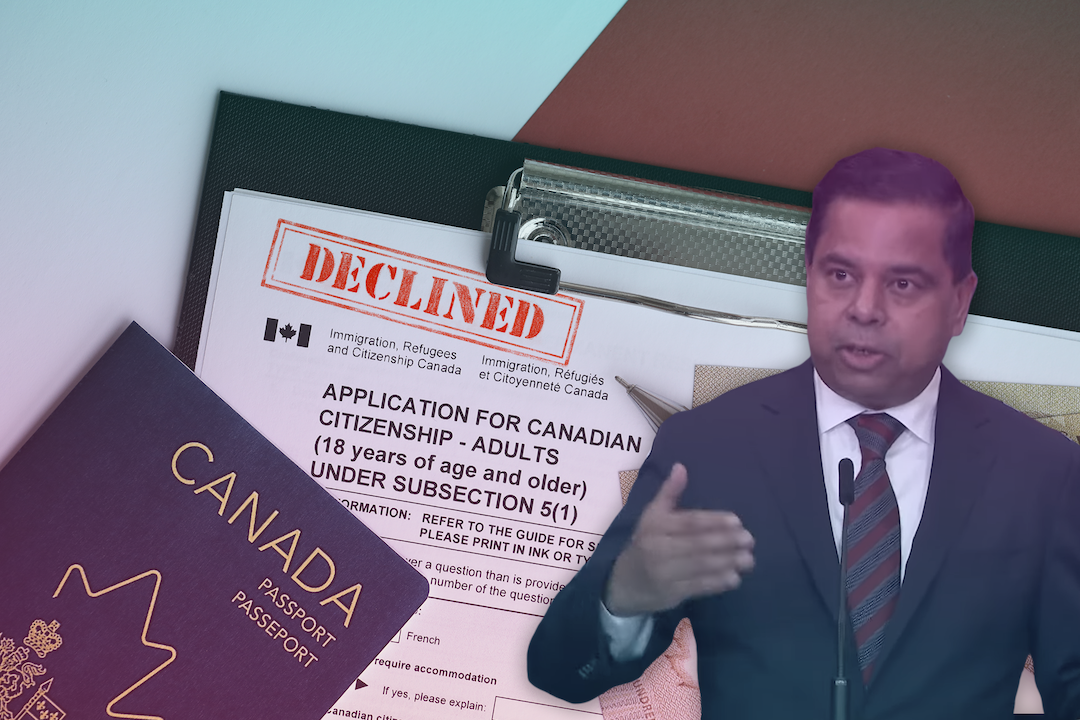
The Liberal government’s new immigration legislation, which was passed in the House of Commons yesterday and is on the verge of being made into law, is rooted in rhetoric that casts migrants as “dangerous” and “unwanted”—rhetoric that the very Liberal ministers overseeing it once blasted the Conservatives for engaging in.
In 2008, then-Prime Minister Stephen Harper formally apologized for Canada’s response to the Komagata Maru, a ship carrying 376 Indian passengers who were blocked from disembarking in British Columbia in 1914.
“We cannot change the events of the past,” he said, “but we can bring Canadians together in the present to unite our country, and to set us on a course to accomplish greater things in the future.”
Two years later, his government was instrumental in creating the moral panic surrounding the arrival of the MV Sun Sea, a cargo vessel holding 492 Sri Lankans seeking refuge in Canada. Following their arrival, the passengers were arrested and detained by the RCMP—several of them were deported back to Sri Lanka where they suffered torture and even death.
In 2020, Liberal MP Gary Anandasangaree lamented the “failure” of the Harper government to do the right thing. “The narrative that these refugees were dangerous, unwanted and unwelcome strangers was set weeks before the arrival of the MV Sun Sea,” he wrote in the Toronto Star. “Being a refugee is neither a choice nor a crime; it is a necessity.”
Yet earlier this year, now as minister of public safety, Anandasangaree introduced Bill C-12, an omnibus piece of legislation which will severely restrict access to the refugee protection regime, increase deportations and detentions, and introduce highly discretionary powers in the name of “public safety.” The bill passed third reading in Parliament on December 11.
Representing seven different migrant justice groups, we are appalled by the wave of anti-migrant laws and policies being introduced. It is clear these policies are part of a long history of Canada scapegoating migrants. They will exacerbate racism and xenophobia and manufacture consent for Trump-style authoritarian agendas.
Bill C-12 was tabled just as drastic cuts were announced that will prevent more people from accessing permanent residency. This will impact refugee applicants, international students, temporary workers, and the thousands of people already residing in our communities without the papers needed to live with dignity.
These policy announcements are framed in language that has become the norm: instead of taking responsibility for decades of neglecting public infrastructure and services, politicians blame migrants for growing inequalities, sending a chilling message that they are not welcome.
While these policies are often framed as “shifts,” they are in fact part of the foundation of Canada’s immigration strategy. Although separated by nearly a century, the stories of the Komagata Maru and the MV Sun Sea connect a throughline in immigration discourse and policy in Canada—one tying together borders, empire, capital, and national narratives.
Settler-colonial sovereignty in Canada was first established through the theft and exploitation of Indigenous land, the displacement and dispossession of Indigenous peoples, and the control of labour through policies that determined who could enter, work, and remain in the country.
In parallel, imperialist wars and global capitalism have forcibly displaced more and more people, gobbling up their land, forcing them into starvation wage labour, and stoking the climate crisis. Canada’s role in this global apartheid system happens through its mining and fossil fuel industries, as well as its own military-industrial complex which is arming the perpetrators of genocide in Sudan and Gaza.
Yet, when people on the move arrive at the border, they are sorted into categories based on perceived “desirability.” These classifications are shaped by race, geopolitics, and economic interests—refugee, migrant, temporary worker, even “security risk.”
The border controls the flow of capital and labour, enforced through state violence, under the framework of “national security.” Today, the border is deeply tied to militarization and surveillance, intensified since the so-called ‘War on Terror.’
With a 40 per cent increase in the military budget and a significant increase in the number of RCMP and Canada Border Services Agency officials, the surveillance state and the war on migrants are about to intensify.
The net effect of these policies is to push more people—our neighbours, friends, schoolmates, and those who grow our food and take care of our families—into precarity. This spells lower wages, more exploitative working conditions, no access to public services and protections, and life in constant fear of detention and deportation.
This is what the war on migrants and constant scapegoating intend to achieve: capital accumulation and labour exploitation in service of the wealthy and powerful.
Instead of issuing empty apologies decades from now, this government can avoid a lot of harm by enacting an immediate, full, inclusive regularization program, withdrawing Bill C-12, and ending the Safe Third Country Agreement.
Indeed, Anandasangaree is right to say “migration is not a crime.” We need to recognize our shared humanity across borders and choose solidarity instead of manufactured division.
This article was collectively authored by the following:
Nazila Bettache is a physician and member of the Caring for Social Justice Collective, based in Tiohtià:ke.
Titas Banerjee is a member of South Asian Diaspora Action Collective (SADAC).
Samira Jasmin is a member of Solidarity Across Borders.
Amel Zaazaa is the co-founder and executive director of the Observatory for Migrant Justice.
Camille Bonenfant-Martin is a member of Common Front against Bill C-12 and for Migrant Justice.
Karen Cocq is the co-executive director of the Migrant Workers Alliance for Change (MWAC), a membership-based organization of migrants, and has been active in migrant justice and workers’ rights organizing for 20 years.
Mostafa Henaway is a community organizer with the Immigrant Workers Centre.

When I went to journalism school 10 years ago, my parents thought that they would eventually read my articles in The Montreal Gazette. Today, that newspaper is a husk of its former self. But I get to explain that I’m working towards critical, independent, and sustainable journalism.
Want to be a part of the future of journalism? Support our work with a monthly contribution. Sign up here.
– Amanda Siino, Development Director, The Breach
Immigration | Carney’s border bill is a gift to Trump—and a roadmap to ‘mass deportation’
Migrant Justice | Liberals and Tories perfected the exploitation of migrants for big business
Immigration | The media is blaming immigrants for the housing crisis. They’re wrong
1 comment
Comments are closed.

It’s not really a war on migrants though. Canada will still be admitting tons of immigrants. Immigrants that we can’t really afford to let in due to crumbling infrastructure and public services. And while it’s true that the infrastructure and services issues are the governments fault that doesnt change the fact that allowing in far more immigrants than what we can accommodate is a bad idea.
It’s also important to note that refugee doesn’t mean the same thing it used to. Refugees used to be fleeing situations where there could reasonably say they were in grave danger. Now refugee is a term slapped onto anyone who claims it regardless of whether or not it’s true. Thus the rise of economic refugees. People that use the title and render it meaningless.
It’s not scapegoating to point out something true. Mass immigration has clearly eroded public services, health care, and housing. There are government reports, and research that supports this. No one is blaming the immigrants that took advantage of poor immigration policy. They’re blaming the government that put the policy in place. Articles like this are a smoke screen to excuse bad immigration policy by saying curtailing mass migration is racist. When really you just support terrible immigration policy and have no reasonable way to support it so you pretend that what is happening is different than what is actually happening.