
It was a “very unusual” scene: an older woman in a wheelchair being confronted by an armed police officer in a stark show of force.
In May, a migrant in her late 50s named Clara attended an immigration appointment in Montreal. After an agent from the Canada Border Services Agency (CBSA) issued her a deportation order, her lawyer noticed her distress and called an ambulance.
When the paramedics arrived, so did the police.
An officer approached wearing two handguns, one on each hip. Clara’s lawyer, Anne-Cécile Khouri-Raphael, recalls the officer loudly insisting that he would not remove his weapons because he feared for his safety.
“The kind of very loud voice, male presence, when facing someone far away in a wheelchair, was very unusual to me,” Khouri-Raphael told The Breach. “It felt incredibly asymmetrical in terms of a show of power.”
She believes CBSA called the police on Clara, whose real name and country of origin The Breach is withholding given the sensitivity of her situation, after Clara said she was afraid to return to her home and was thus deemed a flight risk by border agents.
As Prime Minister Mark Carney’s Liberal government has set aggressive targets for deportations, scenes like this are playing out across Canada, though particularly in Quebec, where CBSA agents are employing several escalating tactics.
The Liberal government has allocated $30.4 million to CBSA to expand enforcement, with a goal of carrying out 20,000 deportations a year.
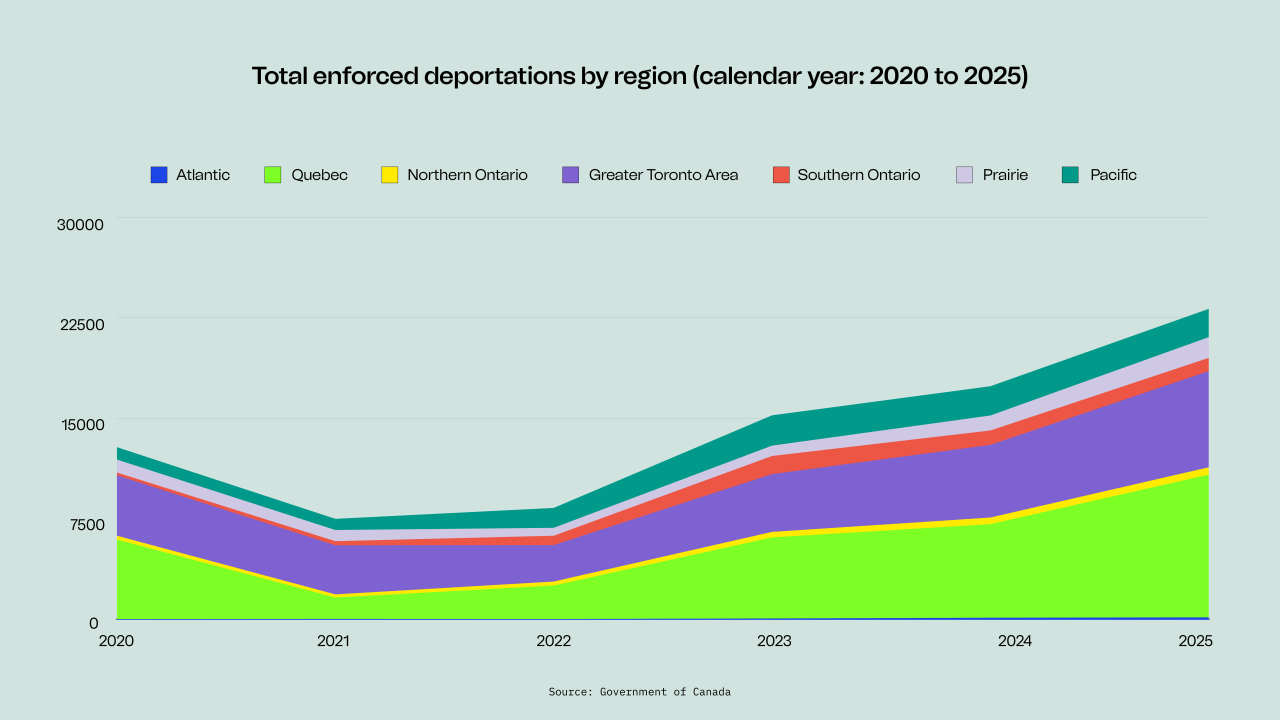
Carney’s Liberal government boasted that in 2025, they deported even more than that: 23,160 people, the highest number in one year in Canada’s history.
More than half are being deported just from Quebec, where hundreds of migrants are being removed on a weekly basis.
Multiple immigration advocates and lawyers told The Breach they’re witnessing aggressive tactics that include CBSA detaining migrants without any prior contact, and plainclothes officers confronting migrants at their homes, workplaces, places of worship, and elementary schools.
Typically, the agency conducts an initial risk assessment with migrants that they are monitoring before deciding how to proceed. Rarely are migrants detained and told they’ll be deported on first contact—which advocates say is now happening more often in public and private places.
The border agency is also rushing to cut off asylum-seekers’ legal options for staying in Canada.
Border agents are deporting migrants whose applications to stay in Canada are before the courts, and targeting the family members of migrants who have already secured protected status, in some cases breaking up families.
Gwen Muir, an immigration lawyer with the Migrant Justice Clinic in Montreal, calls the escalation of deportations and CBSA tactics “harsh and unprecedented.”
Increasingly reminiscent of the U.S.’s migrant crackdown, advocates attribute the actions to a border agency flush with expanded funding and emboldened by a growing anti-migrant political climate in Quebec.
Border agency ‘speeding through’ with deportations
Mostafa Henaway, an organizer at the Immigrant Workers Centre in Montreal, told The Breach that CBSA in Quebec has been engaging in a “very unnerving” rush to remove those whose asylum claims have been rejected before they can use any other legal tools to stay in the country.
A person whose asylum claim is rejected can appeal the decision, apply again on humanitarian grounds, or ask the Federal Court of Canada to review their case. But all of these processes take time, money, and—usually—lawyers.
They can also apply for a Pre-Removal Risk Assessment (PRRA) to make sure they’re not being deported to a country where they could face torture or persecution. But they have to wait 12 months between when their asylum claim was rejected and when they can apply for such a risk assessment.
Henaway said rejected refugee claimants are being deported before the 12-month waiting period is up.
Individuals with precarious status are trying to temporarily halt the removal orders with an urgent legal motion known as stay of removal requests, while other legal challenges are pending.
“Every community organization is absolutely saturated with these requests,” Muir from the Migrant Justice Clinic told The Breach. “Rather than waiting for some applications to go through, CBSA is just speeding through with removals instead.”
CBSA did not return a request for comment by publication time.
The Montreal CBSA office is now processing about 200 deportations each week, said Henaway. “That drastic rise is really putting us in the eye of the storm.”
Families caught in Quebec’s deportation surge
At first, Henaway assumed what was seeing in Montreal was happening across the country. But then he noticed CBSA enforcement in his city was going beyond what was happening elsewhere.
“In Quebec, CBSA was rushing to execute deportations even if the circumstances didn’t warrant it,” he told The Breach. “Even if people had their children in school, or their children were Canadian-born, or if they had medical issues.”
Gaurav Sharma, another organizer with the Immigrant Workers Centre, usually supports clients with issues of unpaid wages or health and safety concerns. He’s now fielding regular calls from workers who have had police or CBSA show up to their homes.
“I can understand they are doing their own duties,” Sharma said of the authorities. “But my God, the police are coming and children 10 years old are witnessing the situation. What kind of impression and impact does that leave, when police are arresting their father or mother and then deporting them?”
Maryse Poisson, the director of social intervention at the Welcome Collective, an organization supporting people with precarious immigration status in Montreal, said that in the last two months alone her organization has worked with eight families where a parent was set to be deported while their children would remain in Canada.
The Welcome Collective’s recent cases have included a father who was set to be deported to Mexico, where he fears persecution by drug cartels, while in Canada he is caring for a seriously ill child and his spouse is pregnant.
In another case, the mother of a newborn was set to be deported to Guinea, where she faced family abuse and forced female genital mutilation, without an assessment of the risks she would face if deported.
Both of those deportation orders have been stayed.

These are just two examples among a spate of family separations that spurred the Welcome Collective and the Table de concertation des organismes au service des personnes réfugiées et immigrantes to hold a press conference in May calling for a federal policy to suspend deportations that break up families.
“These are truly inhumane situations,” said Louis-Philippe Jannard from the Table de concertation at the press conference.
Policy changes fuel a removals crackdown
Quebec is home to a disproportionately high number of asylum seekers in Canada, as it is a major entry point for asylum seekers travelling by land through the U.S.
But Henaway said that doesn’t fully explain the situation in Montreal.
“I don’t think it’s just a numerical question that there are more refugees [in Montreal],” he said, “because if you look at the GTA or the Vancouver area, proportionately our rate of deportation is much higher here.”
CBSA data from the first quarter of 2026 shows that the number of deportations from Quebec is more than double that of the Greater Toronto Area, and on pace to surpass the region’s record high of over 10,600 deportations set last year.
“There is something happening here in Quebec, specifically, to target asylum seekers and create this deportation machine,” said Henaway. “It’s not coincidental.”
According to public opinion research conducted by the federal immigration department, 2024 was the first time in over 30 years that a majority of Canadians held a negative view of immigration, in the wake of increased anti-migrant scapegoating from right-wing politicians and establishment media.
In 2024, Liberal Prime Minister Justin Trudeau abandoned a promise to grant status to undocumented workers, and tightened the criteria for admitting international students and temporary foreign workers.
Then, in 2025, Carney passed Bill C-12, which further constricted the avenues to claim refugee status, and gave the government sweeping powers to cancel immigration applications. The federal government has sent out 30,000 letters to asylum seekers telling them they may now be ineligible for a hearing at the Immigration and Refugee Board.
A 2025 government directive on deportations outlines several categories of non-citizens involved in criminal activity or human rights abuses as the highest priority for removal orders. The document adds that failed refugee claimants who entered Canada without passing through an official point of entry are also a top priority for deportation “due to their impact on the asylum system.”
Quebec happens to be the dwelling place of many rejected asylum seekers who entered Canada outside of ports of entry, particularly from New York state through the now-shuttered passage at Roxham Road.
CBSA data for the first three months of 2026 shows that about 83 per cent of removals are of unsuccessful refugee claimants. CBSA prioritizing these migrants for deportation appears to be a factor in the high number of people being targeted in Quebec.
Former Quebec Premier Francois Legault, who ran on a campaign promise to slash immigration levels by 20 per cent to prevent “extremism” and “violence,” has similarly choked immigration pathways in the past few years.
Legault’s Coalition Avenir Quebec (CAQ) government also removed benefits from asylum-seeking children with disabilities, and repeatedly threatened to cut off social assistance for asylum seekers unless the federal government increased its funding to the province.
All of this has led to a growing number of migrants left without status and supports in Quebec after overstaying their work or study permits.
The response from organizers, said Henaway, must be to point out that governments are unfairly scapegoating migrants: blaming immigrants for the housing and affordability crises, then deporting historic numbers of people in order to appear proactive in addressing worsening social and economic problems.
“With all of the scapegoating, nothing has changed,” said Henaway. “Our cost of living crisis hasn’t changed, our housing crisis hasn’t changed. In fact, we’re facing even more austerity in our public services.”
“It has nothing to do with the amount of immigrants here in the country.”
Meanwhile for Clara, her detention was averted when her lawyer, Khouri-Raphael, pleaded with police, informing them of Clara’s poor health and vulnerable state.
They chose not to take her into custody. But Clara’s deportation order stands, and she is now making appeals to a court to remain in Canada.

I often hear that I’m lucky to have a full-time job in journalism.
Critical, bold journalism that isn’t beholden to media monopolies should be the norm—not the exception.
By supporting The Breach, you’re supporting a more robust, progressive media. Join us today.
– Katia Lo Innes, Associate Producer, The Breach
Immigration | He spent years defending Tamil refugees. As Minister, he’s refusing to stop a deportation back to danger in Sri Lanka
Migrant Justice | What Canadians can learn from U.S. resistance to ICE terror

Migrant Justice | Detentions, deportations, death: Canada’s border service acts in tandem with ICE

9 comments
Comments are closed.


I support a general increase in deportations.
Why? What problem do you think that will solve?
As usual, Canada follows the USA lead, but does it more quietly, without a lot of fanfare, so Canadians can have their cake and eat it too.
Continue to believe in their humanitarian superiority to Americans, and quietly look away while the same racist exploitation goes on inside our cities.
PS. Your captcha BS isn’t clear enough in many cases for an 80 year old with three degrees to see clearly.
I think Canada/Canadians/the Canadian government should be ashamed deporting so many people. We don’t have a housing crisis because there are too many immigrants, we have a housing crisis because housing starts and support for affordable housing has been handled badly by various levels of government. We NEED immigrants, and there will be more and more refugees as the climate crisis worsens. I don’t want these refugees left to die because Canada has a lousy immigration policy.
This is great news. Well done, CBSA
Why? What problems do you think this will solve?
Wish there was a ‘like’ button as I completely agree with the comments of both ingamarie and Debbie Smart.
Indigenous people like myself need to start deporting white people (Starting with the ones in the comments). FUCK KLANADA, the real illegals are white people