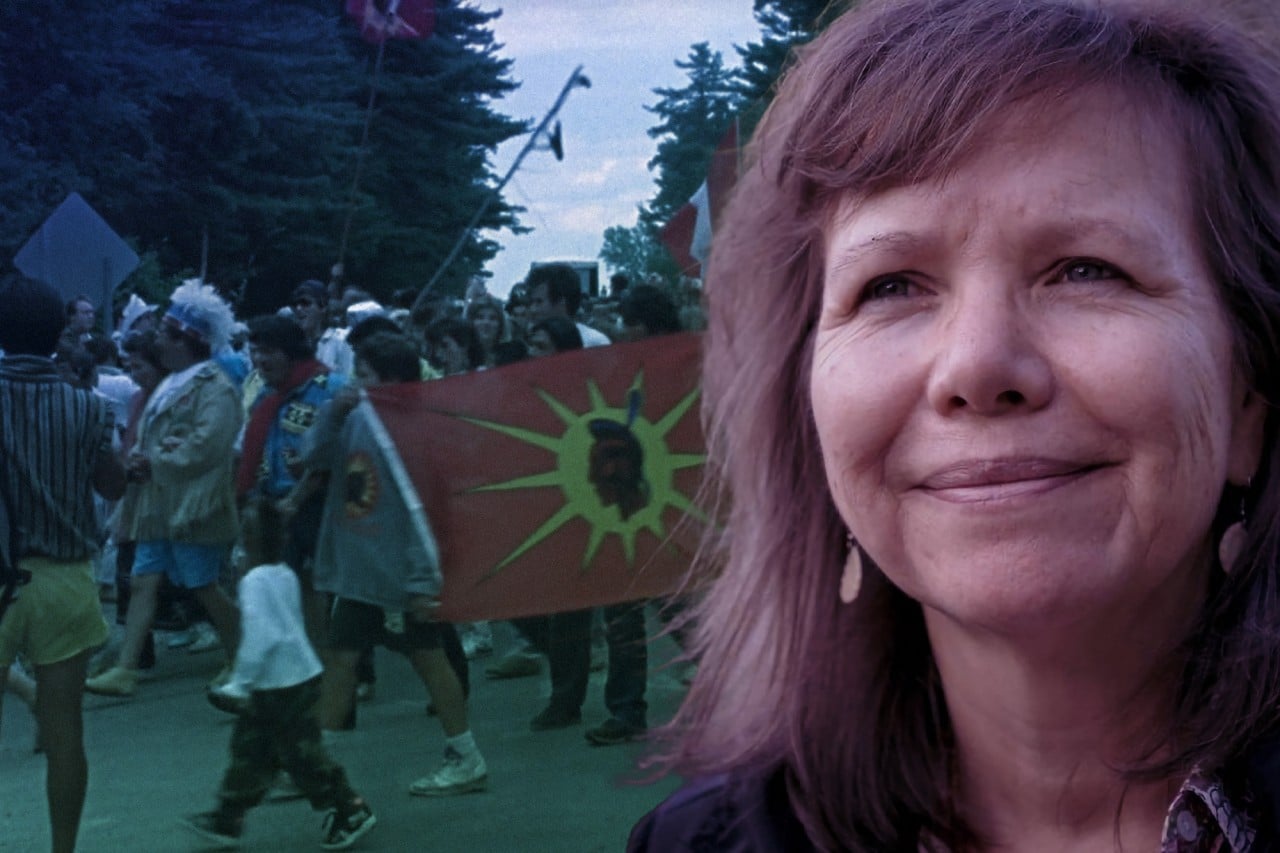
Anyone who has seen news footage from the 1990 standoff between Canada’s military and the Mohawk nation will remember Ellen Gabriel—amidst the heightened tensions, she radiated a quiet and calm strength.
The Mohawk activist, visual artist, and filmmaker is best known for her role as a spokesperson for her community during Canada’s military siege of Kanesatake, otherwise known as the “Oka Crisis,” when Mohawk land defenders stood up to developers attempting to bulldoze the community’s cemetery for a golf course.
But her legacy extends to this day. She has worked to advocate for Indigenous rights and self-determination, including efforts for language revitalization, land reclamation, and justice for missing and murdered Indigenous women.
In her first book, When the Pine Needles Fall, recently long-listed for this year’s CBC Canada Reads, Gabriel offers a look at her life up to the 1990 siege, and her activism since.
In the following excerpted conversation with historian Sean Carleton, Gabriel reflects on the fight for a decolonized future—including how to challenge the corporate and colonial interests trying to destroy the planet.
Sean Carleton: Let’s talk about the role that thinking and dreaming of the future plays in the work of building a better world. In one of our first conversations, I talked about Sioux historian Nick Estes’s book, Our History Is the Future. In the book, he argues that for Indigenous Nations, “There is no separation between past and present, meaning that an alternative future is also determined by our understanding of our past.”
Similarly, in Rehearsals for Living, Robyn Maynard and Leanne Betasamosake Simpson make clear that looking backwards, and understanding the devastating effects of genocide/slavery/settler colonialism/capitalism, is key to looking forward to a better world. Maynard argues: “it is necessary to have the courage to envision the end of this world, that is, the world that white supremacy built, to move toward futures that are premised on life rather than (human, ecological, animal, microbial) waste… I believe that world-ending and world-making can occur, are occurring, have always occurred, simultaneously.” As Maynard points out, the “future feels daunting,” but dreaming of what might be is the only way forward.
Ellen Gabriel: We have a teaching that the land is sacred and that we need to also protect it for present and future generations, and for all our relations. When we understand and try to follow our traditional teachings, then we must think about the future and what kind of legacy we’re leaving those not yet born. This includes the deer, fish, birds, waters, plants, and even insects.
As an Indigenous person, this is what we’re supposed to be thinking about as well, but because of colonial assimilation, there are many Indigenous people who don’t follow that philosophy or belief nor even respect it. They’re focused only on the present and not thinking about their broader responsibilities. It’s one of the impacts from the Indian Residential School system and its cultural shaming, with the messaging that we were inferior; it’s a sort of survival instinct whereby they’re coerced into assimilating this messaging. And so, there are some who turn their backs on their culture and their language, our ways.
But there are a lot of young people who are continuing the resistance movement, like Eriel Tchekwie Deranger and Indigenous Climate Action, who are picking up their duties to protect Mother Earth. They’re fighting against the tar sands and destructive pipelines out in Alberta and British Columbia. They’re on the frontlines of trying to make a better world. They’re aware of how destructive fossil fuels are and how human activities are jeopardizing our collective existence on this planet.
We all want to have a better quality of life. But some Indigenous people, because of the impacts of the Indian Residential School system, approve unsustainable resource extraction on their Homelands without realizing the consequence it has—the destruction of the environment and the threat it creates to the quality of life for their families, future generations, and all our relations.
For example, there is a toxic waste dump here in Kanehsatà:ke, created behind closed doors between the band council and the owners of the dump. All done without any consultation with the community; no free, prior, and informed consent. It’ll be thousands of years before any generation can enjoy these lands again. It’s frustrating because Canada supports this form of dysfunction: it’s so sad for the community, the land, and for future generations. I think it’s part of the punishment that Canada and Quebec have had against the Kanien’kehá:ka of Kanehsatà:ke since 1990. They have abandoned their duty to uphold the highest standards of human rights, and so we in the community are left to protect our own security.
It’s important for the general population to understand that Indigenous Peoples have a diversity of languages, cultures, and beliefs. There is a diversity of Indigenous people too, some who want to protect and practise the teachings of our ancestors, the ceremonies, our governance system. But there are also ones who promote the economic agenda of the colonizer, assimilating capitalism into their daily life, which creates havoc in our communities, and they are rewarded and can do what they want without any consequences. They’re rewarded by settler society’s government, while the rest of us are just labelled radicals, troublemakers, or criminals.
When people talk about saving the planet, it’s really backwards. We’re trying to save our species on this planet because, you know, Mother Earth’s been here for billions of years. We’re just a tiny blip in her existence. It’s an important teaching that people need to be reminded of when they make statements like “mining is progress,” or “development is progress,” because the focus is on how these projects provide jobs and economic benefit, and we hear the rhetoric that Canada must be competitive in the world market. Progress seems to mean ruining lands that can provide food and medicine for us, lands where we find peace in this frustrating world of ours.
For me, progress refers to how we sustain ourselves on this planet into the future, how we find ways to survive the climate crisis, how we have a peaceful coexistence free from war and violence. But some people in power don’t think this way; they’re not concerned with finding ways to be economically prosperous while still taking care of the planet for future generations.
I think it’s really important that people understand that when we’re talking about “environmental activism,” we’re really talking about having respect for Mother Earth and loving all our relations enough to put our lives on the line to protect the future. When we put our bodies on the land to protect it, we’re often discredited and our reputations attacked, either within our communities or by outside forces that incentivize the divide and conquer approach. But we’re only doing what is our responsibility under our own Indigenous laws and obligations. History will show that what we’re doing is the only choice we have if we’re to be true to ourselves and to honour Mother Earth, giving the future generations a fighting chance.
Carleton: Maynard and Simpson argue this exact point in Rehearsals for Living. Maynard explains, “I believe that I am able, that we are able, to commit together to demanding the impossible because we are steeped in old-new, future-oriented political traditions that show us that there is nothing inevitable about the present, that it need not be permanent.” She clarifies by saying, “Abolition is imagination work, anticolonial struggle is imagination work, conjure work, science fiction in real time. It is daring to see that the world now did not need to be as it was, does not need to be as it is, and certainly, most importantly, need not—will not—remain this way..”
Thinking about the “imaginative work” of looking to the future, what do you think the next generations will need to contend with? How can we rebuild the world in better ways in the coming decades?
Gabriel: I always try to remain optimistic. So, I’m hopeful we won’t just go back to the old normal and that we fight to make the “new normal” more sustainable and inclusive, in many respects.
I want youth to remember those Indigenous Elders and people who fought hard in the resistance movement to try to make changes before they were born; to build on the strategies of the past and learn from the strengths and weaknesses of resistance to make their efforts stronger and more effective. I hope for the youth and those not yet born to be able to live on a planet that has the capability to provide them with clean water, good food that’s not contaminated by pesticides. It would be beneficial to use the framework of an Indigenous democratic society, to feel included, to want to become involved in their community.
We need change, a kind of radical change. We have some serious work to do in restructuring our societies, and we have reconciliation work to do with Mother Earth and all of our relations. There are too many leaders, on all sides of the colonial spectrum, promoting the status quo of oppression, ignoring human rights and environmental rights. They’ve been ruining the land and waters for centuries, and that’s the “normal” we need to move away from. We need to find ways to be kinder to each other and to be more respectful of all life on this beautiful planet.
In the economic world they say there are two things that make the world turn: fear and greed. I see a lot of people afraid of losing money. Greed is such a powerful force in our capitalist world. As an example, the developer who is knowingly selling Kanien’kehá:ka lands to build luxury homes, claims to understand the Kanien’kehá:ka of Kanehsatà:ke, our history and our struggle. However, it’s evident from the fact that he never stopped selling lands which don’t belong to him, that all he cares about is the bottom line. His goal isn’t “reconciliation” but to make money, and it would affect his profit margins if he were to respect our rights. It’s all about greed.
We must continue the struggle and challenge the colonial laws and policies that are used to contain and constrain Indigenous Peoples. We need to dream and imagine what a better future can look like and work hard to bring it about. But there are so many rich and powerful people with seemingly limitless resources who work hard to maintain the status quo. Those of us demanding justice, our lands returned, are labelled radicals, threats to the economy, dangerous. But in truth, the current “economy,” as it functions now, is the real threat to our collective survival on this earth. That’s the issue. People who benefit the most from extraction and exploitation want all of that profit to continue, they’re okay with the destruction of the earth for their own gain.
They have no problem trampling the human and environmental rights of Indigenous Peoples and all people and all our relations. While Indigenous people are not against “development,” many of us want to ensure that development is sustainable and done in ways that benefit and protect future generations—not just a billionaire’s profits. We need to really start thinking about this and the best way forward. I hear people say they care so much about children and youth.
Well then, the future generations’ rights to inherit a healthy environment needs to be prioritized. Indigenous communities need to have access to clean drinking water, we need to restore the ways of survival we’ve been given by previous generations. We have to persistently protect our rights, our identity, and our lands. It’s because of the Canadian bureaucracy and apathy that the issue of Indigenous Peoples’ human rights and our long-standing historical concerns have dragged on for this long. We must be able to protect our languages and cultures, which are the foundations of our relationship with the land and the key to our survival. But it’s always the rich—the one per cent who are calling the shots (businessmen and politicians and corporate lobbyists)—whose motivation is based upon fear and greed but never a human rights-based approach.
Climate change is wrapped up in the consequences of genocide, slavery, colonialism, and capitalism, and we need to fight to change the whole system that is threatening our survival here on earth. A future in which there is peace and security whereby Indigenous Peoples who are following their Traditional Laws can leave behind a good, peaceful, and prosperous way of life for future generations.
Carleton: Art Manuel talks a lot about how colonialism brought capitalism, and capitalism is about extraction for profit for very few people. He always says he’s not against development, but that Indigenous Nations need to be able to control and benefit from development in ways that take care of future generations—and that will benefit everyone. Nevertheless, many Indigenous Land and Water Defenders are perceived to be against development when, as you’re saying, it’s about creating a future that can sustain the next seven generations. Do you think there are any positive signs that things are changing?
Gabriel: In some ways, with Indigenous people working with environmental NGOs and other allies, there is growing momentum to work together to protect Mother Earth. The TRC has an important Call to Action that advocates for all members of society to learn about Canada’s genocidal project and speak the truth about Indigenous Peoples’ experiences and realities in the Americas. This includes naming all the religious ideologies and European countries who benefited from Canada’s genocidal project. It also calls for people working in government to use a human rights lens and Indigenous rights perspective in their work.
But Canada has placed most of the burden of reconciliation on the shoulders of Indigenous people. It is, as the TRC said, the responsibility of Canadians to change society and strengthen relations with Indigenous Peoples. No one can afford to be complacent.
Over the five hundred years since Contact, Indigenous people have gone from a collective mindset to an individualistic mindset, and that shift is hurting the people, our cultures and languages, and most importantly, the land. It’s really an overwhelming situation. We don’t have the opportunity that time can provide because we have passed the tipping point. And as the world struggles with all its problems, Indigenous Peoples’ human rights are marginalized, making it harder to decolonize, and so justice in these lands and for its peoples is not equitable. Justice is slow, costly, and not easily accessible—it’s only for the rich few. Most Indigenous people cannot afford it. The costly, biased, and racist colonial court system is too expensive, has been ineffective, and sets dangerous precedents for Indigenous people if there are any bad judgments against us.
It has been evident for too long now that the moment to act was decades ago. Indigenous Peoples need to be the ones setting the timelines, the parameters of negotiations, so that we can implement the intergenerational knowledge of how to survive an apocalypse. That’s what we’ve been doing for five hundred years.
At the end of the day, I think all of us, no matter what your belief system is, want to feel safe and be able to feed our families and be able to speak our minds without fear of any kind of reprisals. In many Indigenous communities, and because of social media bullies and racists, that freedom purportedly attributed to a democracy does not exist. I don’t think people really understand what democracy is, that everyone must contribute to society to evolve and create positive change.
How many people are actively involved in the decision-making processes in their communities? Voting every few years isn’t enough. A democracy requires that people get involved and take action to protect themselves and the land. When people are passive about their rights and leave the decisions to so-called leaders it opens the doors to corruption. Today it’s lobbyists who influence governments so they can justify, through economic prosperity, the violation of everyone’s human rights. More attention and vigilance are required from us all.
This is an adapted excerpt from When the Pine Needles Fall: Indigenous Acts of Resistance by Katsi’tsakwas Ellen Gabriel with Sean Carleton, published in September 2024 by Between the Lines.

“It’s about getting to the bottom of things. It’s about unveiling who has the power and what they’re doing with that power.”
Linda McQuaig, journalist and author
As a non-profit, free from powerful corporate interests, we invest in investigations and uncover the cover-ups. Sustain our journalism for transformation.
Indigenous Rights | ‘Economic reconciliation’ is a false promise for Indigenous peoples
Oil Industry | Alberta’s anti-energy inquiry aims to undermine First Nations opposition to Tar Sands
Activism | Indigenous rights are a counterforce to the climate crisis
1 comment
Comments are closed.
Ms Gabriel makes it sound like Indigenous peoples have always lived in peace and harmony when we know that is not true. There were wars around territories and some of the conquered were kept as slaves. Yet you will never hear an indigenous person speak about these things. They’re not called “Mohawk Warriors” for nothing.