When ten programmers resigned en masse from Hot Docs last week, it sent shockwaves through Canada’s cultural industry and documentary community.
While many are learning for the first time about the fault lines concerning working conditions at the country’s most important documentary festival, the problems have been a long time in the making.
More than a decade ago, I sat down with Hot Docs’s then Executive Director, Brett Hendrie (he stepped down in March, 2021), for a spirited conversation about festival ethics. I was researching Hot Docs for a doctorate and had approached Hendrie for a chat in a pub near the festival’s headquarters. That year, Coca-Cola had come on as its Environmental Film Sponsor, and I conveyed staunch opposition that was shared by many in the documentary community.
“This is major greenwashing at a hugely important event devoted to documentary!” I exclaimed. Hendrie looked at me calmly. “Look outside at those busy Toronto streets,” he said. “How many people do you think have even heard of Hot Docs?”
While there was some truth to documentaries being the lesser-cared-for cousin in the film family, it was a poor justification for partnering with corporate giants like Coca-Cola. Regardless of documentary’s station in the world of entertainment, Hot Docs was then, and still is today, one of the most important institutions for the production and distribution of documentaries in Canada. What happened there mattered.
The festival’s roots were as a unique filmmaker-run organization, begun in 1993 when watching documentaries in public with strangers was a relatively novel idea. Over the next thirty years, Hot Docs helped grow the documentary audience, offered crucial training programs, corralled millions in funding for projects, and annually convened the documentary community. In 2019, it finally listened to the urging of filmmakers and had an Indigenous director open the festival.
But Hendrie’s remarks at the time were sobering—a sign of how the organization had evolved, and what was to come. The ethical compromises management was willing to make for a major corporate sponsor were not isolated, and would soon extend to working conditions as well.
As part of research on the festival for a forthcoming book on Hot Docs, I’ve found that many of the festival’s institutional pathologies originate in its adherence to tenets of neoliberal capitalism: bigger is better, high pay at the top with benefits supposedly trickling down, and the cultivation of corporate partnerships over diverse political relations.
The pursuit of an American-fashioned, pop-commercial growth meant that the festival’s leadership eventually ran the non-profit, partially-publicly-funded organization as a kind of entertainment business.
Belief in this model got Hot Docs to where it is today: influential, important, and in trouble.
A stream of resignations becomes a flood
The programmers who quit Hot Docs last week called into question not only the festival’s management, but its direction—revealing deep fault lines in the festival’s foundation.
While it is undeniable that festivals, like most cultural institutions in Canada, are facing challenging times in the post-pandemic, inflation-burdened, Netflix-and-perish era, the programmers helped us see through the marketing and public statements of Hot Docs to the political choices the festival has made.
In their public statement, the programmers stated: “We were expected to work in an ever-changing, chaotic, unprofessional and discriminatory environment.” The “toxic work environment” at Hot Docs, they said, included “lack of respect for protocol,” disregard of programmers’ views, and “breaches of contracts.”
While they were the first to quit en masse, an estimated 60 employees have left the festival since 2021. I’ve interviewed three former staffers—who asked to remain anonymous for fear of professional repercussions—who described a dysfunctionally top-down and disrespectful workplace.
Some quit because of the unreasonable pressures of the job. Others left because of the precarity or low wages. Still others left because of the lack of meaningful engagement and response to their suggestions to improve the festival.
The structural cracks were made official and public earlier in March, when newly hired president Marie Nelson told media that the pandemic was not over for Hot Docs and that it was facing a financial crisis that jeopardized its future.
Commentators were quick to draw disconcerting parallels to the Just For Laughs comedy festival, which canceled its Montreal and Toronto editions this year, citing rising costs and diminishing sponsors. Like Just For Laughs, Hot Docs relies on a combination of government funding, ticket sales, and corporate support.

(American) Power and its Discontents
The hiring of Nelson last year was celebrated in festival press releases but was a sign of another dimension of turmoil at Hot Docs.
Marie Nelson is a former VP at ABC News/Disney, and an American living in the United States. Gazing south of the border is not new for Hot Docs. The festival has chased the American dream for several years—notably in its historical mirror-programming of Sundance documentaries.
Yet the move by the festival’s board of directors to hire an American entertainment veteran who would remain in the U.S. was indicative of the lopsided power relations within the organization and the fawning respect Hot Docs has for U.S.-dominated commercial entertainment.
Nelson’s hiring points to a growing ethics chasm between Hot Docs’s decision-makers and its community. It was a move further inflamed by the claim—heard from former staffers I have spoken to—that Nelson is flown first class between countries and stays in “top drawer” hotels in Toronto.
The festival has been under the spell of commercial entertainment for some time. Programming trends support the argument that Hot Docs’s gaze has been too fixed south of the border: Cancon has steadily declined since the first edition three decades ago, while American films have made a rapid ascent.
Big ideas beyond big banks
Hot Docs’s motto is “Outstanding, Outspoken,” but in reality it has focussed on “outstanding,” mostly in the guise of commercially-viable documentaries. Meanwhile, it has been “outspoken” through the barest engagement with activism possible (Former president Chris McDonald once claimed in an interview with me that the festival “doesn’t do politics.”)
The corporate coziness and supposed political agnosticism put the festival out of step with much of the documentary community, a significant part of their audiences, and much of its former and present staff.
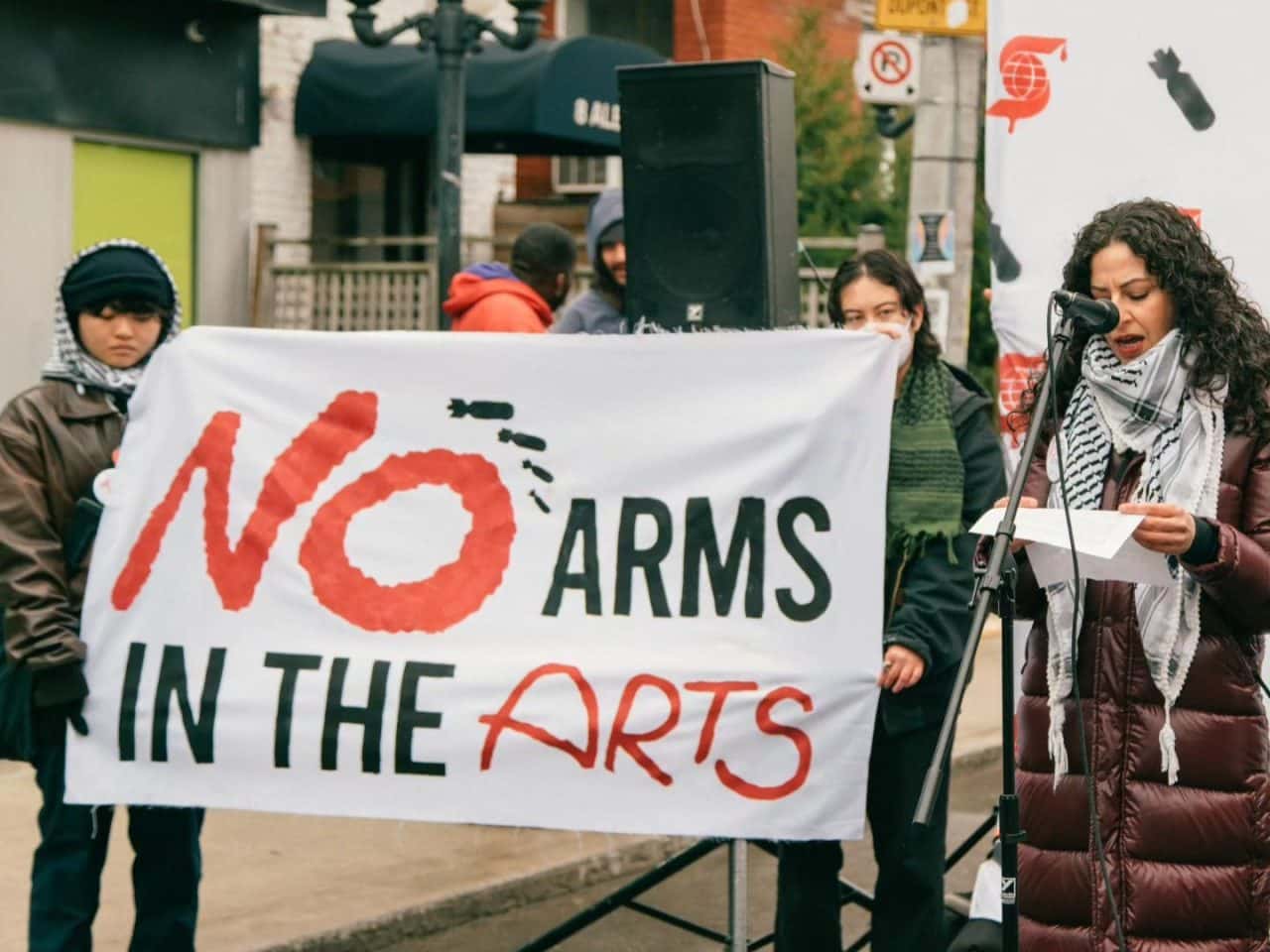
For example, Scotiabank sponsors the “Big Ideas” series at Hot Docs. On March 26th groups such as Film Workers for Palestine, Writers Against the War on Gaza, Artists Against Artwashing, and CanLit Responds held a rally demanding Scotiabank divest from Israeli weapons manufacturer Elbit Systems. They drew attention to Scotiabank’s funding of the festival and what they say is Hot Docs’s silence on Israel’s bombardment of Gaza. The festival’s statement on Gaza was interpreted by many, including some staffers, as a tacit support of Israel.
Hot Docs’s former Senior Industry Manager Julian Carrington, who worked for the festival from January 2018 to March 2023, told me in an interview that Israel-Palestine is just one issue among many that suggests Hot Docs is in need of a major reboot.
“I think it needs to be far more contemporary,” he said. “It is a festival that has tried to cater to an older demographic, but particularly post-pandemic, their habits have changed [to online]. Other festivals are pivoting towards younger people with their free memberships for those 25 and under, and Hot Docs should do something similar. They need to reinvent themselves. Who are the key constituencies in this city?”
The only path forward for a documentary festival in this decade is to connect with progressive younger generations, he said.
“Who are the politically-engaged communities that are going to come out for non-fiction cinema? Does Hot Docs’s posture around politics welcome these people? They need to proactively foster community, particularly among younger and more politically engaged people in Toronto and beyond.”

Time for a ‘workplace and labour policy’
Though it is abundantly clear that Hot Docs has myriad problems, these are only now being held to public account.
If it wants to maintain the support of its documentary community and evolve as a festival, there are questions it needs to answer . The festival has no public policy on corporate partnerships, or about which political organizations it works with (some embassies are embraced, for instance, while others are off limits,).
Hot Docs has prided itself on showcasing strongly-voiced films (even sometimes truly outspoken), yet it has a history of keeping screening spaces empty of civil society groups and activists.
Board members continually see their films programmed, including in the Canadian competition, raising concerns about the lack of a conflict-of-interest policy.
And with the exodus of fed-up and disaffected workers, where we might ask is their labour and workplace policy?
These critical questions cannot presently be answered because Hot Docs has yet to be transparent about its practices.The festival is certainly not alone in this regard, but it has a chance to lead—and it seems it now must, if it is to meaningfully respond to the recent walkouts.
According to those who have left the festival in the last two years, Hot Docs needs to shift into a new era—one marked by transparency, accountability, a healthy and sustainable work environment, fairness and equity protocols, political-engagement, community building beyond industry, and locally-focused programming.
Perhaps it could start this year by announcing a Workplace and Labour Policy, by joining thousands of other Torontonians who mark International Workers Day on May 1, or by offering some support to the movement calling for a ceasefire in Gaza.
It would be a welcome first among festivals, and ensure that those passing by on Toronto sidewalks will be hearing about Hot Docs for the right reasons.

“It’s about getting to the bottom of things. It’s about unveiling who has the power and what they’re doing with that power.”
Linda McQuaig, journalist and author
As a non-profit, free from powerful corporate interests, we invest in investigations and uncover the cover-ups. Sustain our journalism for transformation.
Independent Media | Canadian photojournalist’s spirit of solidarity lives on in donation to Gaza
Imperialism | Narcy reflects on the West’s ‘War of Terror’ and his artistic evolution
Liberalism | Leonard Cohen, Cold War Troubadour
2 comments
Comments are closed.

Hot Docs I am so sorry you are going through this mess. I sincerely appreciate all the work staff and volunteers have done for decades. Part of what keeps me in Toronto are these important cultural institutions. Please let me know if there is anything I can do to help.
At least half of the Hot Docs festival’s programming is progressive issue docs. BIPOC and LGBTQ2S+ directors have been statistically overrepresented for years. They wouldn’t accept a movie pushing a conservative issue in a million years. Saying that the financially struggling festival can be saved by becoming more politically engaged, creating more internal policies to administer, and by rejecting corporate sponsorships is risible. This write has a case of: my only tool is a hammer, so every problem must be a nail.