As Tamara Lich lingered in the convention hall at Ottawa’s Westin Hotel, an older attendee wearing a red “Make Canada Great Again” hat approached to ask her for a “huuuge favour.”
Lich—a far-right activist who spent short periods of time behind bars in the wake of her leadership role in Ottawa’s 2022 Freedom Convoy—looked up, startled.
“Is it going to send me to jail?” she said.
“No,” he said. “If I were you, my response would be: ‘I’ve been in jail so many times that one more couldn’t hurt.'”
The bizarre exchange captured something of the mood at this year’s Canada Strong & Free Network (CSFN) conference: once a policy-focused gathering of conservatives, the annual event is now increasingly defined by the personalities, grievances, and symbols that have come to shape Canada’s contemporary right.
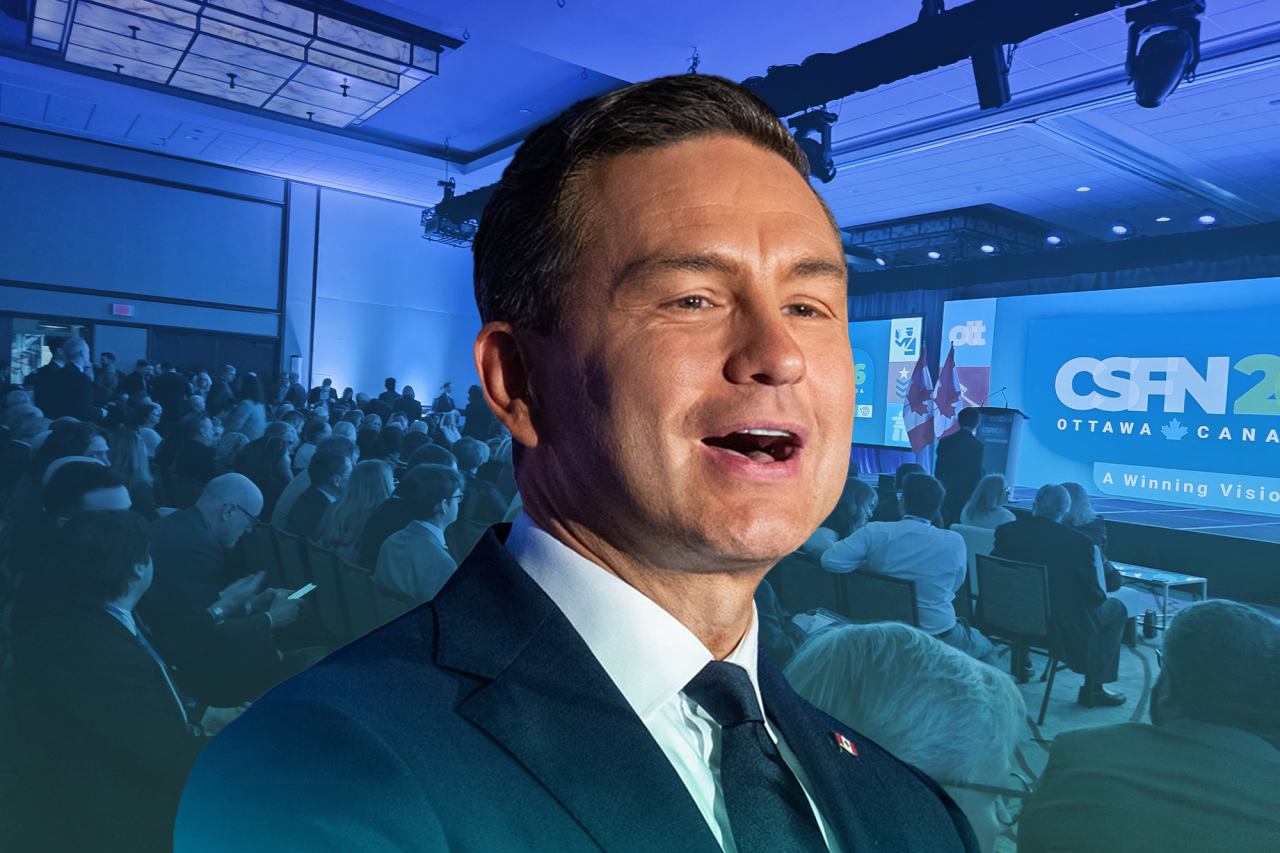
Inside the Westin, former U.S. Secretary of State Mike Pompeo, Alberta Premier Danielle Smith, and Conservative leader Pierre Poilievre headlined a conference billed as an opportunity to strengthen the conservative movement through coalition-building and chart a path forward after a turbulent political year. While The Breach has previously been refused accreditation to the conference, I was able to attend on a student pass to see how Conservatives were responding to a political landscape transformed by Mark Carney’s election.
Beneath the conference’s themes of unity and momentum was a more pressing question: what now distinguishes Canada’s conservative movement at a critical juncture when many of its core policy priorities have been embraced, almost wholesale, by Carney’s Liberal government?
Having attended the conference, listened to speakers, and spoken with attendees, I came away struck by how often conversations returned to issues of culture, identity, and national belonging. While debates over the economy and immigration remained central, many participants were less concerned with wonky differences than with broader questions about what it means to be Canadian, who “belongs” here, and the idea of the country they believe is being lost.
What follows is a non-exhaustive account of the conference that aims to capture some of the tensions and contradictions that animated one of the most influential gatherings in Canadian conservative politics—at a vital moment for the party.
Building the conservative network
Wandering around the conference hall was a small team of Rebel News journalists. Attending panels, networking, and conducting interviews, they largely stayed at the margins of the event. That was not the case for Lich. Despite recently receiving an 18-month conditional sentence related to her role in the Freedom Convoy protests, Lich attended much of the conference and was a frequent presence in the hallways between sessions.
In late-2025, Lich joined Rebel News. Since then, she has become a regular fixture on the conservative speaking circuit, including appearances on a Rebel-hosted Alberta independence tour. At CSFN, Lich appeared to be in organizing mode, coordinating an upcoming series of university events slated for the fall 2026 semester.
The tour, still in its early stages, was described to me as focusing on the state of democracy in Canada and lessons from grassroots organizing. While details remain sparse, it suggests that some conservative organizers are increasingly looking beyond elections and toward campuses as sites of political engagement.
Elsewhere, Mike Pompeo, Trump’s former CIA director and secretary of state, gave a fireside chat to close off the first day. Despite being billed as “Fortress North America,” Pompeo spoke very little about Canada, aside from its status as a geopolitical ally and the place where he got married. Instead, Canada appeared largely as a supporting actor in a broader Western project led by the United States.
Throughout the discussion, Pompeo framed the world as a struggle between the West and a series of authoritarian adversaries that reject “human dignity and property rights.” He argued that countries like Iran should be confronted before they become too powerful, suggesting that earlier intervention could have prevented many of today’s conflicts. “If we had handled them four, seven, or even 11 years ago, we supposedly wouldn’t have had the conflict we are dealing with today,” he remarked. The lesson, he implied, is that Western powers must be willing to project force abroad and see military conflicts through to their “logical conclusion.” In other words, we can’t have another Afghanistan.
Such an approach, Pompeo acknowledged, comes at a cost. It may require unprecedented military spending and sustained public sacrifice. But, he argued, those sacrifices would ultimately leave future generations in a “much better place in the world.”
At the end of the session, when asked whether he might run for president in 2028, Pompeo initially demurred before strongly hinting that a White House bid remains under consideration.
The following day, attendees were still discussing Pompeo’s appearance—more than I heard them discussing Poilievre’s keynote address.

Justin Trudeau: Why can’t we quit you?
You might think that no longer holding political office would mean your influence would wane, but you would be gravely mistaken. Poilievre’s keynote address made that abundantly clear. During his speech, he argued that, a year after Justin Trudeau’s departure, a “neutral and objective read of all the policies on the books … shows that nothing has changed.”
According to Poilievre, Conservatives have “won these debates so thoroughly that Liberals have stopped debating us altogether and started plagiarizing us.” But that plagiarism, he argued, is insincere. Carney’s Liberals remain the same “woke” Liberals who governed under Trudeau, merely repackaged for a different political moment. Worse still, “by all objective measures,” they have not abandoned the Trudeau agenda but accelerated it. Canada’s economic struggles, declining youth wellbeing, and lack of investment and development were all laid at Trudeau’s feet.
While attendees cheered throughout the speech, I heard a different reaction in conversations over the remainder of the conference. Several attendees told me they left disappointed. Shortly after the address, Lich expressed hesitation, telling me she did not understand the “how” of it all. Yes, Carney was bad. Yes, the problems facing Canada were obvious. But what, concretely, was to be done?
That sentiment surfaced repeatedly. Several Conservatives I spoke with described the speech as heavy on diagnosis and light on direction. A couple of younger attendees told me Poilievre sounded as though he was still running against the political landscape of a decade ago.
If Conservatives have already won the major policy debates, as Poilievre claimed, many at the conference seemed unsure what the movement was meant to fight for next.
A worsening identity crisis
What does it even mean to be a Conservative? What are the distinct policies Conservatives are fighting for that clearly distinguish them from Carney’s Liberals?
Again, in his keynote speech, Poilievre argued that Conservatives “have won these debates so thoroughly that Liberals have stopped debating us altogether and started plagiarizing.” Former Conservative leader Erin O’Toole recently struck a similar note, writing to Carney on his Substack: “keep it up on all of these issues.”
Carney’s current agenda on the environment, immigration, government spending, foreign policy, defence, and technology is already being pursued in a manner similar to, if not directly aligned with, longstanding Conservative priorities. Carney is moving forward with new pipelines, aggressive deregulation, disregarding Indigenous sovereignty, cutting immigration and ramping up deportations, gutting the federal public service, inflating our defence (war-making) capabilities, getting tougher on crime, selling off public assets, undermining labour unions, doing away with pharmacare, and doubling down on AI technologies and data centres.
While some key differences regarding social policies, cultural politics, and geostrategic relations with China and the United States remain, in broad policy strokes, they are fairly analogous to many existing Conservative policy platforms.
Because of Carney’s uncanny imitation of conservative politics, speakers and attendees alike appeared to have already conceded a degree of ground on the policy front, begrudgingly beginning to reckon with their movement’s unclear posturing. If many of the policy battles have already been won, what comes next?
At CSFN, the answer increasingly seemed to lie in culture rather than policy. Across the conference, many of the best-attended panels and busiest booths focused on immigration, national identity, gender politics, and the perceived erosion of traditional Canadian values.
If Conservatives are struggling to distinguish themselves through policy, they appear increasingly willing to do so through questions of culture, belonging, and who gets to define the nation.
Shifting further right on immigration
According to Michelle Rempel-Garner, Conservative MP for Calgary Nose Hill and one of the speakers on Thursday’s immigration panel, there are four key principles for immigration policy: ensuring adequate housing; health care and jobs; ensuring newcomers can “properly integrate into Canadian culture”; and preventing abuse of the immigration system. In Rempel-Garner’s view, our current immigration system does not adhere to these key tenets.
While there was spirited “debate” about how to legislate something as sensitive as immigration policy, the discussion initially ping-ponged beyond questions of economics and administration. Much of the panel focused instead on immigration as a cultural issue, homing in on questions of integration and national identity.
In the shift to a “post-national” model, Canada has supposedly lost its unifying identity. While one can bicker about numbers, what it means to be Canadian, according to these panellists, has lost its meaning. When immigrants come to Canada, the “Canadian-ness” they are supposed to adopt has, in this telling, been hollowed out, likely due to a forced dose of “state-driven multiculturalism.” So, what are immigrants to do? Not being able to fully integrate, culturally speaking, means that they cannot fully comply with “our” society and its norms and practices, both eroding “our” distinct national character and undermining the strength of “our” nation—while potentially importing some of the drawbacks of the places these immigrants have chosen to leave.
The flavour of these discussions reflects a further right-ward shift of Conservative policies on immigration, which have seen Poilievre sharpen his attacks on temporary foreign workers, call for more draconian deportation measures, and advocate for “negative population growth.”
Notably, while these discussions touched on the congregation of supposedly radicalized enclaves and the failures of integration, there was little mention of the material conditions that might produce such outcomes. In fact, discussion almost entirely evaded questions of housing, employment, economic security, or institutional supports that might help newcomers build stable lives and achieve upward mobility. Panellists instead remained focused on the need for a dominant and distinctly “Canadian” culture into which immigrants could assimilate.
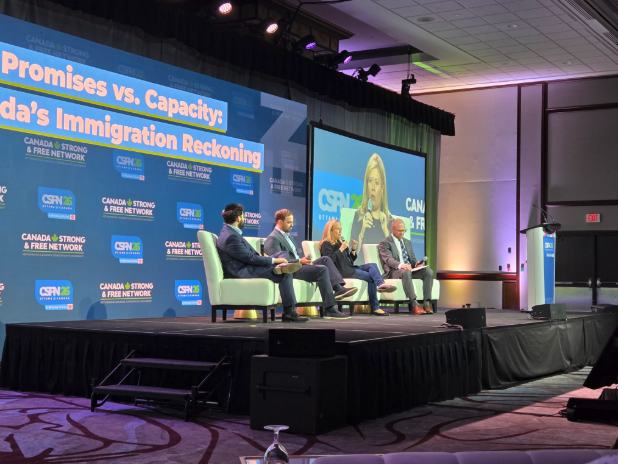
As Anthony Koch, a conservative consultant and commentator for the National Post, suggested, as politics has increasingly become a game of appealing to demographics, the posture of our politics, too, becomes “un-Canadian,” appealing to growing enclaves of immigrant populations and putting their wants above “ours.”
This loss of distinctive Canadian-ness was echoed once more by a group of young conservatives near the end of day two, who were upset by what they saw as a lack of patriotism in Canada. Previous generations, one attendee told me, had “conquered the continent,” and now we were letting so much of what “our” ancestors fought for die.
The sentiment also sat uneasily alongside Poilievre’s keynote speech, in which he praised a room full of patriotic Canadians working to restore the promise of a country where “anyone from anywhere can achieve anything.” The remarks made at the immigration panel, however, seemed to imply that we should not be so accepting of “anyone from anywhere.”
Having an outsized proportion of non-Canadian “Canadian” residents—a “mass,” as it was described to me by one attendee—appeared, at least in the logic of these discussions, as a threat to the cohesion of the nation and the preservation of a distinctly Canadian way of life.
The ‘family’ and Canada’s birth rates
“Family formation and birth rates are falling,” proclaimed Poilievre during his keynote speech. More than ever before, Canadians are finding it harder to buy a house, get married, and have children. Unable to build such a life and form a family—”the building block of any healthy civilization and the best social safety net we have,” as Poilievre described it—and rear a new generation of Canadians, ‘our’ Canadian way of life has come under attack.
Because of this ongoing “withering” of working-class Canadian families, attributed to a “club of Liberal elites and special interest groups,” both the economy and “we,” as Canadians, are suffering. Poilievre’s critique, one which appeals to a nostalgic vision of a time when “the family,” and so Canada, operated properly, highlights the central role the family plays in conservative political thought. The economy relies on “the family” as a resource, one which structures both “our” culture and contours “our” identity.
In this vision, the family remains rooted in relatively traditional gender roles—in which men are heads of household and women raise children, a point Pompeo also underscored during his fireside chat. Other kin relations, changing economic conditions, and progressive social movements are thus understood not simply as social change, but as threats to the viability of the family model itself.
As Poilievre remarked, the weakening of “the family” undermines the security of the future of all Canadians. Restoring it, therefore, emerges as a central political priority—one framed as more important than expanding welfare programs or strengthening the wide social safety net.
Fossil fuels as gospel
As Poilievre said, “God has endorsed us,” and “we should be the richest.” Yet, we are not the richest. In fact, it seems as though Carney’s Liberals (who are, in actuality, Trudeau’s Liberals) are punishing their citizens. The imposition of carbon taxes and the advancement of an anti-oil agenda are hurting Canadians nationwide. In his keynote speech, Poilievre remarked: “Everywhere on earth where fossil fuel use has risen, life expectancies and living standards have grown. More is better for Canada and the world. And we will keep fighting for it.”
However, despite fossil fuels’ purported innate betterment—a claim echoed by Danielle Smith—fossil fuel energy has been demonized. As Smith put it, “eco-extremists” need to understand that fossil fuels are the alternative. Yes, we can experiment and tinker with modular nuclear reactors, solar panels, and geothermal technologies, but nothing can replace fossil fuels. If we are to support the needs and future of Canadians, we not only need to invest in oil and gas but, per Smith and Poilievre, intensify those investments.
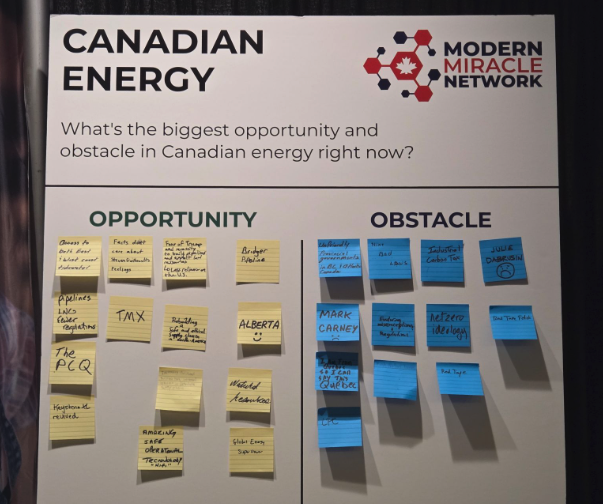
This sentiment was echoed at Modern Miracle Network‘s booth. The fossil fuel advocacy group had decorated its table with literature describing CO2-driven climate change as “a lie” and invited attendees to answer the question: “What are the biggest opportunities and obstacles in Canadian energy right now?” By about 3 p.m. on Friday, May 8, the board contained 26 responses.
On the opportunity side, attendees repeatedly pointed to pipelines, LNG development, fewer regulations, a revived Keystone pipeline, Alberta, technological innovation, and the rebuilding of a “safe and ethical” North American supply chain. On the obstacle side, respondents cited Mark Carney, the Liberal Party of Canada, unfriendly provincial governments in British Columbia and Atlantic Canada, First Nations treaties, “net-zero ideology,” and what one attendee described as a “red tape fetish.”
China (and its nefarious spies)
As suggested throughout CSFN 2026, China (and those on “their side”) stands as a grave threat to “our” Western way of life. Dealings with this state, as small as they may be—say, permitting Chinese EVs to enter Canadian markets, even in relatively small numbers—have the potential to do real damage to Canada, making Carney’s appeals to Beijing quite dire to many attendees. Worse still, while Carney gets “into bed with” Chinese President Xi Jinping, he is spending less time working on Canada’s relationship with Donald Trump, letting the Mexicans “eat our lunch,” as Poilievre put it. Any dealings with China were generally understood as being to “our” detriment.
Throughout the conference panellists and attendees alike noted that China does not mesh with “our” values of hard work, rugged individualism, and family. Pompeo, for his part, repeated erroneous claims that China knowingly spread COVID-19 and warned of the country’s growing influence abroad.
To illustrate the threat, Pompeo recounted his dealings with Chinese spies, describing how numerous they were, how deeply embedded they had become within the U.S., and how difficult they were to root out. China, in this telling, is not merely a geopolitical rival but a sophisticated and ever-present adversary. So determined and advanced is the Chinese state that Pompeo even suggested there were likely spies in the room with us that evening—and that they looked like “us,” perhaps even the people sitting beside us.
An acknowledgement too far
At the start of day two, CSFN opened with a land acknowledgement from current Canadian Medical Association President Margot Burnell, in which she recognized “the never-surrendered homeland of the Anishinàbe Algonquin Nation.” Worth noting, the CMA was also a silver-level sponsor of the event.
Suffice it to say, this did not sit well with attendees. As Lisa Bildy, executive director of the Free Speech Union of Canada (FSUC), explained to me, the ritual of Indigenous land acknowledgements is taking over, politicizing everything—schools, for example. Citing an appeal FSUC is funding before the BC Supreme Court on behalf of a parent who heckled a land acknowledgement at their daughter’s high school drama performance last year, Bildy detailed what she viewed as the outrageousness of this practice. She went on to argue that Indigenous subject matter was increasingly taking over schools, describing high school English classes that had replaced Shakespeare with Indigenous media and assignments requiring students to write their own land acknowledgements. Bildy found the latter particularly ironic, remarking that Indigenous peoples “didn’t have written language before colonization.”
Having a land acknowledgement at the conference stood as an affront to the event’s goal of challenging progressive narratives, including that of reconciliation. Within hours, the incident had been posted by right-wing journalists and outlets on X.
The 30-second “incident” caused quite a stir at the conference and among Conservatives online. It proved divisive enough that Ontario MP Jamil Jivani, during the conference’s final panel, delivered his own Conservative “land acknowledgement” in response. Serious and straight-faced, Jivani told the crowd: “So I thought I might acknowledge the land that we’re on and say we gather here as free men and women on land governed by private property laws. We are enthusiastic to keep that as a tradition in this country. And also a people who don’t believe in two-tiered citizenship.”
Trading blows with Burnell, Jivani went out of his way, at a conference ostensibly devoted to coalition-building, to attack an event sponsor, only to receive minimal applause.
Another sacred cause
Speaking on day one about foreign policy and international relations, Mike Pompeo said the following: “Imagine we told the Israelis that they couldn’t attack into Gaza. That all they could do was just use their Iron Dome to defend their own nation.”
That would be “nuts,” he remarked later. Securing freedom is important, especially in the Middle East. Peace through strength and unrestrained action is necessary to secure our future.
On day two, nuancing the conversation somewhat, the keynote panel hosted by academic and former Israeli soldier Michal Cotler-Wunsh, examined Israel beyond the lens of foreign policy and instead focused on “Gaza”—with no mention of Palestine—and antisemitism (it was also one of the least-attended talks of the conference. Despite CSFN drawing roughly 500 attendees, I would estimate that only about 45 people were present when the panel began, most of them older men and women).
Cotler-Wunsh—who did little to command the attention of the mere tens of people in the audience preoccupied with their mobile devices—argued that rising antisemitism in Canada is, in part, an artificial phenomenon encouraged by state institutions and “woke-DEI” frameworks, as moderator Rick Ekstein framed it.
Moving to an international legal perspective, Cotler-Wunsh spoke about what she described as the “systematic hijacking, redefinition, inversion, [and] weaponization of the international rules-based order and its institutions” against Israel. Central to this process, she argued, was the redefinition of Zionism as racism through a non-binding UN resolution—something she described as “literally the adoption of Nazi ideology,” “blood libel,” and language drawn from the Protocols of the Elders of Zion—which Canada and the United States voted against.
In Cotler-Wunsh’s telling, this marked the beginning of Israel’s international isolation, subjecting the country to a form of institutionalized discrimination that ultimately contributed to the conditions leading to October 7, which she described as the “worst attack on Jews since the Holocaust.”
Following Carney’s swing to the right, Conservatives are searching for ways to distinguish themselves. As many of their traditional policy priorities are adopted, or at least echoed, by the Liberal government, the movement increasingly appears to be defining itself through social and cultural issues instead. Moving toward more radical, ethno-nationalist posturing, CSFN highlighted the horizons of the future of the movement—one that trades coded jargon and dog-whistles for more overt hate, with white supremacists already taking notice.
As Rachel Gilmore reported, the Dominion Society, a far-right white supremacist, anti-immigration group led by Daniel Tyrie, a former People’s Party executive director, was in attendance, “humanizing” the organization and its politics. According to Gilmore, “some conservatives were buying what he was selling.”
The future of the conservative movement is at a crossroads. As this conference underscored, its trajectory is increasingly favouring a far-right politics of creeping ethno-nationalism and intensifying appeals to anti-feminism and white supremacy. Whether that proves an electorally successful strategy remains to be seen, but conservatives may be hungrier than ever for something new.
The Breach’s investigations don’t just inform our readers—they force the powerful to react.
An exposé on blood plasma privatization led to national headlines. Our revelations about the government’s cozy connections to Big Pharma sparked a parliamentary probe. A report on high-tech price-fixing by mega landlords resulted in a criminal investigation.
From activists to elected officials, people are using The Breach’s journalism to push for transformative change.
– Dru Oja Jay, Board President, The Breach
Right-Wing Politics | Carney stole his policy book. So Pierre Poilievre is going full anti-immigrant
Social Movements | To start winning in Canada, here’s how the Left can organize the suburbs

Pierre Poilievre | Poilievre’s ‘anti-elite’ Tories stack top council with corporate lobbyists
2 comments
Comments are closed.
And I would bet that no speakers or even audience participants had a word to say about electoral reform – i.e. equal votes and proportional reprentation which would give voice to conservative voters across the country who have no representative they voted for to represent them in Ottawa. (not unlike Liberal and NDP conventions and conferences). According to the article, it’s all abour how to finesse first-past-the-post elections into winning 100% of the power with 40% or less of the vote. That’s too bad for legions of conservative voters. And voters supporting all parties across the spectrum.
The “Conservative Party” has sold its soul to the oddly similar Zionist Jews and the white supremacists. We live in troubled times.