
With Prime Minister Carney borrowing much of the Conservative policy book, what has Pierre Poilievre decided to do? Go even more extreme on immigration.
As the Liberals have shifted rightward—not just on immigration but also on military spending, climate policy, and public safety—the federal Conservative leader appears to have gone looking for an issue on which to distinguish himself. He is now signalling that scapegoating immigrants and people seeking asylum will be central to that plan.
Poilievre spent the summer testing such messages—and they’re moving in an increasingly more radical direction. A year ago he wanted to reform the Temporary Foreign Worker Program; now he promises to cancel it, blaming it without evidence for depriving Canadian youth of jobs. Last year Poilievre said “we need to have smaller population growth”; now he’s arguing that “we need to have negative population growth for the next several years.”
And just a few weeks ago, he exclaimed during a press conference that non-citizens who are convicted of crimes need to “get the hell out of Canada” once they serve their sentences.
Poilievre’s allies in think tanks, lobby firms, and the media think he’s found a winning strategy. In the wake of Poilievre’s defeat in the last election, former Conservative staffer Josie Sabatino described it as a “new era” in which Poilievre can “move beyond the risk-averse messaging of a campaign.” National Post columnist Geoff Russ called it “a once-in-a-generation opportunity to finally turn immigration into an issue our politicians can openly and honestly debate.” Conservative activist Amy Hamm declared that the days of labelling Conservatives as racist for their views on immigration have passed.
And Sean Speer in the Hub praised Poilievre for making a “worthwhile bet” that there is a “critical mass of Canadians—particularly in and around major cities—who will support such a message.” Conservatives previously did not want to be “branded as anti-immigrant in a political environment where first-generation immigrants alone make up as much as 15-20 percent of eligible voters,” Speer writes. “Something however has changed.”
The Conservative leader’s boosters might have a point. Rising unemployment, a cost-of-living crisis, and a wave of extreme xenophobia south of the border make the soil fertile for this kind of politics. There’s already a deep-seated notion, cultivated by politicians and elite media, that migrants are here primarily to benefit Canadians—but that they’re disposable when times and circumstances change.
Anti-immigrant sentiments will only grow the more immigrants are falsely blamed for problems in housing, health care and unemployment—all of which are better explained by the policies of austerity-loving politicians and the corporate class. None of these dynamics are new in Canada, but they are likely to grow with more oxygen from federal Conservatives.
We’ve already seen the impact of years of heightened scapegoating: polls show the highest level of opposition to immigration in 30 years. And beyond shifting Canadians rightward, such rhetoric is also emboldening the far right: openly racist groups are marching with banners in our streets. Unless a coherent anti-racist movement confronts these threats, Poilievre’s allies may end up being right.
Carney shifts rightward, Poilievre follows suit
Liberals themselves are in no position to push back. Mark Carney and his party have adopted the baseless argument that unsustainable immigration has put a strain on housing, infrastructure, and social services. The government promises to cap the overall number of permanent residents in Canada, and limit annual growth. The federal Conservatives agree with both of these proposals.
Caving to attacks from Poilievre, the Liberals under Justin Trudeau cut back on international students and temporary foreign workers. Deportations also jumped by about 60 percent in his final year in office, and a record amount of public funds were spent on removals.
Carney has followed suit by introducing a bill to restrict asylum claims. His government has also enabled Donald Trump’s all-out assault on non-citizens by sending them back across the border when they flee. Less than a decade after Trudeau’s 2017 statement welcoming “those fleeing persecution, terror and war,” a similar invitation from a Canadian PM seems almost impossible today.
While Poilievre’s policy proposals may not differ much from Carney’s, his habit of misrepresenting and exaggerating to sharpen his scapegoating will create more political space for forces that are even more aggressively racist and xenophobic. For example, it’s unlikely someone who hears Poilievre’s call to decrease population growth will parse the wonky links between inflation, immigration, and worker productivity. The oversimplified message is that immigrants are the problem—and fewer of them will make Canada stronger.
Canadians may not realize that, thanks to the policy shifts by the Liberals, the government is already projecting a slight decrease in population in the coming years. In other words, Poilievre’s call for negative population growth is already happening, but that won’t stop him from trying to cynically sound the alarm.
Meanwhile, Poilievre will focus his energies on exploiting an already-existing mythology by praising “good” immigrants, who have come to Canada the right way and for the right reasons, and “bad” immigrants who are here to harm us and must be kept out or removed. He may never go so far as to demand mass deportations, as some anti-immigrant organizers are now spouting in major Canadian cities. But he hasn’t given any indication that he’d oppose such movements, many of which include his own supporters and sympathizers.
Progressive movements have to grow to confront this anti-immigrant tide. In response to right-wing calls for exclusion, deportation and scapegoating, we must renew our demands for higher wages for all—irrespective of one’s status—more inclusive public services, and status for all non-citizens, whether they are international students, temporary workers, or undocumented people. If we don’t, Poilievre may succeed in his quest: distinguishing himself from Carney and winning electoral power at the expense of immigrants.

“We need media that enlarges the sense of what’s possible.”
Naomi Klein, journalist and author
Want to support hope-fuelled journalism? Become a sustaining member.
Immigration | Carney’s border bill is a gift to Trump—and a roadmap to ‘mass deportation’
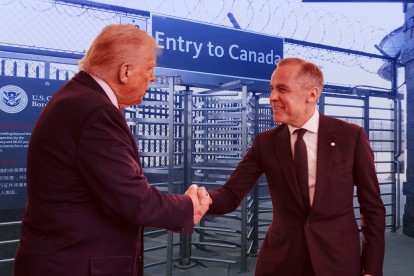
Immigration | ‘Deeply hypocritical’: Pierre Poilievre slammed ‘illegal border crossers,’ but his own relative crossed and stayed

Immigration | Canada’s open secret: International students are here to be exploited