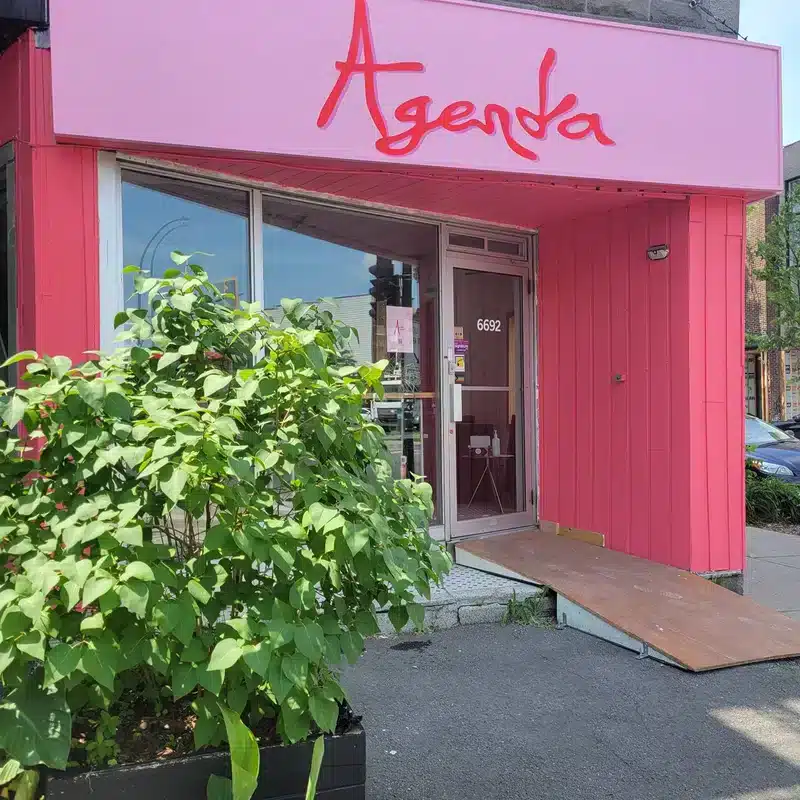
Earlier this year, I watched a new community venture pop up in Montreal’s Petite-Patrie neighbourhood, the bright pink of their shop sign cutting through the late-winter gloom. A former coworking space that I had only ever seen empty was being transformed, week by week, into a queer bookstore that promised to be a new hub for community and organizing. Often I’d say hello as I passed, looking in as a group of people I vaguely knew from local queer organizing and zine fairs put up custom shelving and pulled the space together.
Later, when I spoke to the bookstore’s founder, she said that the decision to have the remodel and renovations so public-facing was deliberate. She had wanted people to see that there was work being done—that something was being created by and for the community. “I wanted this work to be transparent,” she said. “I want people to know that there is actual work being done to make this happen.”
In Montreal, an unlikely renaissance of grassroots arts and culture projects seems to be unfolding, despite the effects of the pandemic and rising unaffordability. A number of smaller-scale solidarity co-operatives are currently providing space and resources to a wide range of artists, activists, and community members across the city, from trans and feminist organizers to anarchist authors to Indigenous artists.
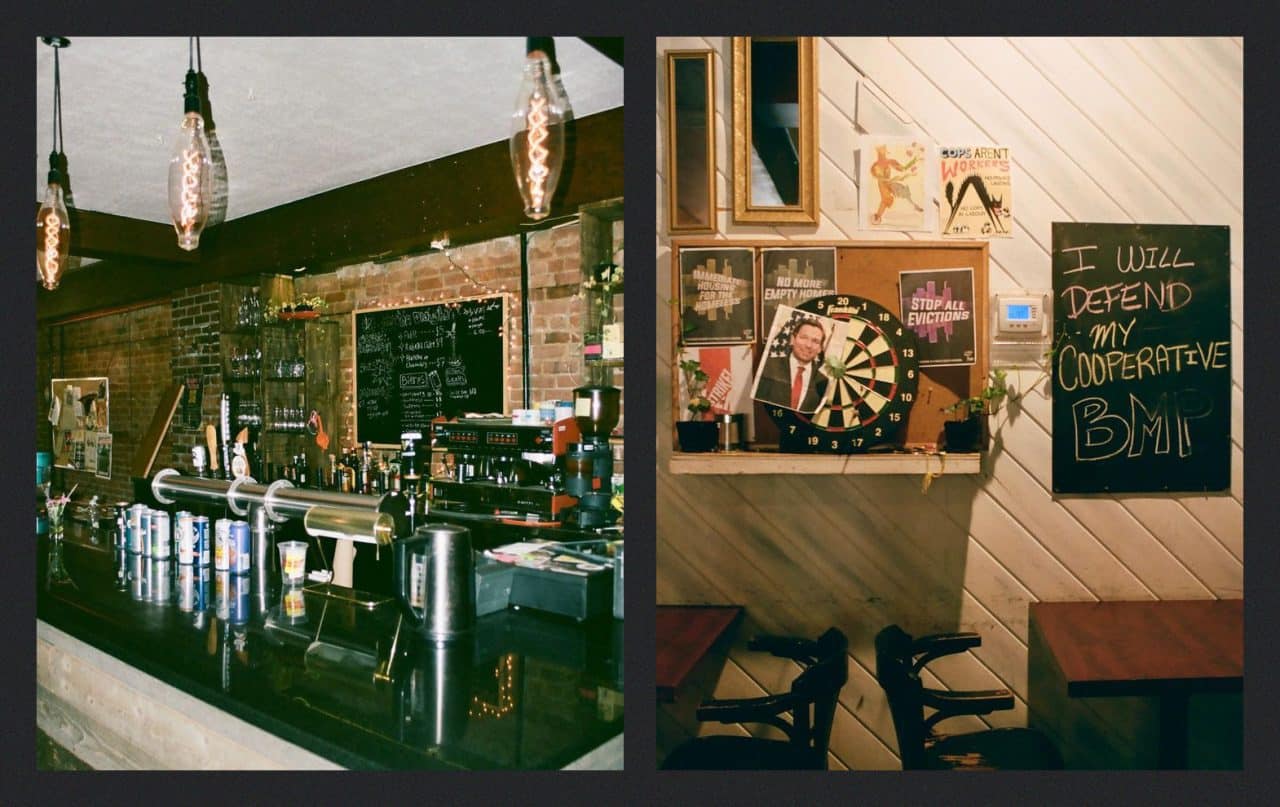
Over the past few years, we have seen the emergence of community spaces Coop BMP, Bâtiment 7 and Brique par Brique, arts and culture oriented bar La Poubelle Magnifique, transfeminist bookstore Coop Agenda and the daphne Indigenous art gallery, to name just a handful of the relatively new left-wing grassroots groups providing physical spaces for community members and artists in the city.
Meanwhile, in Toronto, the art and culture scene has been squeezed for years by the city’s ever-rising rents, and neither politicians nor the heads of flagship cultural institutions have put much effort into fostering a lively grassroots community. In this past year, bolstered by ongoing reverberations of the COVID-19 pandemic, that squeeze has shifted into a lethal vice-grip.
Even the largest and most well-resourced arts and culture organizations seem to be cracking apart, and smaller ventures have difficulty getting off the ground. The decimation of Toronto’s cultural scene is so stark that even the Toronto International Film Festival (TIFF), a mainstay of the international film festival circuit at which Oscar contenders frequently premiere, has scaled back operations.
The twin crises of housing and cost of living have put pressure on the traditionally bustling arts scenes in these two major cities. Arts organizations are seeing funding drop across the country, both from the Canada Council of the Arts—which recently announced that spending would be cut until at least 2027—and from provincial agencies. Last year, Ontario cut back $5 million of one-time grants to its cultural sector, while in Quebec, approximately $720,000 disappeared from the provincial arts grant budget between 2023 and 2024.
But where the two cities differ is how attractive their arts and culture scenes are for corporate investment. While Toronto’s broad cultural scene is now being starved out by capitalist interests that have prioritized chasing growth over serving their communities, its grassroots scene has struggled to keep financially afloat. Over time, only the largest-scale corporate-backed ventures have seemed to be able to survive—and now even those are disintegrating.
Amidst this freefall, Montreal’s left-wing artists and cultural workers are eking out a survival. Their successes are a reminder that community-centered arts ventures can genuinely support connection and organizing, despite the financial and societal pressures that increasingly make both art and activism difficult.
Cultural collapse under the weight of corporate fickleness
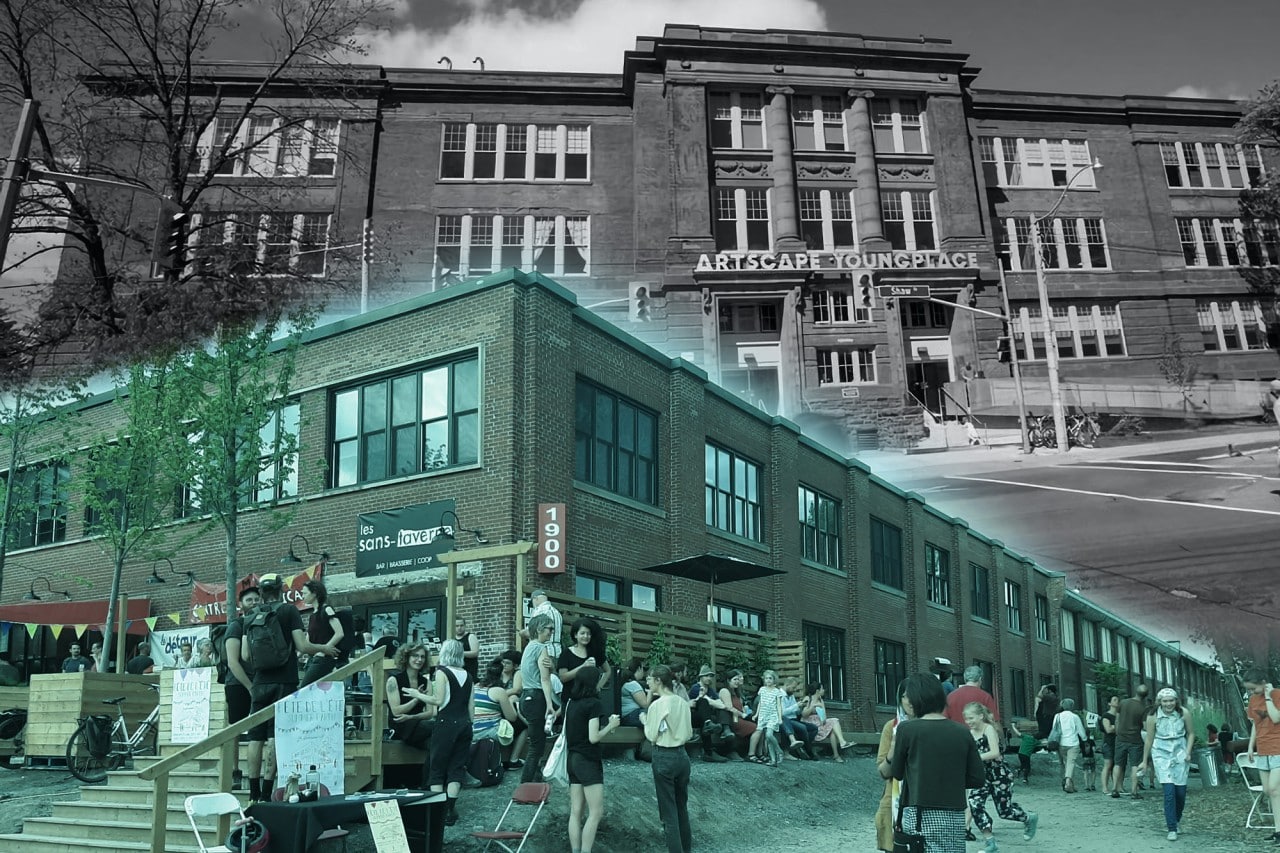
In Toronto, the bad news accumulates. Artscape, a group of nonprofits that provides studio space and resources to artists, officially entered into receivership in January, reporting that it was no longer able to keep up with its expenses and debt. A number of the city’s festivals, including the Fringe and Luminato, have faced major programming cuts. Back in March, a number of Hot Docs programmers quit en masse, citing a bad work environment and contract issues, while the festival itself is reportedly having its own financial struggles. TIFF, which famously lost Bell as a sponsor last summer, laid off at least twelve full-time staff ahead of this year’s scaled-back edition.
Mixed with grief for the closure of so many institutions has been a sense of anger and resentment that Toronto’s arts and culture scene has increasingly only provided a stable community for neoliberal executives, rather than the artists and community members that they purport to serve. In an article for The Local, Soraya Roberts accused Toronto’s art institutions of stacking high-level positions in their organizations with executives who routinely prioritize development over providing real resources for their arts community, singling out Hot Docs as a particular offender.
Similarly, Artscape’s collapse has been caused by a tenuous financial structure. Once one of Canada’s largest single cultural space operators, Artscape used a financial model that author and cultural worker Caitlin Jones referred to as “market-light”: a large part of Artscape’s operations relied on continual real estate development and expansion in order to cover operational overheads. That seemed to work—until it didn’t.
When the pandemic hit and collecting revenue from event space rentals and artist studio rent was no longer viable, Artscape slid further and further into debt. By the time the organization entered receivership, it owed an eye-watering $37.5 million. “To funders,” Jones writes, “Artscape [was] an efficient investment option—but at the expense of smaller organizations with their own goals.”
Hot Docs, which was famously headed up by an American former Disney executive, was routinely criticized by the documentary film community for its reluctance to engage with politics in a meaningful way and for frequently cowing to corporate sponsors.
In March of this year, for example, groups including Film Workers for Palestine and Artists Against Artwashing held a rally to protest Scotiabank, which sponsors the Hot Docs “Big Ideas” series and also funds genocide in Palestine. In response, the festival released a statement that seemed to favour its corporate sponsors and to offer little criticism of Israel’s assault on Palestinians in Gaza.
It all resulted in a culture of prioritizing profits over the art, the artists, and the community at large. “Instead of supporting the arts,” writes Roberts, “leaders at organizations like Hot Docs increasingly go all in on ‘exciting’ new plans for ‘incubating’ what amounts to nothing more than very expensive vibes.”
Hot Docs and Artscape demonstrate how investment into the most apolitical versions of our arts and culture scene can be a tool for artistic gentrification, in which the communities that these projects serve increasingly lose out to growth and mainstream markers of success. As Toronto itself has been reshaped primarily for developers and the wealthy, its arts and culture scene—once very much dominated by underground artist-activists—has become little more than edgy window dressing for overpriced real estate.
Organizing bolsters Montreal’s arts scene
Over in Montreal, however, grassroots arts and culture spaces that support local and left-wing organizing have been popping up with gratifying regularity. While several were lost during the pandemic, including the much-beloved Cagibi queer cafe and the Never Apart queer gallery, others have managed to thrive.
The Coop BMP, for example, grew from an effort to prevent gentrification in the Milton-Parc neighbourhood in the late 1960s, when a real estate developer purchased 96 percent of the buildings in the area. The community, outraged about gentrification, came together through the 1970s to organize against the developers with demonstrations, festivals and sit-ins. The resulting Société de Développement Communautaire Milton-Parc (SDC) is a community landlord that manages all commercial spaces in Milton-Parc and has the first pick of any building that goes up for sale.
In 2021, the SDC purchased a bar that was closing down and asked locals what they would like to see in operation instead. The answer was a community centre that offered food and drink and could serve as a physical space to support cultural and social justice projects in the area. Thus, Coop BMP was born.
Jonah Ryan-Davis and Rachel, two of the worker-members at Coop BMP, believe that while the coop’s success is based on the history of organizing in their neighbourhood, there is a municipal sympathy toward grassroots groups in Montreal that is well-suited to cultural organizing. “I think it’s part of the fabric of the city,” Ryan-Davis said. “Through collective action, people have managed to gain legal pathways to ownership of cool collective spaces, multiple times all over Montreal.”
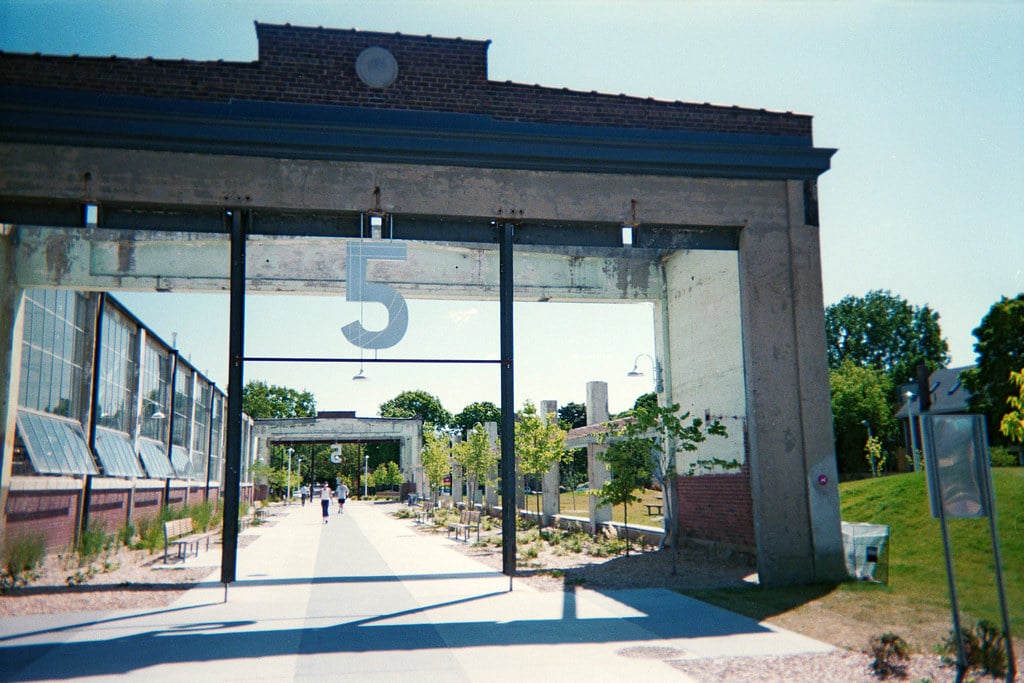
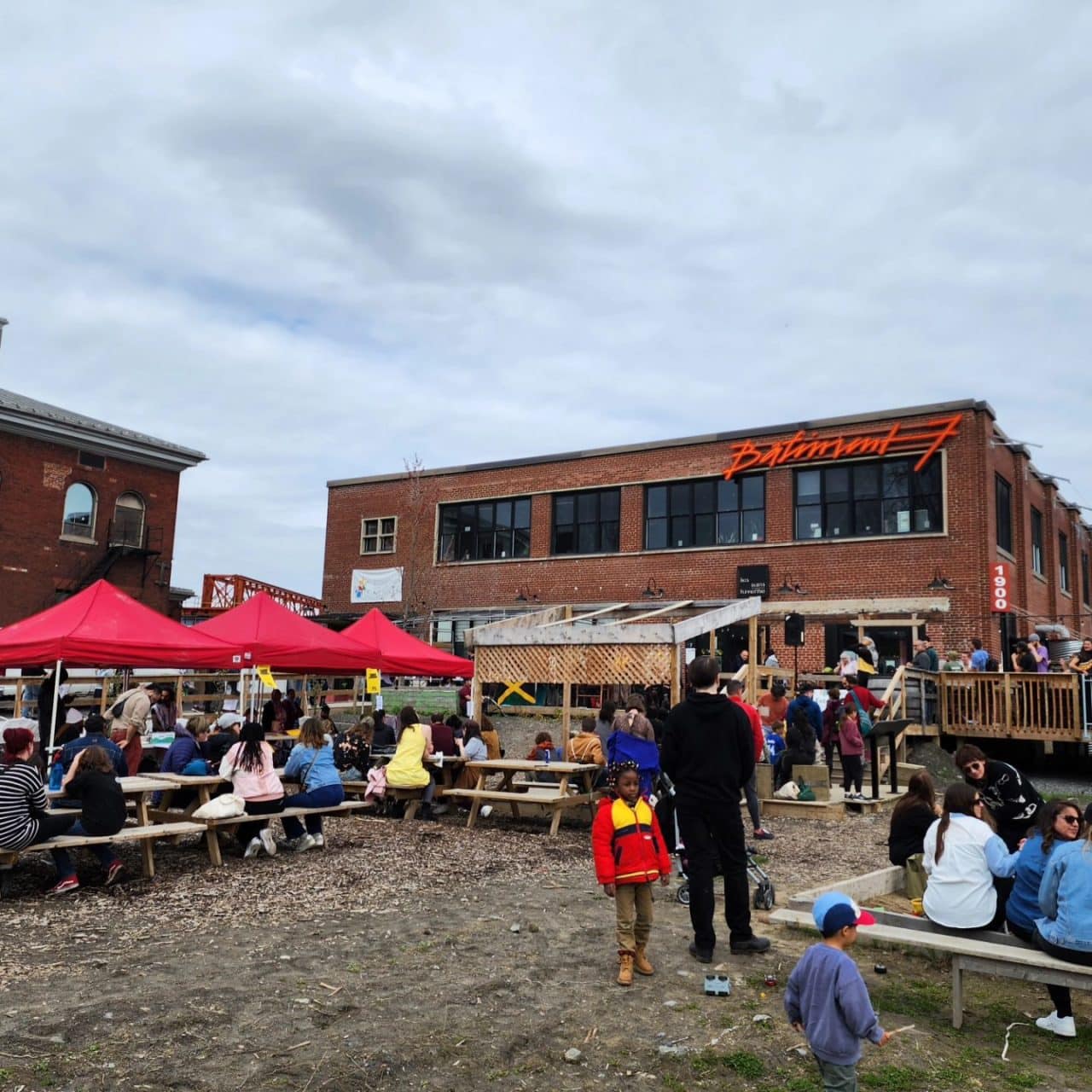
The pair also point to Bâtiment, a cooperative in Pointe-Sainte-Charles, as another success story. It grew out of the community claiming a heritage building in a disused lot. In 2003, a 90,000-square-foot former CN train warehouse was purchased by a real estate developer to be turned into condos and luxury entertainment facilities. In 2012, after significant mobilization and lobbying, the community pushed the borough government to reject the real estate developer’s requests for zoning changes unless the largest building on their property was transferred to community ownership.
After rounds of crowdfunding, grants, and financing from other community groups, Bâtiment 7 finally opened in 2018, and now provides a wide range of services to the community including a grocery store, brewery, art studios, textile and puppet workshops, an art school, and a mechanic.
Both Bâtiment 7 and Coop BMP have been able to capitalize on Montreal’s more community-focused approach to urbanism, in which activists and community members have been able to effectively lobby for their needs to be heard. But not every left-wing grassroots cultural project has such a well-resourced history to draw from.
Trans cultural organizing reignited in Montreal
In the Petite-Patrie, a new bookstore, cafe, community space and print workshop opened this year without the benefit of years of neighbourhood organizing. Coop Agenda is a transfeminist project—a branch of feminism that makes a priority of trans liberation—that emerged directly from Montreal’s radical trans community. It grew out of Éditions Agenda, a transfeminist book distro, and TRAPS, a transfeminist support and resource collective, and was funded through a combination of grants and crowdsourcing, with the local community contributing $25,000 through an online fundraiser.
“I realized I was bringing in some hefty amounts of money by just using community-building as an economic tool,” Judith Lefebvre, one of the coop’s founders, told me in an interview. She says that the idea to open a physical space came to her after she realized through her work with Éditions Agenda and TRAPS that while the trans community and activist scene in Montreal was by no means wealthy, there was enough support from the broader community to finance a physical space if they came together.
The coop was envisioned in part to try and replicate the successes of transfeminist organizing networks in North America in the late 90s, and to provide a space that could support the needs of the community. If trans and queer organizers need a place for printing or distributing creative work or holding parties so that they can make rent, Coop Agenda will provide the space and resources.
Physical queer spaces have been disappearing at a rapid rate for years. With transphobic rhetoric increasing across North America, having a home base for organizing, community interaction and cultural production is paramount. Agenda has already supported the development of Dick’s Lending Library, a local library project of which I am a member, and has hosted left-wing book sales and book launches. It will soon host the AGM for the Movement for Transfeminism, a transfeminist collective organizing for trans liberation, ahead of its inaugural congress in the fall.
For Lefebvre, putting the community’s collective efforts toward opening the bookstore feels like a basic step toward supporting trans liberation and cultural production that had felt lacking in the current organizing scene. She’d seen queer and trans non-profit groups dominated by white, middle-class interests with little political imagination, and hopes to foster a more expansive political community at Coop Agenda.
Community faces off against the corporate city
Arts and culture organizations cannot exist as islands. Coop Agenda, Coop BMP, Bâtiment 7 and Montreal’s other left-wing cooperative arts and culture spaces benefit from a specific history of organizing in Montreal, but they also stand apart from Toronto’s Artscape or Hot Docs because of their commitment to their actual communities.
That isn’t to say that every socially conscious arts and culture project in Toronto has fallen victim to neoliberal executives who don’t care—clearly the city is still capable of being home to some grassroots projects, such as Hearth Garage, an anti-oppressive, queer-led gallery launched in 2019, or the Riverdale Arts Hub, which specifically aims to highlight the work of immigrants and diverse local communities. But the challenges are numerous, with commercial rents increasing almost 20 percent between 2020 and 2023.
Montreal’s coops, too, are not immune to the problems of unaffordability, noise complaints and gentrification that are plaguing the city at large. “We’re still very much under the pressures of everything that’s happening outside of our walls,” said Rachel of Coop BMP. “But it’s been nice seeing the amount of energy from people who care about this space and want it to keep going.”
What is clear, however, is that resources that support a meaningful arts and culture scene must be pointed toward citizens and local artists, not corporate priorities. The non-profit model in itself isn’t necessarily the problem: it’s that nonprofit organizing can, as an endeavour expands, become increasingly disconnected from its original purpose. When an arts and culture resource stops serving artists and becomes more of a jewel in a city’s cultural portfolio to prove its worth as an investment opportunity, the community loses out.
We need an arts and culture scene that is community-minded and focused on people rather than stakeholders: only from there can left-wing cultural organizing blossom.

“We need media that enlarges the sense of what’s possible.”
Naomi Klein, journalist and author
Want to support hope-fuelled journalism? Become a sustaining member.