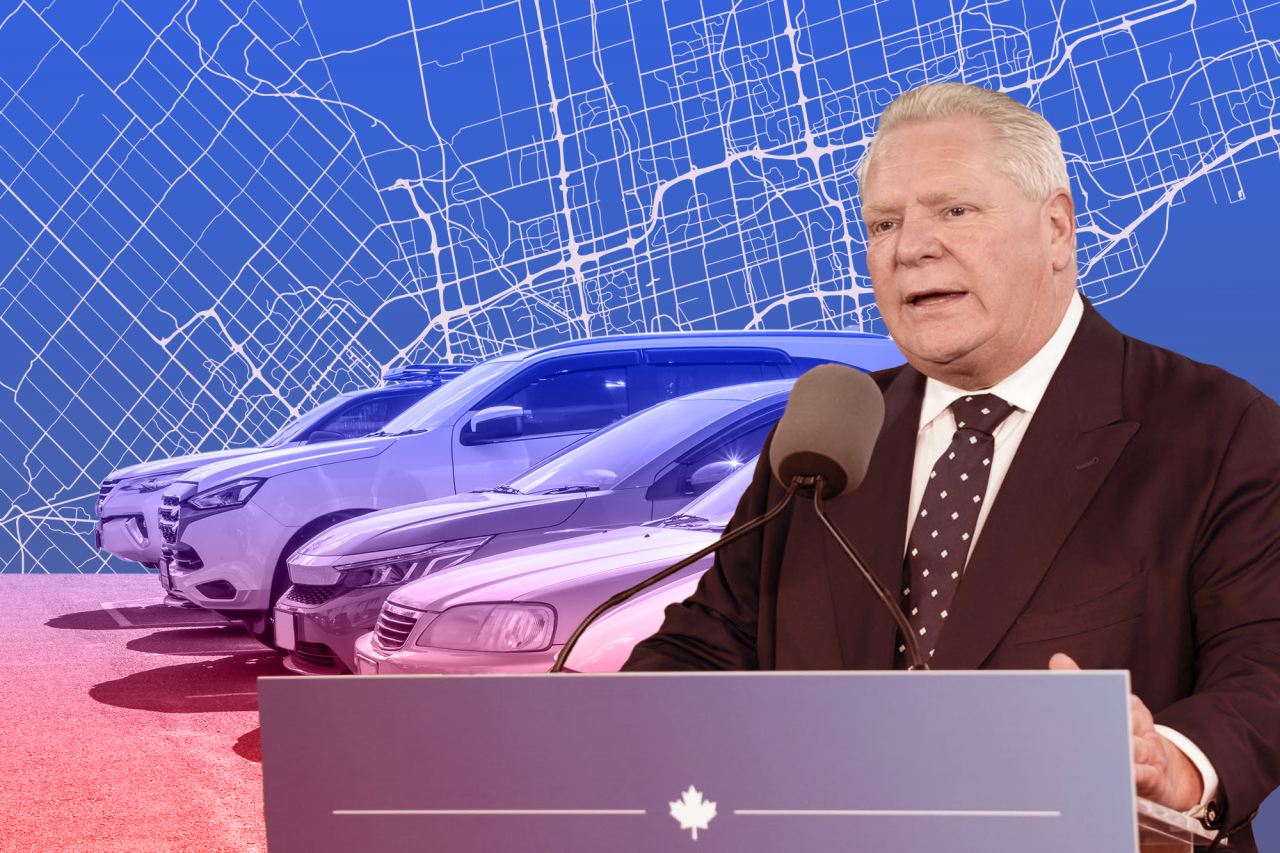
Doug Ford has taken another swing at his favourite punching bag: bike lanes.
Yesterday, the Ontario government announced a new omnibus bill proposing a mishmash of changes to different laws and regulations. If passed, the bill will make it easier for landlords to evict tenants, impose new hurdles for renters seeking to raise issues at the Landlord and Tenant Board, and strip power from municipalities over building roads and housing.
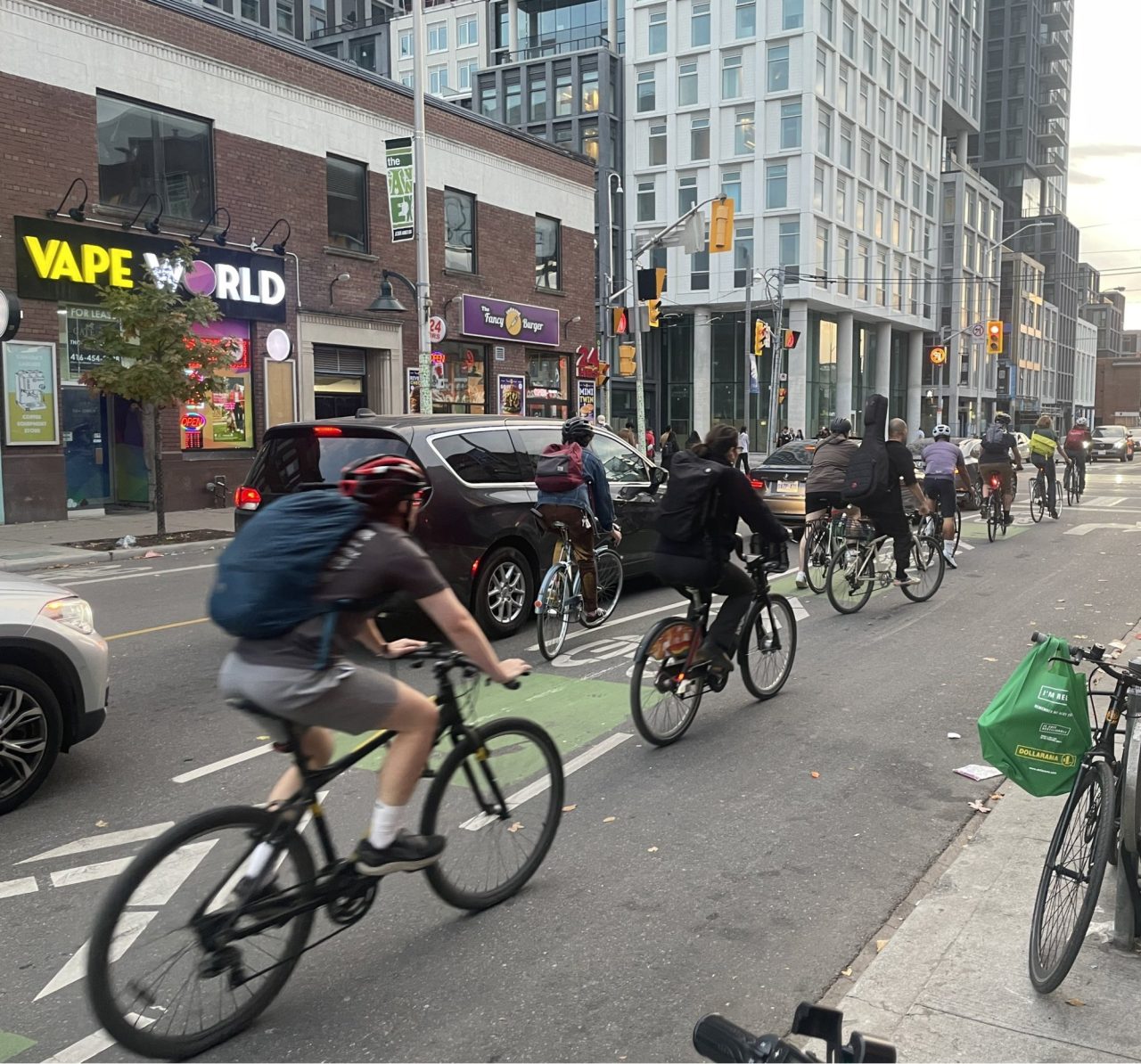
And, buried deep inside the Fighting Delays, Building Faster Act is a ban on municipalities constructing bike lanes that would take away a lane of car traffic.
Ford‘s anti-bike crusade is about more than just whipping up a culture war to gain favour with his suburbanite voters and speeding up his personal commute from Etobicoke to Queen’s Park. The new bill is, in fact, a gift to corporate lobbyists, crossing an item off a wish list the Toronto Region Board of Trade released in the form of a report nine months ago.
In February 2025, the Board of Trade—one of the largest business lobby groups in Canada—released a report called “Breaking Gridlock: Congestion Action Plan for Toronto.” Outlining the “congestion crisis,” the report said that “Congestion strikes at our productivity and erodes our competitiveness.” In the face of economic uncertainty, it argued, “Canadians want action to secure our economic future.”
The report offered five recommendations, including one to “Unclog the Arteries.” This action item called for moving bike lanes off “priority connector roads.” In other words: banishing bikes from any street the business lobby considers a “priority.”
Ontario’s new bill takes notes, and then escalates. Instead of moving bike lanes off “priority” streets, it simply bans the conversion of any car lanes to bike lanes on any street across Ontario municipalities.
The bill also leaves open the door to prohibit infrastructure that takes away a car lane for “[a]ny other prescribed purpose.” Meaning it could be used to ban dedicated bus rapid transit lanes and curb lane cafés.
Ford’s car-mania
At first glance, the new bill looks like a tantrum in response to the challenges Ford has faced over Bill 212, the Reducing Gridlock, Saving You Time Act. That omnibus bill, passed into legislation in 2024, requires “prescribed municipalities” to seek approval from the minister of transportation before building new bike lanes that would reduce the number of car lanes. So far, no municipalities have been prescribed. In the same breath, Ford also gave himself the power to rip up 19 kilometres of bike lanes on Toronto’s Yonge, University, and Bloor streets.
Advocacy group Cycle Toronto took the government to court, arguing that wiping those bike lanes off the map would endanger road users and infringe on Canadians’ Charter-protected rights to life and security of the person. Cycle Toronto won the case in July—and Ford was livid.
He went on a tirade against the judge who decided the case: “These judges that are bleeding hearts, I can’t wait until they retire. Matter of fact, I’ll pay them to retire earlier. I’ll pay you out, for two, three, four years. Just get out of the system.” The Government of Ontario promptly appealed the decision.
Ford’s car obsession is well-known: he has introduced gas and fuel tax cuts; scrapped license plate sticker fees; eliminated a program that tested cars for emissions; is planning a new highway that would help turn the Greenbelt into suburban sprawl; and proposed building a car tunnel under Highway 401, which, as a Globe and Mail columnist wrote, “may just be the worst idea in the history of the world.”
The Toronto Region Board of Trade report and the government both say traffic costs Ontario billions in lost productivity. But there’s no evidence that banning bike lanes would reduce traffic—in fact, it’s just the opposite. The judge who struck down the bike lane rip-up wrote in his decision that the government ignored its own experts: “records produced by the government in this litigation show that the internal advice prior to passing Bill 212 was that protected bike lanes can have a positive impact on congestion and that removing them would do little, if anything, to alleviate gridlock, and may worsen congestion.”
What Bills 212 and the Fighting Delays, Building Faster Act will do, however, is deliver more profits for the circle of large corporations hiding behind the Board of Trade’s insistence that it works for “small and medium-sized enterprises.” For example, one of the Board of Trade’s highest-tier partners is oil company Enbridge, and its Congestion Task Force includes representatives from the 407 Express Toll Route, CAA, and Uber.
These corporations want Ontarians to keep pumping gas, hailing rideshares, and driving to work—demoting alternatives.
Corporate interests have long driven Ford’s attacks on bike lanes. Back in 2023, four Toronto businessmen calling themselves Balance on Bloor launched a petition against new bike lanes on Bloor West. A year later, Ford’s transportation minister echoed the group’s talking points as he announced new restrictions on bike lanes across the province. The premier then said he’d rip up the Bloor West bike lane.
Reporting in The Trillium revealed that Balance on Bloor’s four directors included people well-connected to the Progressive Conservatives, having collectively donated nearly $25,000 to the party since 2014. One was a former PC Party candidate and founder of a real estate investment firm. Another was a real estate agent. Another was a director at an investment banking firm, yet again with real estate clients. Another was the owner of an Etobicoke bar frequented by the Ford brothers.
Ford postures as a folksy everyman, looking out for the average suburban commuter stuck in gridlock on their way home to their family. But his new bill is another example of how he shrewdly teams up with wealthy private interests.
If the new omnibus bill becomes law, corporate interests will succeed in setting every city in Ontario back by a decade: more cyclists and pedestrians will be killed by cars, and more carbon emitted on our roads will intensify climate change. And traffic won’t even get better.
But as long as dollars keep flowing to car companies and oil barons, Ford will be smiling.

“It’s about getting to the bottom of things. It’s about unveiling who has the power and what they’re doing with that power.”
Linda McQuaig, journalist and author
As a non-profit, free from powerful corporate interests, we invest in investigations and uncover the cover-ups. Sustain our journalism for transformation.
Resource Extraction | To become an ‘energy superpower’, Canada wants to bulldoze Indigenous rights
Housing | Ontario’s rent allowance isn’t a safety net—it’s a poverty trap

Ontario | How Doug Ford keeps getting away with it
2 comments
Comments are closed.

I’m wondering if municipalities and other stakeholders can start boycotts or some other “naming and shaming” activities of these “Friends” of the premier. Making cyclists less safe for the sake of a flex in the face of the data should have some sort of negative consequences
How can Torontonian / Ontario residents fight back tho ? I’m not Canadian and I haven’t been in the city for long but it seems like there should be some consequences to such blatant lies and corruption?
I find populism both sickening and scary, because it is effective. How are progressives gonna be able push any agenda to the suburban public if they are convinced that fighting car-centric city planning is fighting them ?