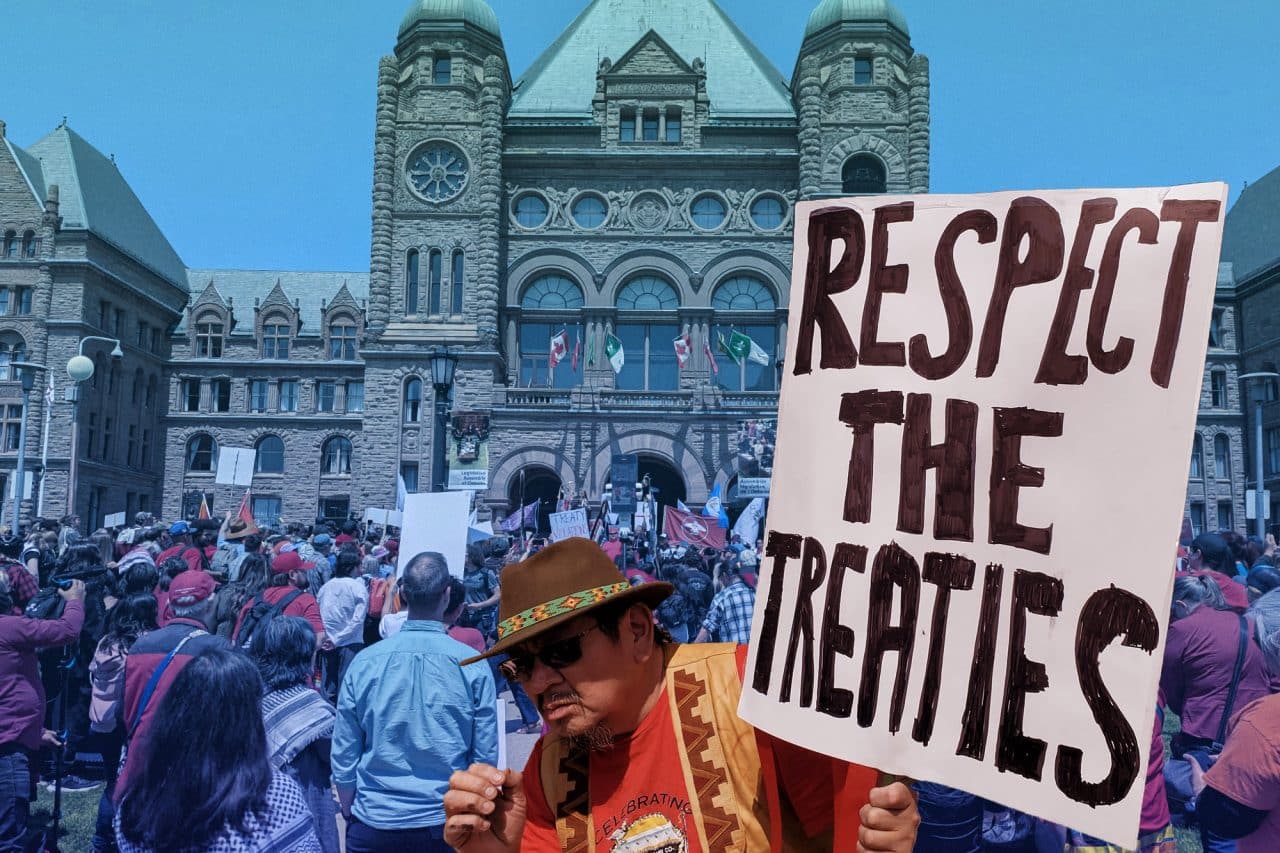
From coast to coast, Indigenous peoples in Canada are seeing governments bulldoze their rights and sovereignty to speed up resource extraction projects—all in the name of fighting Trump’s trade war.
Lawyer Pam Palmater joins Desmond Cole on the Breach Show podcast to discuss the current resource push, Canada’s legal obligations to Indigenous peoples under domestic and international law, and the new wave of resistance brewing across the country.
The Breach Show is our podcast featuring sharp analysis on politics and social movements in Canada. Subscribe to the podcast on Apple, Spotify, Iheartradio, Youtube Music or your favourite service.
Desmond Cole: Welcome to The Breach Show featuring sharp analysis on politics and social movements in Canada. I’m your host, Desmond Cole.
As I record this episode today, wildfires are raging across the Prairies with smoke drifting not just into my backyard here in Toronto, but even drifting across the Atlantic Ocean, reaching as far as Europe. Tens of thousands of people have been displaced by the wildfires that are raging—about 200 of them—many of them from Indigenous communities.
In the midst of this climate breakdown, the federal government and several provinces are choosing to add more fuel to the fire.
There’s a growing push to fast-track resource extraction projects, from oil and gas to so-called critical minerals, and they’re using Trump’s economic threats as political cover to ram them through—steamrolling Indigenous rights and gutting environmental and labour protections along the way.
To discuss this, my guest today is Pamela Palmater, who’s of course no stranger to Breach listeners. Pam is a lawyer, professor, writer, and a member of the Eel River Bar First Nation. She is the chair of Indigenous Governance at Toronto Metropolitan University, a regular media commentator, and the author of several books, including Indigenous Nationhood: Empowering Grassroots Citizens and Warrior Life. Nice to see you again, Pam.
Pam Palmater: Hey, thanks for having me, Desmond. Lots to talk about.
Cole: So much. Let’s get into it. When we talked last, during the lead-up to the federal election, you were concerned that resource development might threaten Indigenous sovereignty. It seems that what’s been playing out since—you predicted and you saw coming, from conversations about the Ring of Fire in Ontario, about Mark Carney not necessarily signaling the same commitment to Indigenous relationships as Justin Trudeau, his predecessor.
What are your thoughts right now as we see Indigenous peoples speaking out and rallying in both B.C. and in Ontario against new laws to speed up resource development, and as Prime Minister Carney also pushes through with his plans to make Canada a so-called energy superpower?
Palmater: All of what you said is super concerning. I think out of all of this the provinces are always the worst offenders here because they all believe, “these natural resources are ours. We can do whatever we want. If there’s any First Nation issues, well, the feds can deal with that.” Which really just ignores what the law says, what the Constitution says, what the Supreme Court of Canada has said, and ultimately, because some projects go across provincial borders, necessarily the federal government is involved.
I’m always looking for weasel words. Having previously worked at Justice Canada, full disclosure, I know what some of those weasel words are. It’s easy to say “reconciliation.” It’s easy to say “partnership.” And it’s easy to say “economic reconciliation.” But unless you’re saying, “we will respect free, prior, and informed consent (FPIC) that comes from the United Nations Declaration on the Rights of Indigenous Peoples that we passed with Bill C-15 at the federal level,” unless I hear those exact words, I’m not very positive about what the outcome will be.
Then of course, we had the Justice Minister saying, “First Nations don’t get a veto. That’s not what FPIC is about.” He’s walked back those comments, sort of, but not enough to give me any comfort that our rights are gonna be respected.
Cole: Sean Fraser, the Justice Minister, he did basically say that we have a duty to consult with people, but we don’t necessarily have to get consent. There’s no veto, he said, for Indigenous communities to stop us from developing the projects that we want to.
Doug Ford basically said the same thing—“of course we want to consult. We just don’t want it to take two or three years”—which seems to kind of ignore, as you’ve written before, Pam, the whole point of having these processes in place. Everyone’s just seeming to say now that they’re an inconvenience.
Palmater: Well, and not just an inconvenience, but a total misinterpretation of the law. They keep talking about, “we have a bit of a duty to consult, let you know what’s going on.” But that’s not the law in Canada.
The Supreme Court of Canada said the law is a duty to consult, accommodate concerns, and in many cases get consent.
Now that comes from Canada’s constitutional law and constitutional rights trump all other rights, but then add on to that the United Nations Declaration on the Rights of Indigenous Peoples (UNDRIP) and it’s free, prior and informed consent.
So those two things are wedded now. UNDRIP used to be out there. Now it’s wedded at the federal level. Even though a project might start out as provincial, if it crosses borders, it becomes federal and now Bill C-15 [the Act respecting UNDRIP] is required.
They’re really misinforming Canadians about what the legal standard is. And we’re not delaying anything: it’s the federal and provincial governments that take us to court that get injunctions that don’t deal with us right up front.
We are not opposed to development and the economy and all of these things. However, you cannot presume that our only option is to say yes.
If you want to have sexual relations, you have to get consent. And if you say no, do we call that a veto? If you’re going to have surgery in a hospital, you have to sign a consent form. But what if you say no? Is that called a veto? No, they only use an impoverished version of our legal right to have consent say yes or no, as in, “it’s just, we’ll have a conversation with you, but you don’t get to say no,” and that’s just not the law of consent in any context.
Cole: That’s very clear. Let’s talk about some of the specific legislation that’s in the works across Canada right now. So in British Columbia, for example, NDP premier David Eby just passed at the end of May—by a single vote in the legislature by the way—a new act called the Infrastructure Projects Act.
The government claims that this law is needed because important new projects are getting slowed down by the development process, which they often refer to as “red tape.”
Now the province, with this new law, can bypass permits and environmental assessments, not just for new things like hospitals and schools and highways, but also for private oil, gas, and mining projects.
This is despite the fact that Indigenous leaders, Pam, were warning us for weeks before the bill passed that it would deeply damage the provinces’ relationship with Indigenous peoples.
Now that it has been pushed through, what does the passing of the bill tell you about the B.C. government’s priorities?
Palmater: Well, shockingly, B.C. was the only province that passed similar legislation to the federal government actually enacting the United Nations Declaration on the Rights of Indigenous Peoples in B.C., which requires free, prior, and informed consent. It’s just this massive contrast and conflict between, “here’s what we’re saying we’re going to do, and here’s what we do in practice.”
I would argue that that whole bill could be challenged on a large number of fronts. But the biggest one is that you don’t get to circumvent the Constitution and prioritize private interests over constitutionally protected rights, because the Supreme Court of Canada has already said Aboriginal rights trump the interests of others: commercial people, people that are doing things for recreation. Corporations don’t have constitutional rights. We do.
That’s a problem. The other thing I think that’s really a problem and environmentalists have pointed out is, well, what’s the point of having an environmental assessment or environmental legislation or rules to protect species at risk or waterways or any of those things if you’re just gonna skip over it? There’s a whole lot of violating the so-called rule of law going on.
Cole: In Ontario, we’ve got Premier Doug Ford who’s also trying to push through legislation. His bill has the interesting name of the Protect Ontario by Unleashing Our Economy Act. This proposal also promises to speed up major infrastructure and resource extraction projects by reducing delays and eliminating what they call duplication in the approval process.
But this week, over a thousand First Nations leaders and environmental groups rallied against the bill outside Queens Park, the provincial legislature in Ontario. They say that the law tramples treaty rights and threatens serious ecological damage. Pam, what stands out for you about Doug Ford’s proposal now in Ontario?
Palmater: It’s effectively the same. It’s this whole idea—and keep in mind when Pierre Poiliever was doing his campaign—it’s always this word about “unleash,” “unlock,” which is another way of saying “steal.”
Regardless of what you say, to hell with constitutional rights, treaty rights, international rights, to hell with clean water and farmable land for Canadians. We are going to steal what we want, as fast as we can, before the courts will even be able to catch up.
That’s the thing. Once you do the damage, by the time we go through the court process, what if they say, “yeah, Doug Ford, you are wrong.” But now you’ve emboldened and empowered and prioritized all of these corporations—because, make no mistake, it’ll be corporate interests that run rampant here, which also implicates workers’ rights, labour rights.
lf you’re just going to fast-track and say “here corporation 1-2-3, who has bank accounts in every other country but Canada, you get to just go ahead and do this.” Where are the negotiations for the skilled labour? Where are the protections for workers? All of these things are really trying to circumvent every single law and they complain all the time about delay and red tape.
Environmental protections are not red tape. Indigenous rights are not red tape, and certainly workers’ rights and protections are not red tape. Red tape is if you have to fill out 50 of the exact same forms, if you have to wait for someone to stamp it. Bureaucratic delay is red tape. None of these legal rights in Canada are red tape.
Cole: Now, at the federal level, the government has been making this big resource push under the banner of nation building and making Canada a so-called “energy superpower.”
Mark Carney, since becoming prime minister, has recently been sitting with oil executives. He did that earlier this week, actually, to reassure them that his infrastructure plans are not going to threaten their industry.
Carney’s been doing another thing this week, which I want to ask you about, Pam, which is he says that he’s going to get our natural resources out of Canada to new international markets. He’s touting what he’s calling “decarbonized oil.”
For those who don’t know, the idea of “decarbonized oil” is pretty absurd—it’s an oil industry euphemism that Mark Carney seems to be picking up on. Oil contains carbon. In response to his comments, even one of Carney’s advisors said “the government is embarrassing itself by using this industry and marketing speak and ignoring basic high school chemistry.” Pam, what do you make of Mark Carney’s priorities so far around resource extraction?
Palmater: I’m always concerned when anyone says “superpower” anything, because with superpower comes the trampling of rights of other people and the environment.
But that aside, this whole decarbonization thing: maybe they need to read some of the science books that say decarbonization are steps that people take to move away from using fossil fuel. If what you’re doing is, “we’re going to let the oil float to another country and not use any fossil fuel in the transportation,” it is such a bastardization of what in fact it is.
It confuses Canadians. Decarbonization to me would be, “you know what, over here, we have an opportunity to use wind power, hydro power, some other kind of green energy power, solar power, instead of fossil fuel.” That’s decarbonizing Canada.
Cole: Another really important thing to have everyone think about too, is that the release of carbon dioxide into the air doesn’t just come from things like fossil fuel production.
Although fossil fuel production is the number one industry related release of CO2 into the atmosphere. It also comes from forest fires, and 2023 was the absolute worst year for forest fires.
There was a Guardian piece that said that it is estimated that the amount of CO2 released into the atmosphere in 2023, during the worst year we’ve ever recorded for forest fires, was three times as much as the entire CO2 emission of the Canadian economy. The entire thing: three times as much. When we’re not dealing with the causes of things like these massive wildfires that we’re seeing across Canada, we’re not managing our CO2 output.
That stat of how much the forest fires emit is not counted in Canada’s emissions in terms of how much we cause.
Palmater: The cognitive dissonance you have to have to literally be surrounded by forest fires, caused directly by climate change, because of CO2 emissions and say, “you know what, I think we need some more fossil fuel.” At what point are they going to get it?
It just seems so ridiculously distant from logic and the fact that those corporations, those ones that sit around boardrooms, they can fly over to whatever country they want to, sit around their rich boardrooms, talk about how much money they’re going to make for their shareholders. They’re not going to be in the middle of those forest fires. They’re not going to be losing family members. They might not be permanently displaced. Some of these communities might entirely burn to the ground, and we know that takes time to rebuild.
They’re so far off the mark, that it doesn’t even make sense to me that they could even try to convince us that this is a good thing—all under the guise of, “Trump has created this situation and its urgent measures.”
Short of emergency war measures because we’re now in some kind of WWIII, you don’t get to circumvent the law and the health, safety and well-being of people.
I’m here in Thunder Bay today with First Nations in more northern areas and there are smoke warnings all over the place here, saying “don’t have activities outside, keep a fire watch in your communities.” They’re the ones who will pay the price.
It’s always Indigenous peoples and impoverished communities that are first to pay the price for these irresponsible decisions that don’t make any of us rich. It makes these corporate shareholders rich.
Cole: I’m glad you brought up the rationale for why the governments of Canada and these provinces say that this has to happen now. We’ve mentioned it off the top. They’re saying Donald Trump is threatening us.
Just last night, actually, Trump said he’s escalating his tariffs, not just against Canada but everybody, to 50 per cent. Those are specifically, by the way, tariffs on steel and aluminum.
So the industry is saying, “well we need lots of aluminum to do these fossil fuel, oil and gas projects, and now Trump’s making it more expensive to export them. Wouldn’t now be the absolute perfect time for us to engage in and fast track these projects because it’s going to hurt us otherwise?”
What is your thought about this being a realistic response to Trump’s tariffs?
Palmater: I think it’s a strategic response. We’re kind of in a scenario where worldwide it’s getting harder and harder to say, “screw the environment.”
Now, they very strategically can say, “oh my gosh, look at Trump. Everything is going to go downhill in Canada. We have no choice but to fast track this before he invades the country or Russia comes in through the Arctic,” really creating this fear.
That’s how governments work all over the planet: fear. Get citizens fearful and then they’re not going to question these really bizarre decisions that you’re making. This is a strategic use of Trump. I don’t think it’s going to play out in reality. Trump is like, “okay, okay, no, we’re good. No, 50%. No, we’re good.” Trump’s not going to be there forever, but our planet will be. We don’t want to destroy it simply because of who’s in office in the U.S.
Cole: Pam, one thing I’ve heard is that the resistance to all of these potential projects could bring about what some people are calling “Idle No More 2.0.” I use that terminology with some air quotes, because that is how some people are framing it. I wonder what you think about similarities between what we’re seeing right now and previous Indigenous resistance to government overreach and encroachment on sovereignty—but also what’s different?
We’re not in the era of Stephen Harper. We’re not even in the era of 2020, when we saw mass demonstrations across the country in support of the Wet’suwet’en LNG fight.
Palmater: I think that’s a good question and I understand why people use that reference. I don’t know if what’s to come is going to rise to the level of Idle No More.
Idle No More was very unique in terms of the situation. It was towards the latter end of Stephen Harper’s reign. Absolute neglect and destruction of our territories, treating us as though we were terrorists, threats to national security and critical infrastructure, omnibus bills, no debates. Canadians were up in arms too. I mean, we were all pretty much locked in arms against Stephen Harper.
We now have a situation where there’s a new prime minister. People tend to give new prime ministers a bit of leeway to see, “okay, well, what’s gonna happen? Are you gonna respect our rights? Are you not gonna respect our rights?”
When it comes to a local area, I think what they’re really talking about is resistance. For some it may be protest, for some it may be litigation. Who knows how it’s all going to roll out, but I don’t think it’s going to be kind of national in scope like it was for Idle No More, because we were talking about a whole bunch of issues with Idle No More.
Here, I think it’s going to be targeted. Like Wet’suwet’en was the Coastal GasLink pipeline in Secwepemc Territory. It was the Trans Mountain pipeline. Canada’s response was what garnered this nationwide attention. Same within Mi’kma’ki, when those racist fishermen were burning down our boats and shooting at us. It’s the lack of response to protect us which got it.
Here, it’ll probably start out, “okay, well here’s what’s happening in Anishinaabeg territory or what’s happening with Chiefs of Ontario, with the 133 First Nations in Ontario,” and it’ll effectively be the response of the province or the federal government, their law enforcement, how they respond to our resistance, that’ll really determine whether it gets to a nationwide uprising or not.
I think that the temperature is rising because of what’s also happening in B.C.
You’ve got what’s smoldering here in Ontario—pardon the pun—and what’s happening in B.C. with similar legislation and First Nations saying “we’re not going to take this sitting down.”
If you’ve got that on both ends of the country, that could potentially lead to a nationwide response. I doubt to the level of Idle No More, but who knows? I’m in if that’s what they do.
Cole: What I am hearing you say is that these things happen organically, that you can’t forecast or plan for a social movement in resistance to government overreach.
Palmater: Yes, exactly. I always say, tell the government you’re pushing back. Tell them that they’re in for a fight. Tell them that they don’t know who they’re dealing with. You know, rally the troops. Do everything strategically behind the scenes. But never say what exactly your response is going to be, because then you’re stuck with it.
If you say, “our response is going to protest,” and then you don’t, you lose credibility. If you do, you’re limited to that response only and the government can say well, “well go, ahead protest, march in the streets. We’re still going to do this.”
Everyone handles it differently. I think First Nations have rightly pushed back on Ontario. They’ve made some amendments to the bill, but of course nowhere near enough, but those amendments wouldn’t have come but for First Nations saying, “you’re in for a fight.”
Cole: Well, we talked about this during the federal election. We talked about it during the provincial election, Pam. I have a feeling that we’re going to be continuing this conversation and we rely on you to help guide us and give insights. Thank you so much for sharing that with us today.
Palmater: Well thanks for covering it. We all got to stick to this together. All of us who care about people and the planet.

“It’s about getting to the bottom of things. It’s about unveiling who has the power and what they’re doing with that power.”
Linda McQuaig, journalist and author
As a non-profit, free from powerful corporate interests, we invest in investigations and uncover the cover-ups. Sustain our journalism for transformation.
Federal Election 2025 | The end of the reconciliation era?
Indigenous Rights | ‘Inherently racist’: Wet’suwet’en leader on the crime of defending her land
Indigenous Rights | ‘Economic reconciliation’ is a false promise for Indigenous peoples
1 comment
Comments are closed.
Is it fair to conclude from this article that to date, no ‘big’ projects have been named that would run over Indigenous Rights?