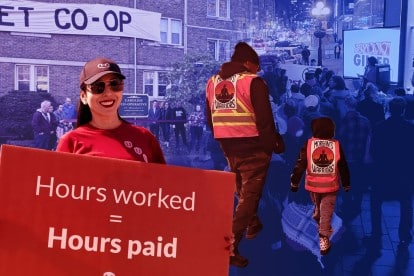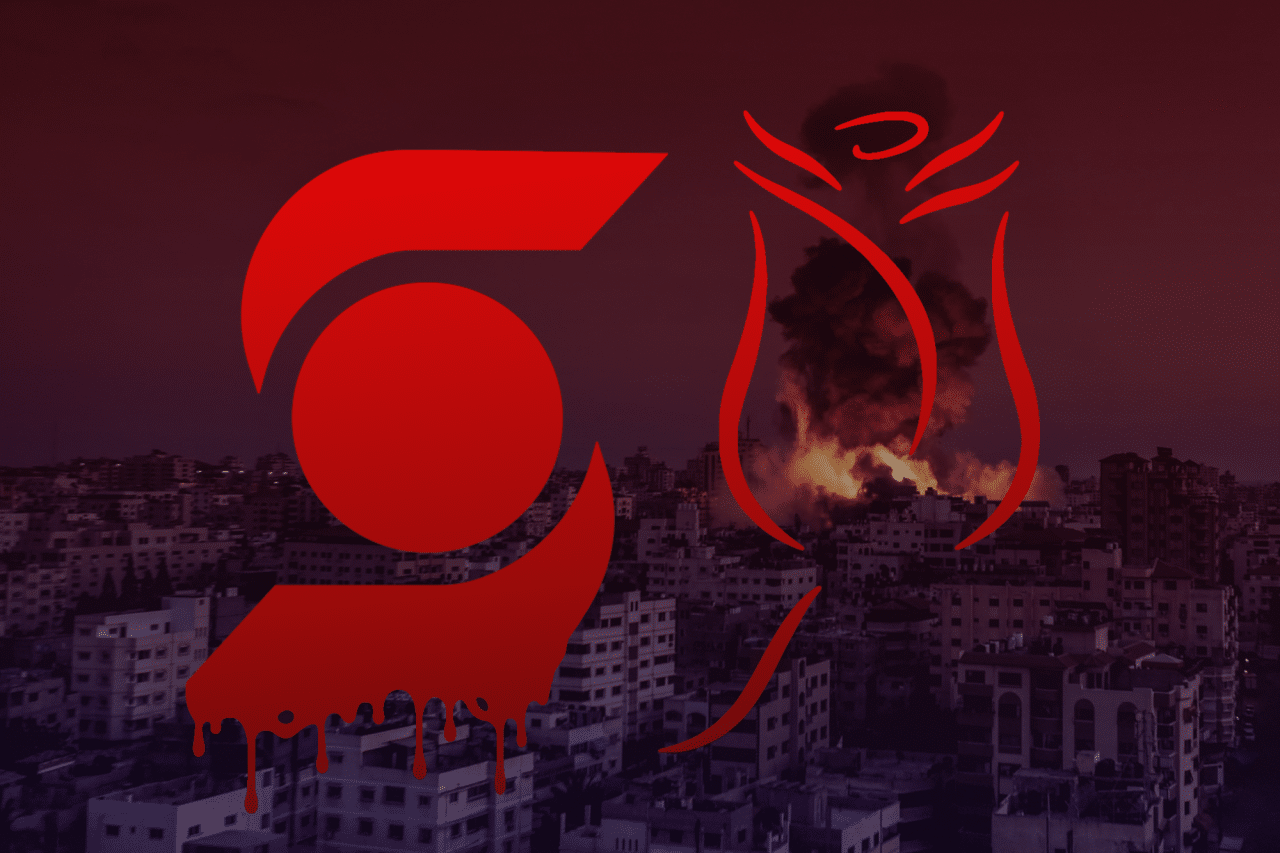
On a mid-November afternoon in 2023, a handful of people gathered in a pub in Toronto’s Yorkville neighbourhood to put the finishing touches on a carefully assembled plan. Among them was 25-year-old Maysam Abu Khreibeh. She was heartbroken and furious.
It was just over a month into Israel’s assault on Gaza; a rocket had recently hit the al-Ahli hospital, killing hundreds. Now Israeli forces were surrounding the Al-Shifa hospital. Inside, oxygen was running out and doctors were cutting preterm babies out of women killed by Israeli shells.
Abu Khreibeh is Palestinian and had been participating in rallies since the invasion began. She wanted to do something bigger.
“It was a huge turning point in terms of what the world deemed permissible,” she recalls. When an organizer she knew reached out asking if she’d participate in an action, she immediately agreed.
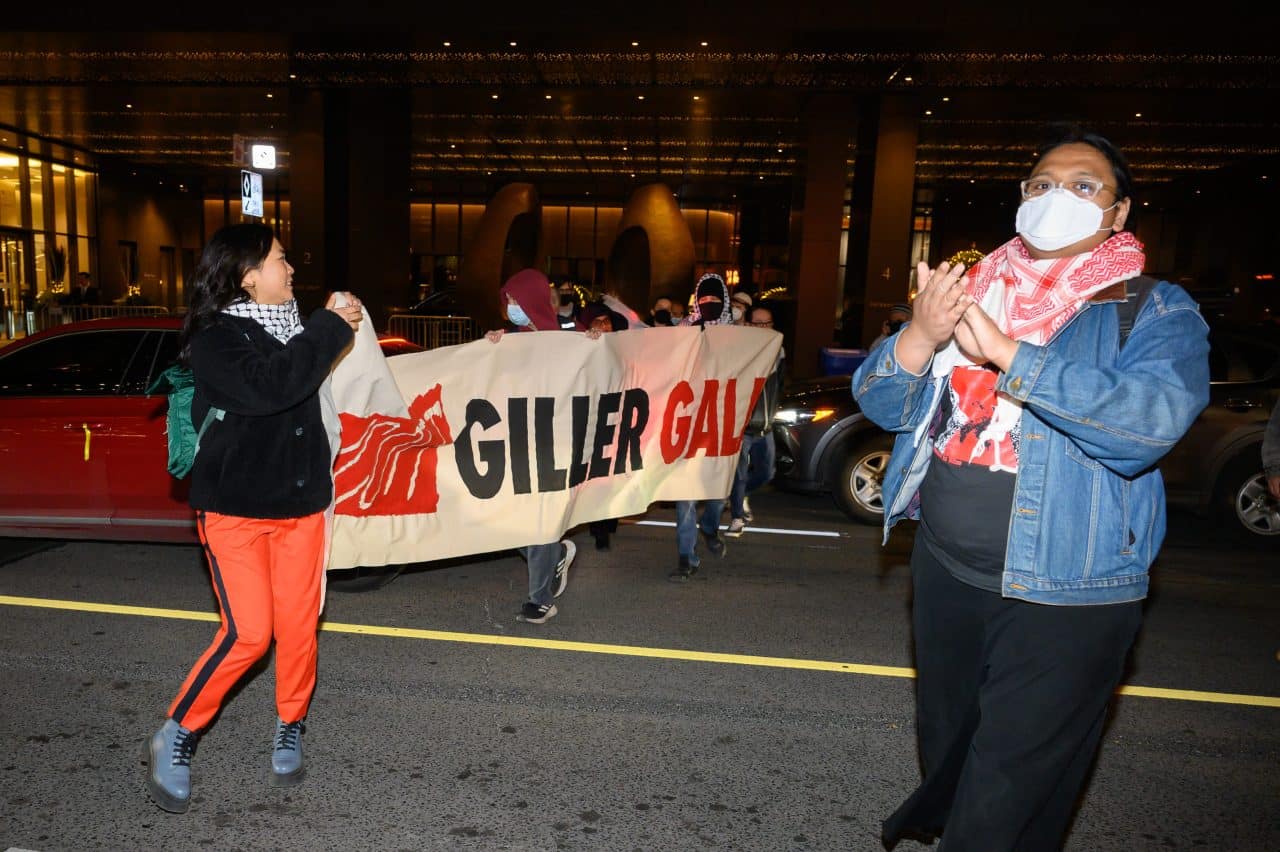
Later that evening, Toronto’s cultural elite gathered in the ballroom of the Four Seasons Hotel to anoint the best literary novel of the year. The Giller Prize gala was broadcast live on CBC. Guests sipped champagne and comedian Rick Mercer cracked jokes on stage. He was startled when two people stepped up next to him and unfurled signs that read, “SCOTIABANK FUNDS GENOCIDE.”
Few, if any, in the audience were aware that the event’s big sponsor, Scotiabank, had almost $500 million invested in Israel’s largest arms manufacturer, Elbit Systems, whose drones, weapons, and ground equipment were being used by the Israeli military in its assault on Gaza.
Security quickly hustled the activists off the stage. The audience booed.
Abu Khreibeh was still in the room, posing as a photographer. She sent footage of the disruption to the Palestinian Youth Movement to post on social media. Initially she hadn’t planned to say anything, but when she realized she was the only member of the team who hadn’t been thrown out, she made a quick decision.
She waited until the night’s big winner was about to be revealed before she mounted the stage, shouting: “Scotiabank is complicit in the genocide of the Palestinian people!”
Police handcuffed Abu Khreibeh. She was held in the hotel lobby along with two other protesters until the early hours of the morning. As they left the gala, guests in suits berated them and urged police to lay charges.
Later, members of the production team for the gala provided police with footage and photos to help detectives identify others who were involved in the protest.
The Giller Foundation did not respond to a request for comment from The Breach about its production team’s role in the police investigation.
At first an officer told Abu Khreibeh she’d likely be released with a trespassing charge, but after talking to the event organizers, police charged Abu Kreibeh, Evan Curle, and Fatima Hussain with criminal offences: mischief and the use of a forged document.
Abu Khreibeh was dismayed by the severity of the charges. She wondered if it had been worth it.
“We didn’t know if these writers would give a shit about us, to be honest,” she says.
Sparking a movement
Many writers, it turned out, did give a shit. The protest ignited one of Canada’s most effective pressure campaigns in recent times.
Although it isn’t an official campaign of the Palestinian Campaign for the Academic and Cultural Boycott of Israel (PACBI), it belongs to the tradition of boycott and divestment strategies employed by Palestinian solidarity movements.
Hundreds of writers, artists, filmmakers, and cultural workers have taken part. By the summer of 2024, Scotiabank had reduced its stake in Elbit Systems to less than a fifth of what it had been before the protests. And the movement has brought an end to the Giller Prize’s 20-year partnership with Scotiabank.
But the movement also achieved something that can’t be measured in numbers: it created a community of artists, authors, and organizers drawn together by a common cause and sustained by the discovery of their collective power outside of the established cultural institutions.
At this fraught political moment, when democracy is under assault and the intertwined crises of climate change and inequality threaten everything we cherish, it’s worth paying attention to how this grassroots campaign was built.
Successful pressure campaigns that win material change are generally guided by people who understand movement theory—who know how to set goals, identify targets, and escalate pressure tactics. Much of the news coverage of the Giller protest and its aftermath has spotlighted the prominent authors who spoke up, but the movement wouldn’t have achieved what it has without organizers who worked tirelessly behind the scenes.
The day after the disruption, novelist Farzana Doctor saw Abu Khreibeh’s footage. She contacted a few writer friends who decided to publish an open letter expressing support for the protesters and urging literary institutions to call for a ceasefire.
Within days, the letter had been signed by more than 1,800 writers, editors, and publishers. For a few days, Doctor and her co-authors scrambled to field media requests and manage the signatures pouring in. But once the initial buzz dissipated, they wondered what to do next.
Two people who saw the potential of the moment were Michael DeForge and Aliya Pabani.
Pabani had been working as a freelance podcaster and artist in 2020 when she started volunteering with a support network for residents of homeless encampments. She began recording interviews for a podcast about illegal evictions.
She was at Lamport Stadium when police descended on the encampment, flattening tents and dragging people away, including her. That was the moment she decided to get into organizing more seriously.
“It was the feeling of standing shoulder-to-shoulder with unhoused people who were like: ‘We could never have imagined that we’d have a choice, that we’d have power!’ That feeling was incredible,” Pabani said. “I became a believer in building a base, in doing what it takes to bring the people together.”
DeForge, a graphic novelist, was already organizing for Palestine solidarity with Writers Against the War on Gaza. In January 2024, just a few months after the Giller Prize protest, Pabani and DeForge got together in a cafe and began to sketch out an idea for a campaign that would bring together writers, artists, filmmakers, and photographers to put pressure on a specific target.
Scotiabank makes for a strategic focus
Scotiabank was deeply invested in weapons, but the bank has also branded itself as a champion of the arts: in addition to the Giller, Scotiabank sponsored the Hot Docs Film Festival, the Scotiabank Photography Award, CONTACT Photography Festival, and the Toronto Biennial of Art.
Pabani and DeForge saw this as a key point of leverage. They reached out to other groups, including the authors of the Giller letter, Writers Against the War on Gaza, Film Workers for Palestine, and Artists Against Artwashing.
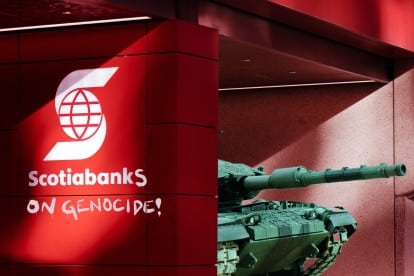
On a drizzly day in March 2024, a group of writers, filmmakers, artists and organizers gathered outside the Hot Docs Cinema to launch the “No Arms in the Arts” campaign. Novelist Noor Naga, a former Giller finalist, spoke in front of a banner featuring the Scotiabank logo dripping with blood.
“It’s Scotiabank that needs us for the optics,” she said. “Weapons are not a good look, but books? Books are life-affirming. You have to be alive to read and write them. But we don’t need our banks to invest in the arts at all… What we need from our banks is that they do not simultaneously fund and profit off an ongoing genocide.”
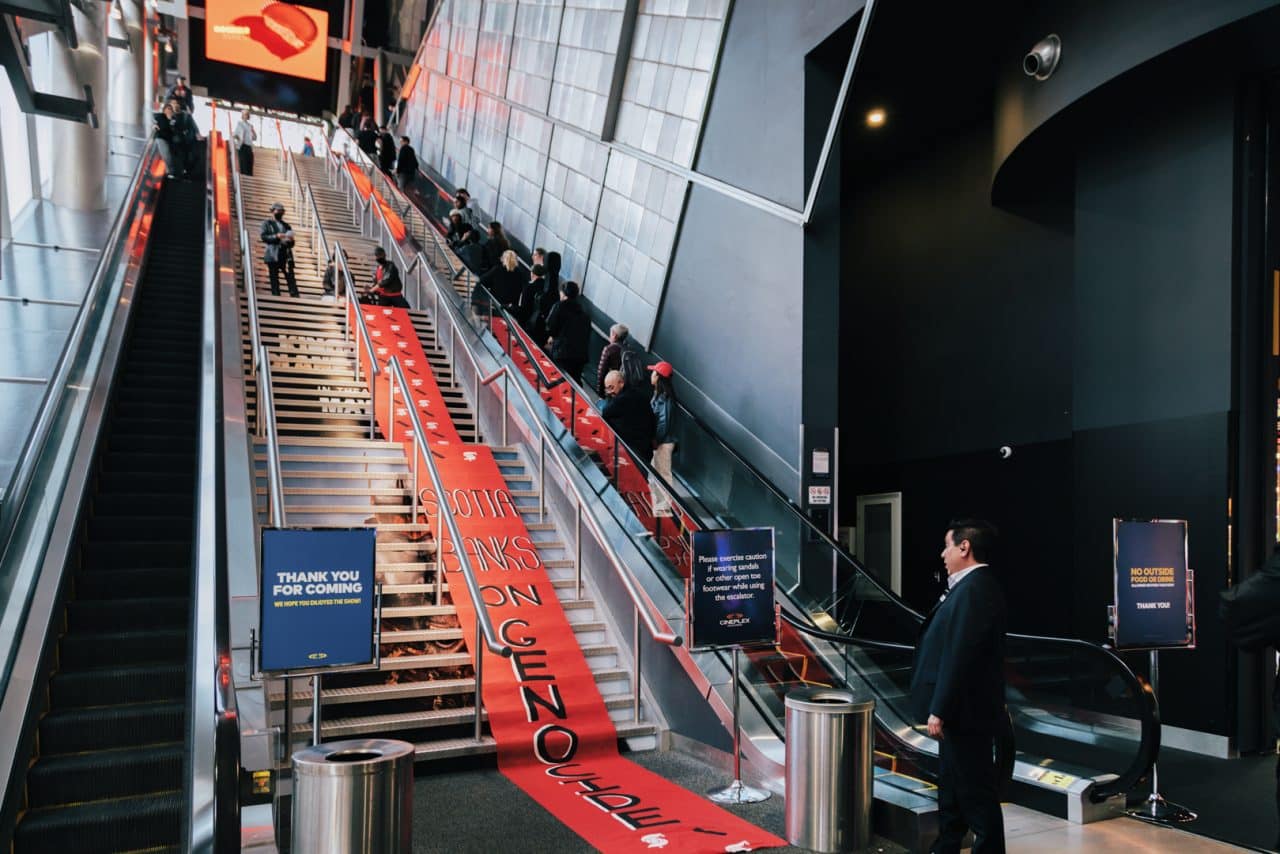
Volunteers with the campaign staged 11 days of counter-programming during the Hot Docs Film Festival. They held a vigil for murdered Palestinian journalists, hosted a panel on Palestine solidarity in the film industry, and unrolled a giant red carpet on the steps of the Scotiabank Theatre painted with the words, “Scotia banks on genocide.”
On the second-last day of the festival, they screened films by Palestinian filmmakers at the then-active University of Toronto student encampment. After the films, an audience member got up and held his phone to the microphone so everyone could listen to his relative in Gaza speaking. The speaker’s voice was soon drowned out by the buzz of Israeli drones.
In the months that followed, No Arms in the Arts organized protests, disruptions, and public statements at the CONTACT Photography Festival and the Scotiabank Photography Award.
Meanwhile, a sub-group calling itself Canlit Responds rallied writers to continue pressuring the Giller. They held a series of public readings featuring writers who had dropped out of Giller book clubs.
“It was really important to have an alternative,” says Pabani. “We wanted to create a space where people could talk about the elephant in the room and how their books could live in the world with a shared political vision.”
That spring, organizers were buoyed by news that Scotiabank had dropped some of its shares in Elbit Systems. Scotiabank insists its financial decisions aren’t affected by public pressure—but filings show that prior to the Giller disruption, Scotiabank hadn’t touched its stake in Elbit in years.
Scotiabank’s investment in Elbit Systems is managed by its subsidiary, 1832 Asset Management. By the summer of 2024, 1832 had nearly halved its investment in Elbit. Maen Hammad, a campaigner with the corporate accountability group Eko, described the divestments as the fruit of a “very effective grassroots, decentralized, mobilizing campaign.”
Canlit Responds decided it was time to step up pressure on the Giller by calling for a boycott. Fifteen authors with new books coming out agreed to withhold their books from consideration for the 2024 prize.
Other authors promised not to participate in Giller events until the prize dropped Scotiabank and two other sponsors: the Azrieli Foundation, the charitable arm of a real estate company with investments in the occupied West Bank, and Indigo Books, whose CEO manages a scholarship fund for former Israeli Defense Forces soldiers.
The quiet, hard work of organizing
None of this would have happened without a strategic goal and hundreds of behind-the-scenes conversations between organizers and artists.
Winnipeg novelist David Bergen initially signed the open letter and dropped out of a Giller event because it upset him that a prize that had helped establish his career was connected to the horrors unfolding in Gaza. But he acted on his own, unconnected to the larger campaign.
When organizers asked Bergen if he would join the boycott, he hesitated.
“Writers tend to see themselves as voices in the wilderness,” he told The Breach. “We’re individualistic. We have these moral stances. We’re hesitant to join a bigger group because we don’t want anyone else to speak for us.”
Pabani got on the phone and explained the strategy to Bergen. In the end, he agreed to participate. He later published an op-ed in The Winnipeg Free Press and spoke about his decision on CBC radio.
He says he wouldn’t have taken these steps without encouragement.
“It was interesting to me to realize how the organizers worked,” Bergen said. “I grew to admire them deeply for their vision and their patience. Aliya would get on the phone for me and talk for an hour. She became my anchor.”
In December 2024, the Crown dropped all charges against Abu Khreibeh and the others arrested with her. On February 3, the Giller Foundation announced it was ending its partnership with Scotiabank. Organizers celebrated, but they made it clear the boycott will remain in place until the Giller drops Indigo and the Azrieli Foundation.
No Arms in the Arts is committed to targeting Scotiabank until it divests completely from Elbit Systems. (In the first quarter of 2025, Scotiabank increased its stake in Elbit slightly.)
Building ‘another kind of literary world’
The campaign has divided the literary community. Many writers disagree with its stance. Anne Michaels, the winner of the 2024 Giller Prize, took pains to avoid mentioning Palestine or the boycott in her acceptance speech, and the following morning, author Ian Williams talked about his discomfort with the protest on the CBC show Commotion. Others signed the open letter, but wouldn’t go further.
“We had a lot of people tell us we were going about this the wrong way, that we were too confrontational,” Pabani says. “In Canadian society there’s this sense of propriety and avoidance. The hardest thing for authors is to be seen as divisive.”
Yet many writers say being part of a movement has made them feel more connected to a community.
“I haven’t lost anything… I have only gained community,” Noor Naga told CBC’s Elamin Abdelmahmoud.
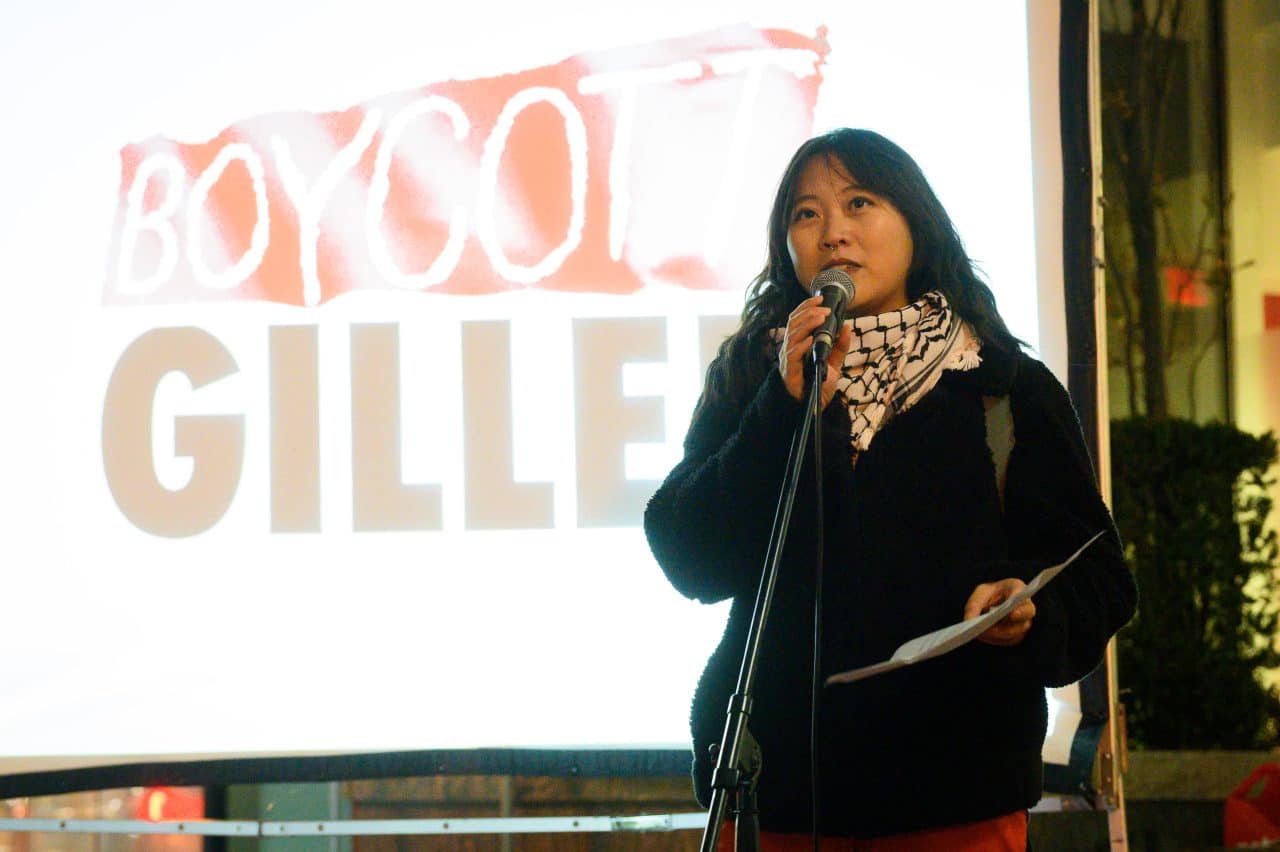
The 2024 Giller Prize gala took place one year after the disruption that sparked the No Arms in the Arts campaign and three months before the Giller announced it was parting ways with Scotiabank. No Arms in the Arts held their own counter-gala across the street from the hotel with a hand-rigged screen and a red carpet someone had salvaged from a curb.
It was a cold night, but Jody Chan, a poet and one of the key organizers of Canlit Responds, addressed the crowd warmly.
“Look around at everyone who is gathered here on the streets instead of in that room up there,” Chan said.
“Look at the hundreds of people who are gathered elsewhere, in Winnipeg, Vancouver, Halifax, Edmonton, and know that we are reading these same words, that we are orienting to the same horizon of Palestinian liberation. And know that another kind of literary world, one that doesn’t traffic in blood money and self-interest but in solidarity and collective power already exists because we the people have made it so.”
Chan went on to quote the Palestinian writer Ghassan Kanafani, who was assassinated by Israeli forces in 1972. The day before he was killed, Kanafani’s niece asked him when he was going to focus more on his writing than his organizing. Kanafani replied: “I write well because I believe in a cause, in principles. The day I leave these principles, my stories will become empty.”

When I went to journalism school 10 years ago, my parents thought that they would eventually read my articles in The Montreal Gazette. Today, that newspaper is a husk of its former self. But I get to explain that I’m working towards critical, independent, and sustainable journalism.
Want to be a part of the future of journalism? Support our work with a monthly contribution. Sign up here.
– Amanda Siino, Development Director, The Breach