What can our water teach us about our relationship with the natural world? How can this understanding help us navigate the political and climate crises we face?
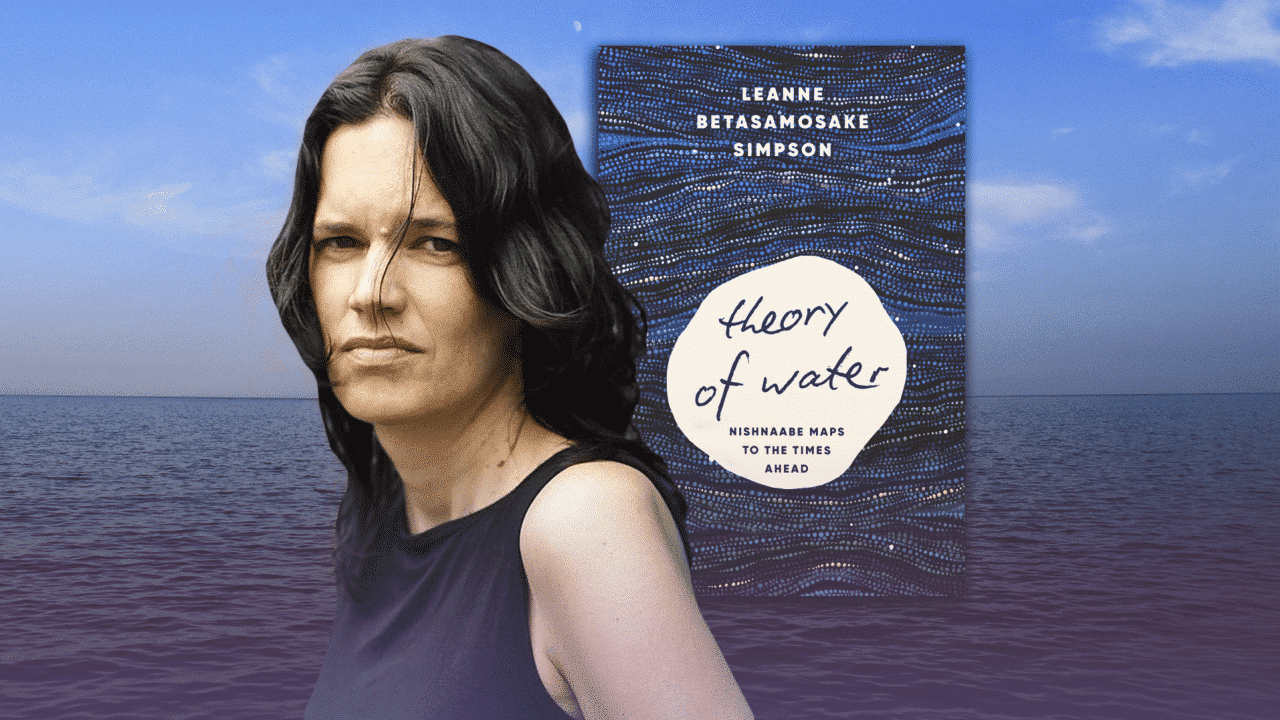
Leanne Betasamosake Simpson joins Desmond Cole to discuss her new book, Theory of Water: Nishanaabe Maps to the Times Ahead, and explores how Indigenous thinking on resistance and adaptations can inform our collective survival.
The Breach Show is our podcast featuring sharp analysis on politics and social movements in Canada. Subscribe to the podcast on Apple, Spotify, Iheartradio, Youtube Music or your favourite service.
Desmond Cole: Welcome to The Breach Show featuring sharp analysis on politics and social movements in Canada. I’m your host Desmond Cole.
For the past two decades, Leanne Betisamasake-Simpson has been writing, teaching, and making music, rooting her work in Anishinaabe intellectual practice and scholarship. Her latest book, Theory of Water: Nishnaabe Maps to the Times Ahead, has been described by author Mirza Waheed as “a beautiful, meditative, and clear-eyed reflection on our shared life on a planet hurtling towards a precipice and an origin story, a prayer and a call to action for an interconnected, centered way of life.”
Leanne Simpson is a Michi Saagiig Anishinaabe scholar, writer, musician, and artist who is widely recognized as one of the most compelling Indigenous voices of her generation.
She holds a PhD from the University of Manitoba and teaches at the Dechinta Centre for Research and Learning in Deninde. Her accolades are too long to list here, but she is the author of eight books, including the recently released Theory of Water, and she joins me today from her home in Peterborough.
Leanne Simpson: Hi, how are you?
Cole: I’m great. How are you doing?
Simpson: Good, thank you so much for having me and for making space for Theory of Water.
Cole: Thank you for writing this book and for giving us the opportunity to speak to you about it. I want to start with the book, talking about “water as a theory or a mapping of life and affiliation and global connection.” Later on you talk about water as a form of Indigenous internationalism.
Now, you talk in this book about the connection that we often experience or talk about with each other through land and how water is deeply connected to and part of that connection to land, but that you view it differently. Tell us about your thoughts on the interconnectedness that we experience through water and why it was such an important inspiration for you to write a book.
Simpson: There’s a few different origin stories for this book, and one of them was certainly my work as an Indigenous scholar and an activist. Early on in my career, I was really focused on land.
I was really pushing back against this colonial narrative that my homeland first was empty when settlers first arrived. Then, pushing back against the narrative that my homeland had people, but not smart people, people just sort of nomadically wandering around the territory without knowledge. Then there was the narrative of, okay, well, there was people and you had some knowledge, but it was not as good as sort of the white people that showed up.
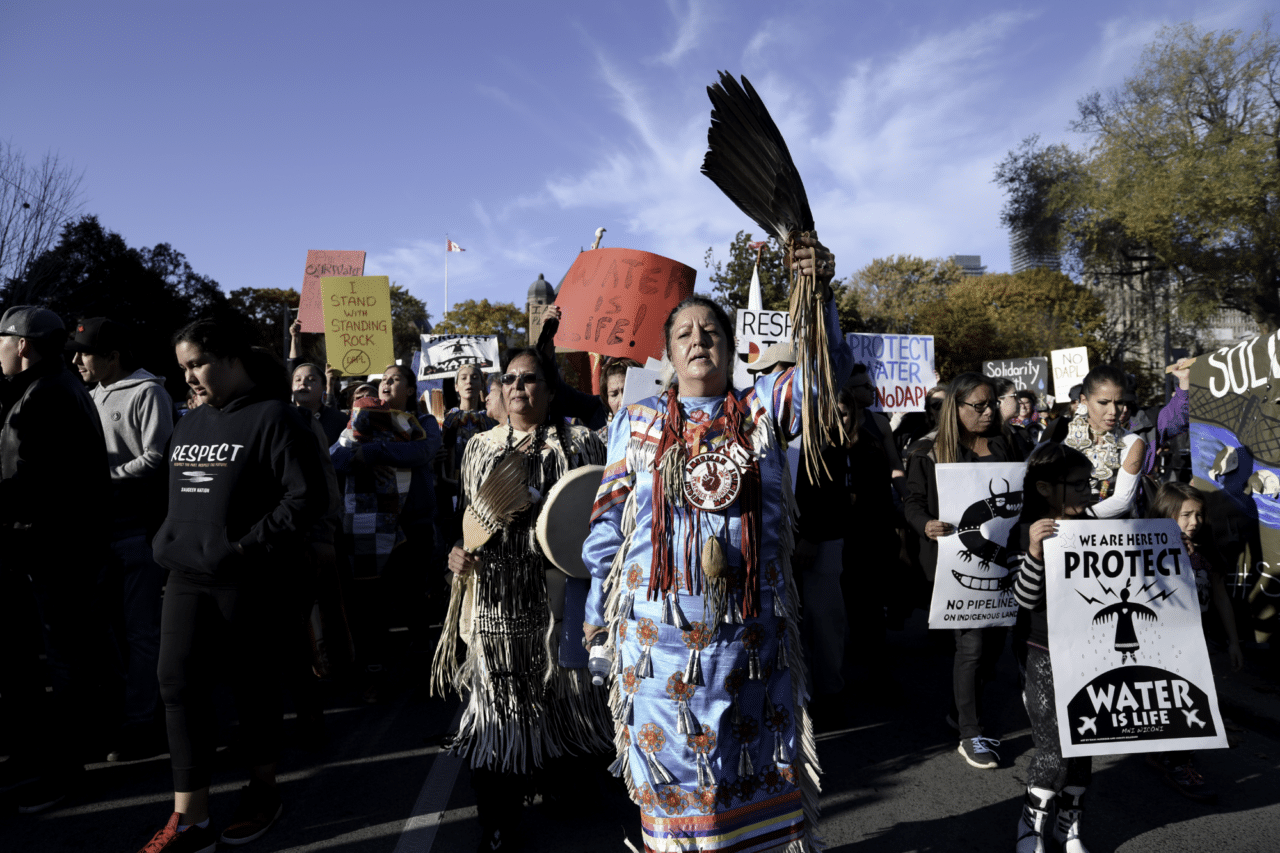
I was really focused on land, and I think there’s also sort of an immediate need when you’re experiencing the different waves of colonialism to sort of be picking up these pieces and fitting them together. There’s also sort of just this immediate need to push back against the continual dispossession of Indigenous people from homelands.
I wanted to get away from the Indigenous or Aboriginal rights discourse. I wanted to get away from the way that the state was framing it. There was a segment of us who were talking about nationhood on land.
At some point I realized that nationhood is so entangled and contaminated by the Westphalian nation state that I was really limiting not only my own people’s thinking around how to live in a way that brings forth more life on the planet, but I was also sort of alienating different movements and different groups of people that I felt like I needed and wanted to be in solidarity with. That’s one narrative of what got me thinking about water.
Another origin point was in my work with Robin Maynard in Rehearsals for Living. In my last letter to Robin, we’re starting to think about how the work that we’ve invited readers to do alongside us could expand outside of the two of us and outside of our own two communities.
I started to think about water. In some ways, I’m really late to the party because Anishinaabe people have been thinking and acting with water for generations and generations, particularly Anishinaabe women. We hold certain responsibilities in our ceremonies and in the caretaking around water.
Water became really interesting to me because it’s transformative. It transforms from a liquid to a gas. It’s part of a massive global water cycle that touches every part of the planet. There exists the same amount of water in the world now as there was when the world was born.
Every single living thing on the planet has their own relationship with water, making thinking alongside water more of an invitation and a collaboration, than individual research.
A lot of the way that water practices life is through this incredible persistence, this steadfastness. Working over this incomprehensible time frame, wearing away at rock until there’s a chasm or a hole. Water leaks. Water is always trying to escape the container. Water does a very good job of escaping the container.
These sorts of properties and practices of water started to become interesting to me as a way of grounding solidarity in a shared practice that remakes the planet. This book, I really wanted to sink into thinking in my language, Nibbi.
Cole: We know that water, as you mentioned, takes on the form of a solid in the form of things like snow and ice.
When snow forms into snowflakes and falls to the ground, you talk about this idea of sintering where snow has this property, where it falls and immediately starts to bond to the other snow that it attaches itself to.
You use this to explain an idea of finding a way to exist within your surroundings without destroying them. Can you talk a little bit more about that?
Simpson: During one of the pandemic winters, I volunteered at the local ski club to be one of the groomers. While I was getting up in the morning and going out on the snowmobile and grooming the snow, I was thinking about sintering as this physical process that snow does.
People living in Canada know about sintering because we know when there’s a big snowstorm, if you don’t get out and shovel it right away, you’re going to have a more difficult job the next day after the snow sinters and the flakes bond to one another. It becomes saggy and sinking and it has more staying power. It’s going to be heavier and harder work.
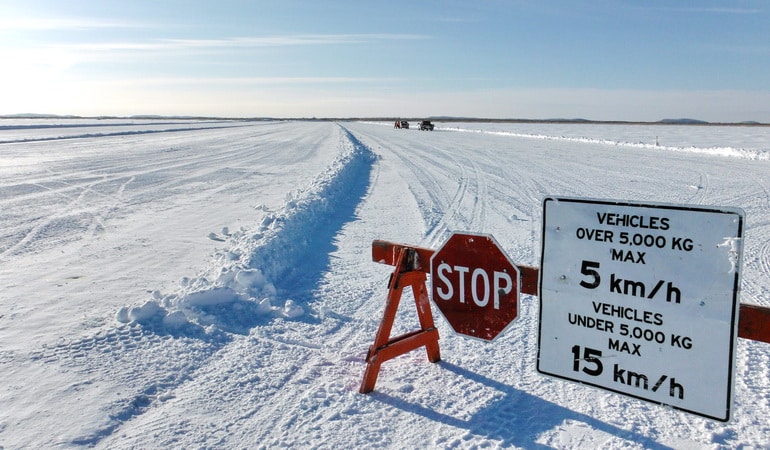
I wanted to think about ways of belonging to not a particular identity or a city or a region. This idea of sintering, learning from snowflakes—observing, being present, thinking about how they fall from the sky world to the earth, which is a radically different environment.
There’s lots of movement involved. The first thing they do when they get there is find a way to belong. They soften their edges. They bond in a physical way to their neighbours in a way that doesn’t destroy their neighbours and in a way that doesn’t destroy themselves. That seemed like a very important practice.
I’m thinking a lot about snow and ice because where I live in sort of southeastern Ontario or central Ontario, every winter we kind of get less and less snow and less and less ice because of climate change and global warming. I am attuned to snow in a way because I feel like I might not have a relationship with snow in the near future. That became a really important insight and grounding for the book as well.
Cole: You were doing a lot of this thinking and writing during the height of the COVID-19 pandemic, and you mentioned COVID a few times in this book.
One of the things that struck me that you talk about is, “water droplets in our breath, connect us intimately as we learned during the pandemic.”
You’re talking about the spread of COVID-19 through the actual water air that we’re breathing and passing on, because as you talk about these cycles, all water is passing through everything all of the time including our bodies to one another.
It really struck me that this level of intimacy with everything else around us can feel overwhelming, especially because of this capitalist culture that is individualistic and that sets us apart from one another and sets us apart from our surroundings. Learning about how, for example, our bodies are connected to one another, connected to the natural world, can feel somewhat invasive.
I wonder what you think about that as a barrier to embracing our interconnectedness and interdependency—this idea that we’re not always used to and comfortable with thinking about the very material ways that we are all connected.
Simpson: That’s an important insight. We all start in water, in amniotic fluid. We have water inside our bodies. We have water outside of our bodies. Within Anishinaabe thought, relationality is sort of the foundation.
I think of my body as sort of a hub of relationships. I exist in a world where I made up my relationships with plants and animals and humans and water and land and air. The COVID pandemic, I think, made us very attuned to the ways that we are connected.
The beginning of the pandemic, the way that we protected ourselves was through isolation.
We knew that our breath was connecting us. We didn’t know how to connect in a safe way. So we isolated. Then, of course, under a capitalist system, those most vulnerable bore the brunt of death and sickness. We figured out a way through masking, through social distancing, through staying at home when you’re sick to protect us as a community..
It wasn’t without its problems because again, we are in this capitalist society where we’re not thinking of the most vulnerable, where we’re not thinking of anyone but ourselves, but we learned how to connect communally.
After the pandemic—and really, it’s not over—after the height of the pandemic, I guess might be the right way to put it. A lot of that fell away quickly. It felt like we didn’t learn any of the lessons that the big sickness might have taught us communally, because capitalism is very invested in us being disconnected.
For Indigenous people, capitalism is very invested in us being disconnected from our lands, from our culture, from our minds, from our spirituality, from those communities and movements that might also work in solidarity with us.
Disconnection is sort of the name of the day. It’s what I’ve grown up with. It’s what many of us have grown up with. This idea of forming relationships can be very difficult. It can bring lots and lots of anxiety.
You have to learn about boundaries. You have to learn about consent. You have to learn about accountability. It’s a relearning and it’s really a re-skilling of ourselves in order to learn how to live in community.
For me, it’s a particular way of living in community, where you’re enacting and embodying multiple systems that are practices of care as a way of taking care of yourself through taking care of others and other forms of life.
It makes sense to me that it would be difficult, that we would be faced with anxiety, that it’s messy, messy work. I think sometimes even I have kind of romantic ideas of what community looks like and what interconnection and interdependency looks like.
But really it’s very difficult work, particularly when the target of colonial violence, a lot of times, is intimacy and our intimate relationships. Because when we’re isolated, when we’re fighting with each other, when we’re paralyzed with anxiety, it’s much harder for us.
Cole: One of the things I love about this book is that it gets us thinking about interconnectedness, as you mentioned, not just with each other but with the land itself.
You talk about artist Rebecca Belmore and her work. I want you to expand on this idea of being in dialogue, not just with each other, but with the natural world and why that’s important to you.
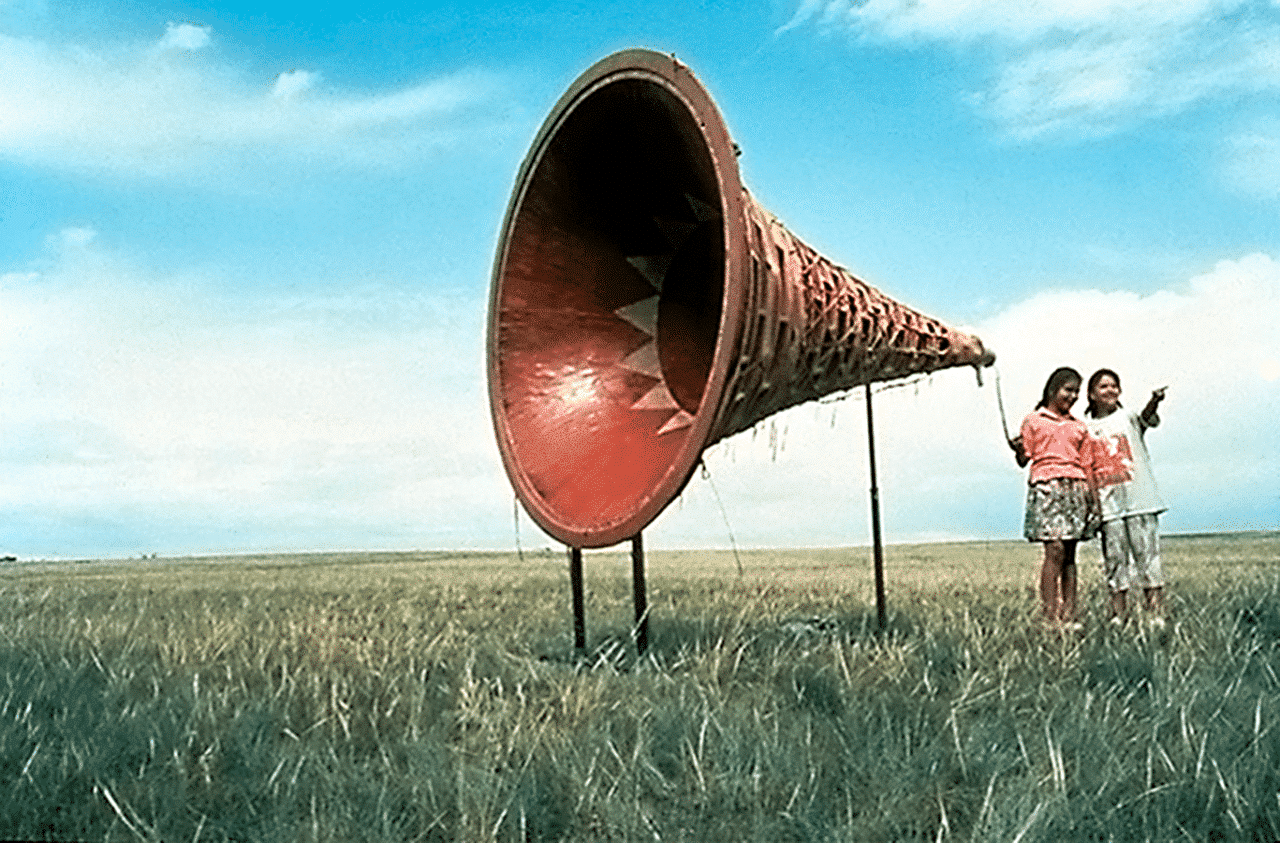
Simpson: Rebecca Belmore made this land-based installation called “Ayum-ee-aawach Oomama-mowan: Speaking to Their Mother”—that is now in the National Gallery in Ottawa—in the wake of the Oka Crisis, the uprising of the Kanien’kéha:ka people in Kanesatake and Kahnawake in the summer of 1990. We’re coming up to the 35th anniversary of that.
In the wake of that, she built this birch bark megaphone that she drove across Canada and installed in different reserves, at different blockades, at different places on the land. It had an amplifier inside it so people could come up and speak directly to the land and their voice would be amplified.
This was before the advent of the internet and cell phones, so a lot of what people said wasn’t recorded, which I love. You can see photographs of people praying into it, of children singing into it, of people saying kind of whatever they needed to say.
There’s tons of community around this sculpture. There’s people sharing food and kind of building community around it.
Fast forward to about 2017, Rebecca revisits that idea with “Wave Sound,” these stone listening devices that are now installed on the shore, this space where you have overlapping worlds.
You have land, you have water, you have sky. These places are generative sites within Anishinaabe thought because you have such a diversity of species that are gathered at the shore. These are places where we learn those important skills about how to be in community Accountability, consent is at the shoreline.
Instead of asking people, instead of asking us to speak directly to the land, the shift is now listening at the shore, listening to water, listening to the shoreline, listening to the overlap, the mosquitoes, the birds, the laughing, the waves. There’s four sculptures of this piece.
That was an interesting shift for me to sort of witness and ask the question, “what does it mean to sit at the shore and to listen to water?”
What does that mean for me? What does that invitation mean for us collectively? Because we’re all going to come up with sort of different ideas. That adds to this collaborative work of building relationships across differences.
It also made me think of this photo that I saw a long time ago of Dionne Brand at the peace camp during the Oka crisis. It reminded me of the line in a nomenclature, “what does it mean to believe in water?”
Taking those kinds of two questions, they became sort of an orienting force for me in this work. As a practice, as a durational practice, as a practice that you can use with students and writers and all different kinds of people.
Cole: The work of Dionne Brand comes up a lot in this book and in your work in general. I think the thing about the megaphone installation for me, that was so powerful that you talked about actually, was the idea of people directing their wishes, desires, thoughts, worries, not at politicians or at the state as you describe, but at the land itself.
Having been somebody who’s gone to and covered demonstrations for the better part of two decades, I just thought that that reorientation of where we are trying to direct our energy for the problems that we’re facing in this world was revolutionary and extremely powerful to me.
Simpson: If there’s any politicians listening right now, within Anishnaabe political thought, the rule of the politicians would be to sit there and listen. Listen to the community speaking to the land, right? They’re not the ones at the megaphone this time.
Cole: We talked about Dionne Brand and the influences that she’s had on your work and on this book. Another person who had a tremendous amount of influence in your work and in this book in particular is Doug Williams.
This book is filled with the voice and the teachings of Doug Williams, who is your late mentor and Anishinaabe educator, elder, and instructor of Indigenous studies at Trent University and a one-time chief of Curve Lake First Nation, among many other things.
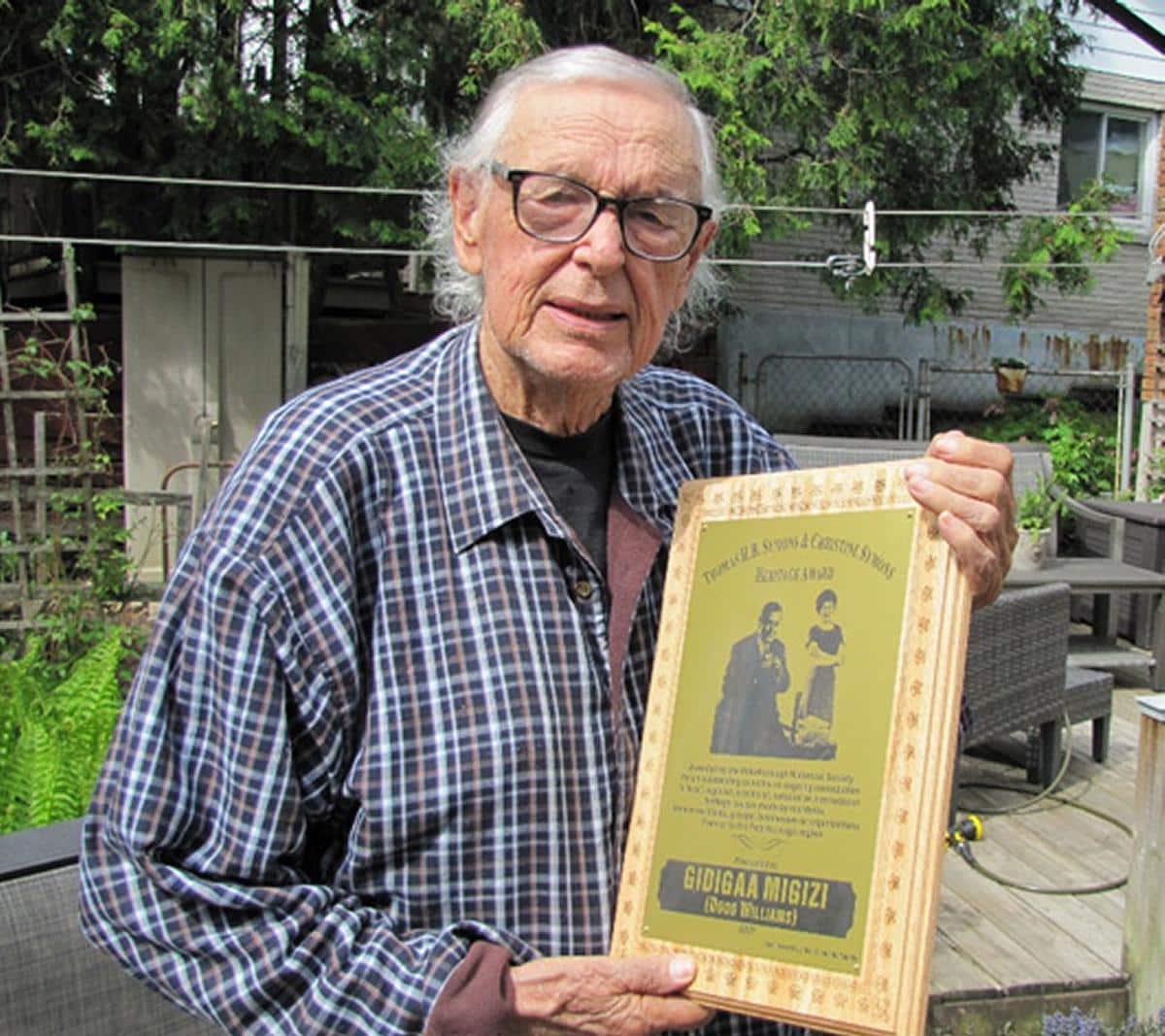
You tell us in this book about how you encountered Doug in the songs of bullfrogs, which he fought in the courts in Ontario for the right to fish. You encountered him in the presence of eels in our waters and you tell that when Doug was growing up in the Stony Lake area, he recalls—this is Northeast of Peterborough—that Lake Stony Lake was “teaming with Eels.”
You go on to say that Eels once made up half of the biomass in Lake Ontario, which is actually unimaginable to me. I wonder where else you encounter Doug Williams and what it meant to you to include so many of his teachings in this book.
Simpson: I was extremely lucky to have spent almost three decades learning from Doug. We were great chums, he would say. We were great friends. We spent a lot of time on the land together. I wasn’t the only one. There are many, many other people that were students of Doug’s over the years.
He had a tremendous impact on my thinking. He was a tremendous teacher of mine and he passed away when I was writing this book.
One of the threads of this book is a grief, me grieving, but also I think more of a collective grief for the present moment that we find ourselves in.
I’m also writing because I don’t want to forget everything that he taught me. I’m writing because I miss him and I want to be having conversations with him but he’s gone. I think those are very kind of common experiences for us when we lose an elder, when we lose a great friend and mentor.
My relationship with him in this book speaks to this shifting baseline syndrome. Him and I would be out on the land. I’ve lived in this area now for over 20 years. I think that I know what the land looks like. I have some land-based skills and he is just constantly blowing my mind.
One day, we were driving around in his truck drinking Tim Horton’s coffee and he starts remembering, talking about eels and I’m like, my mind is blown away. I’m like, “what are you talking about? I’ve never seen an eel here. I don’t know any eel stories. I’ve never tasted an eel.”
He tells me his stories. I go home, I start doing research and I’m finding these mind blowing facts about how the land I think I know, my homeland, I don’t know at all.
There’ve been so many apocalypses in terms of the natural environment that I don’t even know if my ancestors would recognize where I live as a homeland.
This repeats itself. We were driving around, and he liked to stop at overpasses on country roads and listen for frogs because he was always talking about how there used to be so many more insects, there used to be so many more frogs.
Then he talks about both the bullfrog story, where he gets caught by the game warden for harvesting bullfrogs, which is something Michi Saagiig and Anishinaabe people did. We did particularly [harvest bullfrogs] during the Williams Treaty era, where we didn’t have hunting and fishing rights. This was something that people were doing to feed themselves.
He ends up having to take that to court and fight for this right. I wanted to learn how to harvest bullfrogs. We never did that because he said, “we can’t because they’re struggling right now. There are so many less. That’s something that we have to manage ourselves here and support their population and act in solidarity with the bullfrogs and not harvest.”
The book is filled with stories like this, where I think my mind gets blown and I continually realize how little I know, which is weird when you’re writing a book, because generally you’re supposed to have done your research and you’re supposed to know something.
I think there’s a beautiful humility in that and that is definitely one of the threads in the book is his voice and I think it’s a beautiful part for me.
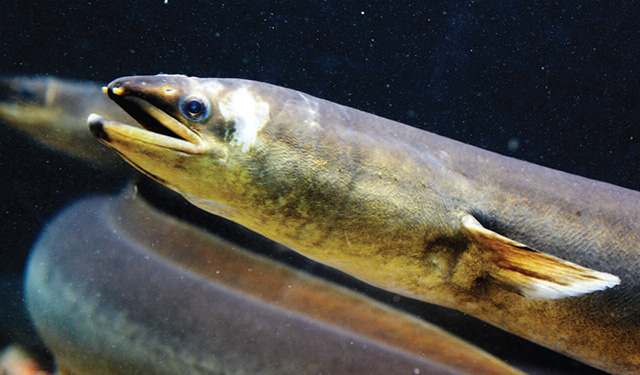
Cole: I think so too. It’s captured beautifully. When you were describing eels and the changes in their populations, just thinking about how, as you describe it, “that Michi Saagii Nishinaabe people were not on the ocean. They were never that far east, but through contact with these eels that were coming all the way through the St. Lawrence and in their great numbers, looking at their bodies, looking at how long they were that season, looking at the kinds of fats that were inside of them. You could understand so many things about the environment of where they were coming from and what the conditions were like.”
Drawing these connections through these animals from people who are never even in proximity to the place where they came from. That was the part that was so striking to me. It’s wonderful.
Simpson: It’s so striking because I think, for me, it dissolved this idea of homeland, because you have these species that I’m sharing time and space with that are coming from radically different environments, traveling tremendous distances, and I still have this intimate relationship with them.
I could have used any kind of migratory bird, but the eels were something that blew my mind.
When I started to learn about eels, I learned that their homeland was the Sargasso Sea and that when they traveled that huge distance from the Sargasso Sea through the St. Lawrence, through Lake Ontario up into my territory, they were coming as relatives.
They were coming as messengers, they were carrying knowledge about what their environment was like, about what their journey was like. This was done in a repetitive way. It happens every year. Our two groups of peoples had this sort of beautiful relationship across this great distance.
That’s true for many, many, other groups. That then starts to reorient the way that you think about land, the way that you think about water, and the way that you live in the world through those sorts of stories and teachings.
Cole: Absolutely. I want to pull another quote from the book. And you say—going back to the bullfrogs—as you’re sitting by the water and listening to them and reflecting on their sounds, you say, “I don’t need to remake the world. I only need to figure out how to fit into the cascading networks of life that I’m already part of, in a way that doesn’t destroy this bullfrog choir.”
Do you find a sense of relief or of hope in the idea of fitting in versus the idea of remaking worlds? I got that sense from reading it’s as if remaking a world that feels so messed up as our planet does today, that task of remaking can feel too big. It can feel too all encompassing.
Simpson: For many of us in this present moment, we know as Ruth Wilson Gilmore says, that we need to change everything. When we’re talking about Black futures and Indigenous futures, it can be overwhelming, because we do have to change everything.
Putting those two ideas together, I started to think, “actually, we don’t have to change everything.” And actually, all the other species on the planets are doing just fine, weaving themselves into the existing ecological cycles and processes that are making up the planet.
There’s a group, humans, that are not doing a good job, and it’s not even humans. It’s cis white heterosexual men that are capitalists, that aren’t doing the good job of weaving themselves into the planet. They’ve set up all of these systems that a lot of us are locked into.
I think there is a little bit of hope in that just tweaking that orientation, because not only do we just have to weave ourselves in, but there’s a lot of teachers and there’s a lot of species that are already weaving themselves in like eels, like bullfrogs, like water, that we can learn from.
We’ll all learn something different based on our relationships. It points to this collaborative nature of world making or fitting into the physical world that already exists.
I need Black feminists to understand the Middle Passage and water the role that water plays in that. I need desert people to understand what it’s like with a very small amount of water and the power that a small amount of water can have in that environment. I need northern peoples to understand ice and glaciers and snow.
It becomes a collaborative struggle to figure out how to weave ourselves into these existing cycles.
Cole: There is so much talk about care, about love, which I feel is often absent from so much of our political language, in this book.
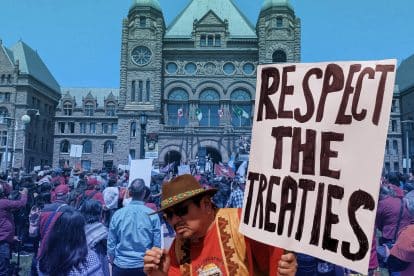
You mentioned the idea of collaborative struggle. I want to ask you about the idea of interconnectedness and struggle. Just yesterday was July 1 (colonial Canada day) but there was also a demonstration happening in downtown Toronto, organized by Idle No More and many allies.
It was about Bill 5, which we’ve talked a lot about here at The Breach. It’s a provincial bill by the Doug Ford government to essentially override all kinds of laws and regulations and protections and to override free prior informed consent of Indigenous peoples so that Doug Ford can get into the ground and mine things and pull things out of the ground for profit for corporations, without anyone interfering with annoying rules or safety standards or regulations or treaties.
I went to this demonstration. We had a march that came down University Avenue and the demonstrators were confronted by the police and several of them were roughed up and arrested.
I remember somebody in the crowd saying we have to preserve ourselves because this is just the beginning of this battle.
How does interconnectedness relate to struggle? Because as much as many of us may try to seek that deeper level of connectedness with each other, with the natural world, there is also going to be a struggle with the capitalist class that you just mentioned, who is not actually going to seek that out, who is not going to practice that, and who is going to fight us every step of the way.
Simpson: Within this container of interconnectedness, there are forces that are not congruent with Indigenous world making and Indigenous thought. That is capitalism, that is fascism, that is hetero patriarchy. That is all of these colonialists, that is all of these kinds of death-making machines.
For me, I see interconnectedness as a generative refusal. It’s a refusal of that death-making machine, and it’s a commitment to generate some alternatives.
We are entering a time where solidarity becomes very important and us having skills to be able to find commonalities across differences within movements and within the resistance is possible.
I’m not interested in trying to be interconnected with capitalism or with colonialism. That’s not on the table for me.
As soon as Trump got elected, when Trump started to talk about tariffs, when Trump started to talk about invading Canada and making Canada the 51st state, the political response of Canada was to increase Canadian nationalism.
That puts increased pressure on Indigenous homelands because alongside that Canadian nationalism, there was this uncritical, knee-jerk reaction to, “we’ve got to develop our resources for our economy to protect our people in our state.”
Immediately, I think Indigenous people knew what was coming. We knew it was coming in the form of pipelines in the West. We knew it was coming in the form of Arctic sovereignty in the North. We knew it was coming in the form of mining in the Ring of Fire in Northern Ontario and also in the North, anybody who has minerals.
I’ve felt like this whole elbows up response was to throw Indigenous peoples under the bus.
I’ve never been on the reconciliation bandwagon, but if anything had changed, I think in that moment, seeing this knee-jerk reaction, and now, it’s not even really a knee-jerk reaction, because now we’re seeing Bill C-5, now we’re seeing Carney back this up with these bills that facilitate extractivism and further dispossession.
The people that are going to pay the price are Indigenous peoples. The peoples that are going to be on the blockades, that are going to be subjecting themselves to police violence, are going to be the people that are trying to protect the Ring of Fire from this kind of extractivism.
It was predictable, but it’s disappointing that there hasn’t been a lot of criticality around that approach. It’s seen as the only approach to stand up to Trump. From Indigenous people’s perspective, or from my perspective, does it matter that much whether it’s American companies and Trump doing the violence of extractivism or if it’s Carney and the Canadians? The end result is pretty much the same.
Cole: I could talk to you about this book for a lot longer, but I think we have to end it here. The book is Theory of Water. It’s published by Knopf Canada. I can’t say enough about this read, Leanne, and I’m gonna go right back to it again when I have some time off to really dig deeper. I wanna thank you so much for writing it and so much for giving us your time today to talk.
Simpson: Thank you so much. It’s been an honour to speak with you. I really appreciate all your kind words.

“It’s about getting to the bottom of things. It’s about unveiling who has the power and what they’re doing with that power.”
Linda McQuaig, journalist and author
As a non-profit, free from powerful corporate interests, we invest in investigations and uncover the cover-ups. Sustain our journalism for transformation.