
At first glance, a recent op-ed from a prominent Canadian columnist reads as a plea for compassion.
“It seems wrong to the point of cruelty to let her sit there week after week in the cold, trapped in the prison of her mind,” Marcus Gee wrote in The Globe Mail about a homeless woman in his neighbourhood. “Surely she deserves better. Surely we can do better.”
The woman refuses to move to a shelter. Because she poses no threat to herself or others, she can’t be forced into one.
Gee speculates that she likely has both mental illness and anosognosia—the inability to recognize her conditions—and argues that “allowing” her to live outside is more cruel than putting her in a shelter against her will.
His solution? “Involuntary treatment”—a policy currently being pursued by governments in Alberta and British Columbia.
Gee’s reflections echo a growing sentiment in the op-ed pages of Canadian establishment media. For months, columnists at outlets like The Globe and Mail and The National Post have been normalizing government policies that strip people of their autonomy and force them into treatment—all under the guise of compassion.
Some of these opinion pieces come from individuals with ties to private clinics—which stand to profit from forced abstinence policies—who fail to disclose their obvious conflicts of interest.
Despite decades of evidence showing that involuntary treatment increases harm and fails to support long-term abstinence, several provincial legislatures are proposing to forcibly “treat” people for drug use.
As poverty and the toxic drug crisis become harder to ignore, these governments are using forced treatment to distract from their own failures. And columnists at our biggest newspapers are helping them.
By championing these dangerous policies, these columnists are also providing political cover to the Conservative Party’s hollow promise to “bring our loved ones home drug-free,” with far-reaching national consequences.
A false dichotomy
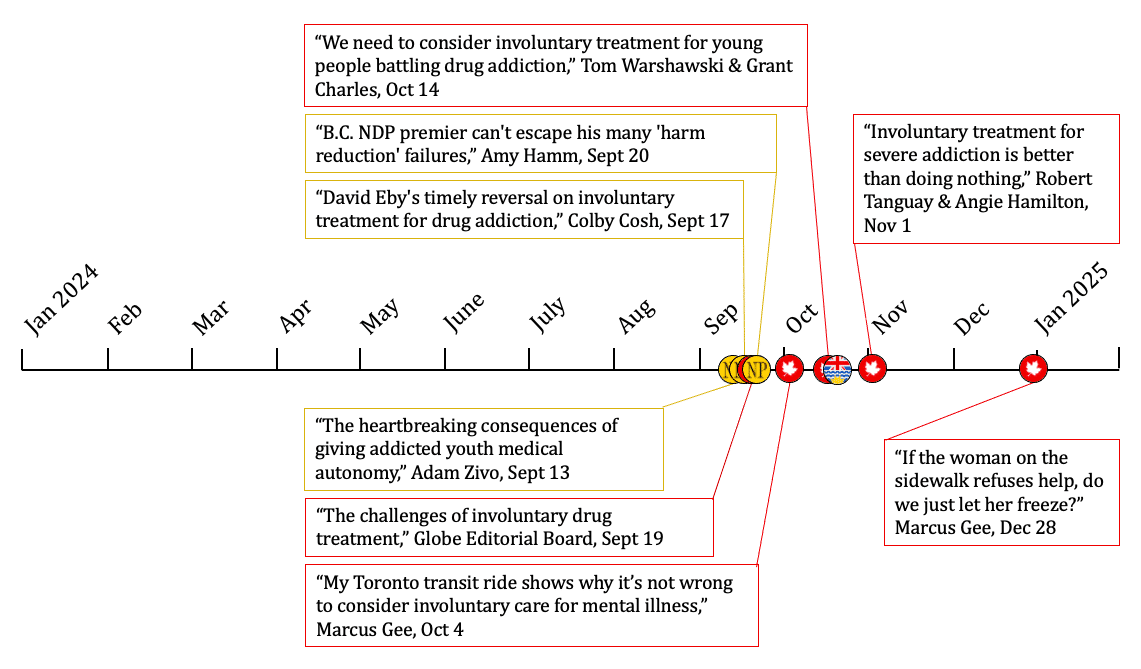
Between September and December 2024, The Globe and Mail’s Opinion section published six columns focused on forced abstinence. Five were in favour. Only one—by health journalist André Picard—pushed back.
This focus on forced abstinence became even more pronounced in the lead-up to British Columbia’s October 19 provincial election, in which it was a central political promise.
In an October 4 column, Gee declared that “in the name of respecting the rights of people with mental illness, we have essentially abandoned them to their fate.” He returned to the theme in December, when he wrote about the homeless woman in his neighbourhood.
Among the pro-abstinence voices was Dr. Robert Tanguay, founder of a private recovery clinic whose financial interest in the topic went undisclosed by Globe editors. His column parroted a common industry narrative, presenting a false dichotomy between forced abstinence and “doing nothing.”
Repackaging coercion as compassion, these arguments downplay the vast body of evidence supporting other intervention options like affordable housing and harm reduction—solutions that remain inaccessible to far too many.
Graphic: Euan Thomson
Since then, the paper has also run columns by Marshall Smith, former chief of staff to Alberta Premier Danielle Smith and now vice president at lobbying firm Rubicon Strategy.
In December, Smith called for a new model of intervention to address the “addiction and disorder crisis” in Canada. While he did not explicitly promote forced abstinence, his call for “strong community boundaries” was a thinly veiled argument for coercion—suggesting that people who use drugs are a threat who must be controlled.
In a follow-up piece in January, Smith celebrated Alberta’s approach to the toxic drug crisis, citing a drop in drug deaths in the province over the last year. But while he was quick to declare Alberta a national leader in drug policy, he relied on incomplete initial mortality rates. He also provided no evidence of a link between the province’s drug policy and declining drug deaths, which mirror a continent-wide trend.
But Smith isn’t just cheerleading for Alberta’s flawed policy. According to recent allegations, he interfered during his time in office to push for contracts benefiting private health care companies. An investigation by The Globe and Mail reported claims he pressured Alberta Health Services to sign new deals for privately run operating rooms funded with public money.
The Breach asked editors at National Post Comment and Globe Opinion for comment on their shift in favour of forced abstinence but received no response. Gee replied that his “columns speak for themselves” and offered no further comment.
Beyond the opinion pages, media outlets have also helped sanitize forced abstinence by referring to it using Orwellian euphemisms like “involuntary treatment” and “involuntary care.”
The word “involuntary” downplays the violence and coercion involved. Meanwhile, describing what happens to people forced into under-regulated rehab centres as “care” or “treatment” lends the practice a false air of legitimacy—despite the lack of medical evidence supporting it.
Failed policies, harmful solutions
Forced abstinence is not a new concept. It has been a common approach used by courts, child protective services, and employers since the beginning of drug prohibition a century ago. But decades of evidence show that involuntary treatment does not support long-term abstinence and instead increases harms, including death.
Research has shown that people in long-term treatment do best when they enter voluntarily and that there is no sound evidence to support coercion.
So why is the public hearing a chorus of calls to expand this failed approach?
With the increasing visibility of poverty across Canada and a toxic drug crisis that shows no signs of ending, several provincial legislatures are resorting to policies like forced treatment to deflect attention away from their own failures that created these crises in the first place.
Forced abstinence is premised on the belief that habitual illicit drug use is the cause, rather than a frequent symptom, of these injustices. It blames individuals—and further criminalizes them—for the very conditions created by government negligence.
On February 5, Alberta Premier Smith announced plans to open forced abstinence facilities in Calgary and Edmonton under upcoming legislation.
Her government’s proposed Compassionate Intervention Act, first announced in 2023, would allow family members, doctors, psychologists, or police officers to petition a judge to issue a treatment order if they believe someone is a danger to themselves or others due to drug use. The legislation is expected to pass this winter.

Under such laws, people could face long-term detention because of a toxic drug supply. For instance, a person in Alberta with a “past history of overdose” could be forced into temporary abstinence—despite the fact that experiencing an overdose is not a crime.
This new legislation is modeled after the Protection of Children Abusing Drugs Act (PChAD), which has been in effect in Alberta since 2006 and allows parents or guardians to forcibly admit youth to an abstinence-only facility—without requiring a medical assessment.
An internal Alberta government review of the PChAD system, obtained by The Breach, found that the province does not monitor outcomes for youths forced into treatment.
Despite this lack of oversight, Alberta is expanding PChAD in disturbing ways.
In November 2024, the province announced plans to convert part of an Edmonton youth prison into an addictions facility that would be partially dedicated to PChAD admissions—a move that dangerously conflates drug use with criminality. To sell this plan to a public sensitive to issues of individual rights and freedoms, the government frames this type of intervention as necessary for safety, arguing that these youths present “a danger to themselves or others.”
Another internal government review obtained by The Breach shows that 41 per cent of those forced into the system under PChAD identify as Indigenous, despite Indigenous youths making up only 10 per cent of Alberta’s total youth population. This alarming disparity and the generational harms Indigenous youth continue to face are conspicuously absent in the opinion pages promoting the expansion of forced recovery.

Real compassion without dehumanization
At the federal level, Canada has co-signed multiple international agreements affirming that treatment should be voluntary, reflecting the widespread consensus on this issue.
Yet Canada cannot uphold these obligations while allowing politicians to scapegoat people who use drugs instead of addressing their own political failures.
These governments have failed to meet people’s needs for a functioning social safety net, adequate health care and housing, a regulated drug supply that won’t kill them, and accessible, regulated treatment options.
While they preach the values of treatment and rehabilitation for drug users, they abandon those seeking help—leaving them with long wait times, unregulated facilities, and predatory private operators eager to cash in.
The expansion of forced abstinence has been a gold rush for these actors, who profit from a system that strips people who use drugs of personal agency and even of the basic right to exist in public.
At its core, the debate around expanding forced abstinence is about how far we are willing to go in dehumanizing people who use drugs in order to sustain a violent carceral system rebranded as “compassionate.”
With the federal Conservative Party eager to sell the illusion of a “drug-free” society—and Canada’s national newspapers greasing the party’s wheels—these coercive policies must be resisted.
To push back, we’ll need publicly supported legal challenges, medical organizations taking firm stances in favour of evidence-based interventions, and continued investigations that expose the profiteers behind this expansion.

The Breach’s investigations don’t just inform our readers—they force the powerful to react.
An exposé on blood plasma privatization led to national headlines. Our revelations about the government’s cozy connections to Big Pharma sparked a parliamentary probe. A report on high-tech price-fixing by mega landlords resulted in a criminal investigation.
From activists to elected officials, people are using The Breach’s journalism to push for transformative change.
– Dru Oja Jay, Board President, The Breach
War on Drugs | A dark future for Canadian drug policy is being designed in the prairies

With Doug Ford’s closure of supervised drug sites, I dread what is to come

Corporate Power | Pharmacare bill is a rebuke to corporate interests, for now

3 comments
Comments are closed.

I am over 30 years “clean and sober.” I no longer attend AA, because smoking has changed the meetings into outdoor recreation with cigarettes and less attendance in the meeting about addiction. I have no more help to give to those who don’t want help. Maybe it is wrong to have “forced treatment.” I wouldn’t know. I sought out treatment by my own choice in 1988 and never looked back. I know so many who did NOT make it and are dead. It wasn’t me that “failed to help” the helpless, but I am not happy with people passed out on the sidewalk. They should be removed like litter and “stored” somewhere, I don’t really care where, it’s not my job. Relieve the public from checking pulses. The cops aren’t nurses. If you don’t like forced removal, please take the trash home with you, if you are so concerned. There is no solution for the degradation of society that is progressing. Save yourself.
Any person involved in “mood-altering” substance abuse is usually “addicted” in one way or another. Addicts die “a lot,” maybe from the substance itself, but maybe from “environmental conditions” like loss of shelter, total poverty and social factors bringing them to unconsciousness. I have seen “cures” followed by deadly failure in relapses. Addictions are a horrible curse upon humanity. Humans often fail as we are all “imperfect.” As you condemn “enforced treatment,” many helpers are disappointed when a loved one falls once again. There ya’ go, that’s life. I guess some don’t realize that “caring” will always consist in forcing change upon those you wish to help. Go ahead and help the addicts that you can. Realize that failure occurs “a lot,” and people die, that’s the way it is.
The author lists many “studies” showing the failures of involuntary treatment yet offers no real solutions. Placing blame on government alone does nothing as government alone did not create this problem yet is expected to be the lone solver.