
With Trump’s tariff threats, Canada is staring down a moment of extreme economic uncertainty—one that will hit workers and vulnerable communities hardest.
It’s a moment that feels all too familiar. The early days of the global pandemic were filled with a similar overwhelming sense of urgency and solidarity.
But the experience of the pandemic response also taught us that empty gestures of solidarity won’t do. We need emergency measures that ensure no one is left behind.
Since taking office, U.S. President Donald Trump has repeatedly dangled the threat of sweeping tariffs, only to delay and then dangle again.
On February 3, he agreed to a 30-day reprieve—apparently in exchange for ramped-up border policing. Days later, en route to the Super Bowl, Trump casually announced that the U.S. would impose 25 per cent tariffs on all steel and aluminum imports.
This week, with the pause nearly over, he said the tariffs will move forward.
Trump’s brinkmanship has already destabilized markets and workers are paying the price in work reductions and layoffs.
If the broader tariffs actually come into effect, these waves will turn into a tsunami.
Economist Jim Stanford warns that the disruption would lead to at least a million job losses—a conservative estimate, he says, when factoring in the ripple effects in local communities.
We know workers with precarious immigration status and those in low-wage, insecure jobs are always hit hardest during any economic upheaval. We learned this firsthand during the SARS outbreak in 2003, the global banking crisis of 2008, and the COVID-19 pandemic.
One popular response to this upheaval has been adopting a “keep calm and buy Canadian” approach. But while swapping out Kraft for Compliments will make the Sobey family happy, it won’t do anything for the rest of us.
Instead of embracing nationalism, we need to look beyond borders. If we fall for these divisive strategies, we play right into the hands of the billionaires.
We need action to shield workers from the next onslaught of job losses, price gouging, rent hikes, evictions, and high interest rates.
It’s time for a “no one left behind” agenda to protect everyone from the devastating impacts of the current tariff crisis.

Learn from CERB: make EI work for us
Five years ago, the emergence of COVID-19 rocked Canada’s economy, forcing millions out of work.
In those first chaotic days of March 2020, it was absolutely clear that our employment insurance (EI) system was incapable of fulfilling its role of stabilizing the economy by supporting workers laid off or in lockdown.
Due to overly stringent rules, less than 40 per cent of unemployed persons could access EI before the pandemic.
For many of those who could get EI, the benefit rate of 55 per cent of previous weekly earnings was impossible to survive on—especially for the 50 per cent of all workers who were earning less than $25.64 an hour, Canada’s median hourly wage in 2020.
That’s why the federal government had to move so quickly to create the Canada Emergency Response Benefit (CERB), which provided workers with $500 a week in income support.
Without it, Canada’s poverty rate would have nearly doubled from 6.4 per cent to 11.6 per cent.
Keeping vast swathes of the population out of poverty is more than a moral question. Spiking poverty has the cascading effect of wiping out thousands more local jobs that depend on employed workers for business.
CERB was rolled out in a moment of extreme urgency. This time around, we have slightly more lead time to address the economic crisis before the worst of it hits: let’s make sure income supports are adequate, widely accessible, and structured to avoid costly and punitive clawback measures against workers.
Today, we all need at least $600 per week in income support, roughly equivalent to the federal minimum wage of $17.30 for a 35-hour work week.
Now is the time to address the easily fixable problems with EI that became more apparent when the pandemic hit.
This can be done with a few obvious tweaks. The number of required hours for eligibility should be lowered to 360 across Canada; benefits should be raised to 75 per cent of previous earnings; and they should be extended to up to 50 weeks for both regular and special benefits.
We also need to end the harsh disqualification rules that exclude so many vulnerable and migrant workers who pay into the program but have difficulty getting benefits when they need them.
To meet the demands of both the present moment and future threats, workers also need to be able to stay on EI while in approved training programs.
With these tweaks, the EI system could provide economic stability when we need it most.

Keep the cost of living down
Social services make life more affordable for everyone. Now is the time to invest in healthcare, education, and childcare to address sustained labour shortages in those vital sectors.
An emergency plan to improve public infrastructure and build affordable, high-quality, social housing would serve the dual purposes of keeping costs down for ordinary people while helping to mitigate job losses.
With so many people facing food insecurity, the federal government must also pass laws to reduce the cost of food.
The Bank of Canada should freeze or reduce interest rates so workers and struggling small businesses aren’t saddled with higher borrowing costs if tariffs trigger more inflation.
Provincial governments should put a moratorium on evictions, as was done during the pandemic, and legislate rent freezes for renters and commercial tenants.
To pay for these essential measures, the federal government must ensure corporations pay their fair share by reversing 30 years of corporate tax cuts and closing legal loopholes. That also means hiring more staff to collect corporate taxes unpaid under previous rules and through various loopholes.
Of course, companies genuinely affected by the tariff crisis also need support, especially small- and medium-sized businesses. But there must be better rules to avoid a repeat of what happened during COVID-19, when big corporations misused public money to issue shareholder dividends.
We need solidarity, not scapegoating
The sense of unity and urgency that has emerged in the past few weeks is reminiscent of the beginning of the global pandemic.
In Ontario, Premier Doug Ford called a snap election, opportunistically trying to cash in on this sentiment and distract voters from his dismal record.
This is another one of those “we’re all in it together” moments, but we need to be careful not to let that “we” be defined in narrow, nationalistic terms.
Our solidarity must include the migrant workers who grow our food and care for the most vulnerable among us.
Last year brought a sharp spike in anti-immigrant sentiment. Migrants were wrongly blamed for the housing crisis.
This resulted in the federal government backtracking on its promise to implement a regularization program, drastically reducing immigration levels, and limiting legal pathways for workers and students to enter and remain in Canada.
Regularization and other slashed immigration programs would have created a pathway to permanent residence for thousands of people with precarious immigration status, so many of whom were lauded as heroes for working on the frontlines of the pandemic.
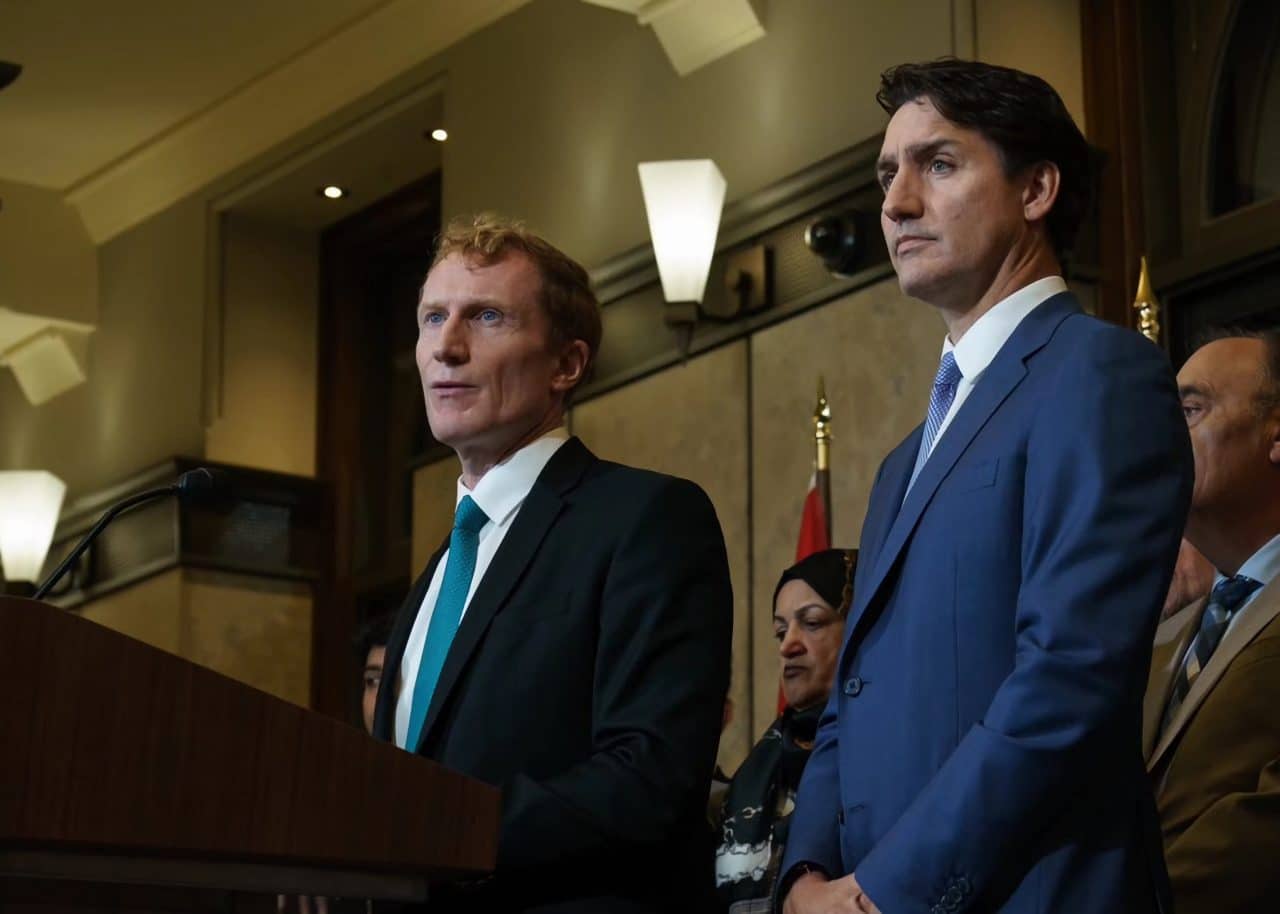
Migrants are already being caught in the crosshairs of the current tariff war as Trudeau pumps $1.3 billion into border militarization and surveillance to appease Trump.
Conservative leader Pierre Poilievre’s “Canada First” pivot is obviously inspired by Trump’s “Fortress America” plan, which can only intensify racist and anti-immigrant sentiments, worsening systemic discrimination in Canada.
The richest one per cent of the world can only wield control when the 99 per cent are pitted against each other.
Whether they come from the U.S. or Canada, Walmart’s Sam Walton and Loblaw’s Galen Weston use the same profit-maximizing playbook to keep wages low and gouge workers at the checkout.
No matter where we come from, workers have far more to gain by uniting to fight for emergency measures that leave no one behind.
As during the pandemic, we need emergency support that protects everyone, from income replacement to housing, from social services to social assistance.
A “no one left behind” approach is also the best protection for a resilient economy. No matter who we are or where we come from, it is we who keep our communities strong: as workers, as customers, as small businesses, and as families.
We need an action plan that serves us, not the billionaires and bankers. Let’s get on it—there’s not a moment to lose.

When I went to journalism school 10 years ago, my parents thought that they would eventually read my articles in The Montreal Gazette. Today, that newspaper is a husk of its former self. But I get to explain that I’m working towards critical, independent, and sustainable journalism.
Want to be a part of the future of journalism? Support our work with a monthly contribution. Sign up here.
– Amanda Siino, Development Director, The Breach
Tariffs | The freakout about Canada’s ‘internal trade barriers’ is a corporate scam

Foreign Policy | Trump’s tariff tantrum against Canada explained

Migrant Justice | Liberals and Tories perfected the exploitation of migrants for big business

5 comments
Comments are closed.

Turn off the power. Hit the switch.
The author seems to think there’s some conflict between ‘buy Canadian’ and reforming EI etc. What’s the conflict? Anyway, in the present situation, it’s completely unrealistic to think Canadians are going to stop anti-American actions.
Deena is right that we need a “no one left behind” approach to the economic warfare that the US is about to unleash. That’s why we need a guaranteed liveable basic income, not EI reform. It seems ironic that her article is side-by-side with Desmond Cole’s piece about the terrible inadequacies of Ontario’s social assistance housing allowance. While the EI systems is broken, social assistance is irredeemably flawed, based as it is on 19th century ideas about poverty, with intense surveillance of recipients built in. A guaranteed liveable basic income, unconditionally available to anyone who needs it, would fill in the holes in the social safety net and provide what we need – an income FLOOR that meets basic needs under everyone. That would provide a “permanent strike fund” that would allow workers to walk away from exploitive employers and force up wages, while also providing income to those who are underemployed or doing unpaid work.
Any “solution” to any of modern problem that begins with the word “buy” is an attempt to exploit people. We can’t save the environment by buying EVs, we can’t save Canadians by buying stuff from Canadian corporations. We can’t achieve peace by buying weapons.
Cory Doctorow wrote a blog piece titled Canada Shouldn’t Retaliate With US Tariffs. Instead, he advocates a way to attack the platform capitalists that would cut into their profits dearly.